
Compare
On Lake Lanier, a private dock and a community slip both grant in-water boat access, but they are different legal instruments with different ownership, transferability, and cost profiles. A private dock is a U.S. Army Corps of Engineers (USACE) Mobile District-permitted structure tied to a single deeded parcel for the exclusive use of one owner. A community slip is a use right inside a shared, HOA-permitted dock cluster governed by subdivision covenants. The right choice across Buford, Cumming, Gainesville, Flowery Branch, and Dawsonville depends on boating frequency, capital budget, maintenance tolerance, and how the buyer values walk-down access against lower carrying cost.
Quick Answer: Private Dock or Community Slip?
The fastest way to sort the decision is by what the buyer is solving for. A private dock solves for control, immediate walk-down access, and a USACE permit that is reassigned to the new owner through a change-of-owner filing at closing. A community slip solves for lower acquisition cost, lower individual maintenance responsibility, and entry into the lake lifestyle without the capital premium of a permitted single-family parcel. Both are valid on Lake Lanier, and both involve different paperwork, different recurring costs, and different exit dynamics.
Choose a private dock for direct access, control, and premium waterfront value
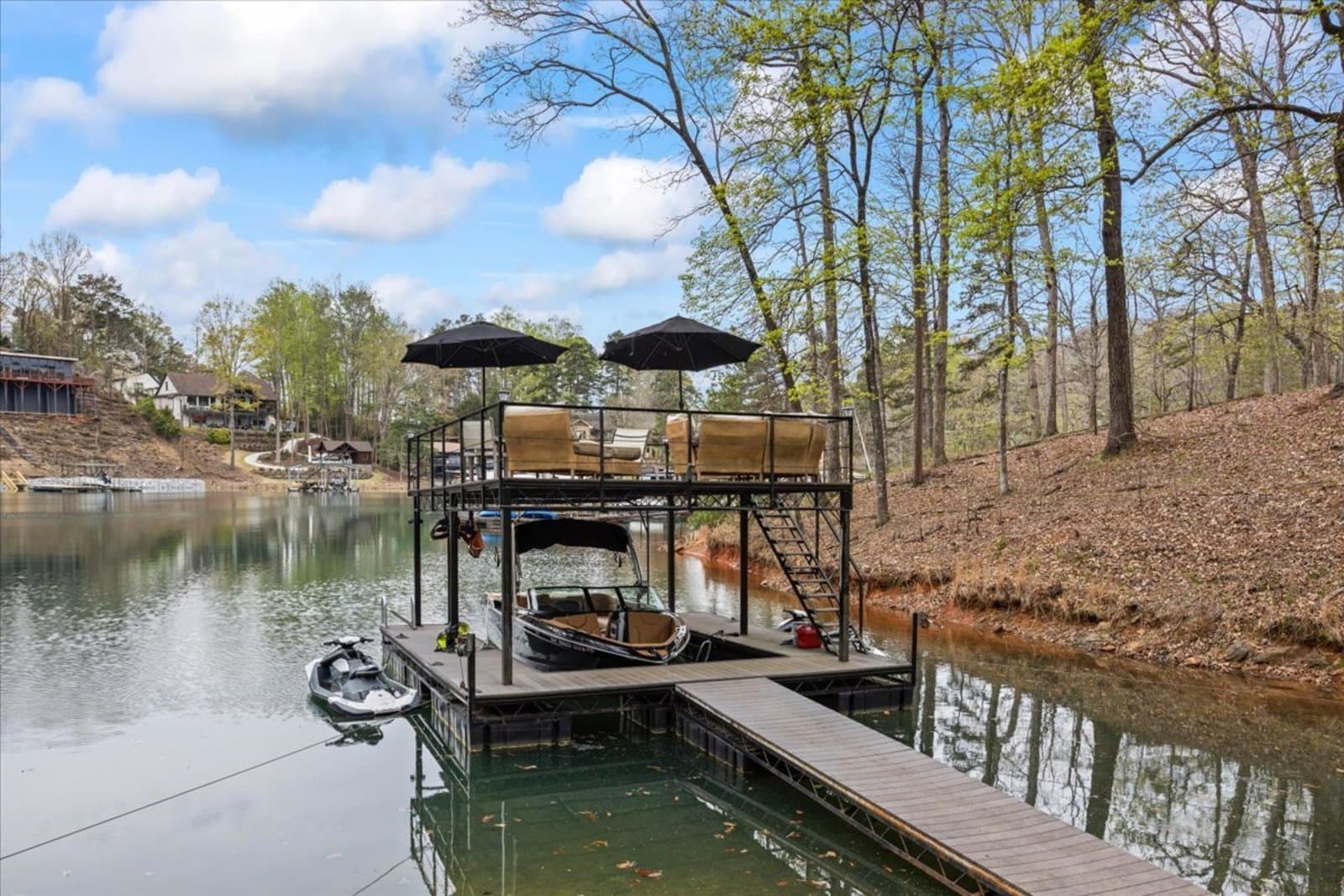
A private dock on Lake Lanier is a USACE Mobile District-permitted structure attached to a single-family deeded parcel. The permit class identifies what the structure can hold: Class I authorizes a single-slip dock, Class II authorizes a double-slip dock, and a small set of legacy oversized structures remain grandfathered under earlier shoreline plans. Because the dock is permitted to the parcel rather than to the boat owner, it conveys at closing with a USACE change-of-owner filing processed through the Lake Lanier Project Management Office in Buford. The practical advantage is walk-down access from the home to the water with no waitlist, no slip assignment process, and no marina lease to renew. The owner controls when the boat goes in, what equipment lives on the dock, and how the structure is configured within the permitted footprint. Current market conditions require a dated MLS comparison that identifies the area, property type, reporting period, and sample before a buyer relies on it. USACE permits and licenses are nontransferable. A new owner of an existing facility may apply through the Lake Lanier Operations Management Office, and approval is not automatic. Confirm the property-specific record and current requirements before closing.
Choose a community slip for lower maintenance and community convenience
A community slip is a use right inside a USACE-permitted shared dock cluster held by a homeowners' association, subdivision, or condominium regime around Lake Lanier. The federal permit lists the community as the holder; the slip itself is assigned, leased, or rotated among member households under the HOA documents, not under USACE rules. Slip assignment policy, maintenance funding, boat size limits, and any priority for waterfront versus interior lots are set by the community's governing documents and vary widely from one subdivision to the next. The practical benefit is access to a permitted shared structure without the capital premium of a single-family permitted parcel. Buyers shopping condominium and townhome inventory near the lake in Buford, Cumming, Gainesville, Flowery Branch, and Dawsonville frequently encounter community-slip arrangements as the entry point into the Lake Lanier lifestyle. Maintenance of the shared dock, USACE compliance filings, electrical inspections, and shoreline vegetation work are funded through HOA dues rather than handled directly by the individual owner, which matters for buyers who do not want to manage a permitted structure themselves. The tradeoff is shared use. Slip rotation may apply, peak-season availability can be constrained, the HOA may impose boat length and beam limits, and resale transferability depends on whether the slip right travels with the unit or with a separate HOA membership. Buyers shopping community-slip homes should review the slip assignment policy, the current rotation or waitlist rules, and the funding source for shared dock maintenance during due diligence rather than assuming the slip works the same way as the unit next door.
How boating frequency, budget, and lifestyle determine the better fit
Boating frequency is the cleanest sorting variable between the two paths. A household that puts the boat in the water most weekends from April through October across Hall County and Forsyth County coves typically values the walk-down convenience and control of a private dock more highly. A household that boats a handful of times each season, particularly second-home buyers splitting time between metro Atlanta and Lake Lanier, often finds the lower acquisition cost of a community-slip home matches the actual use pattern better than capitalizing a permitted dock that sits idle most weekends. Budget sorts the second cut. A community-slip home preserves that capital for other uses, including a larger floor plan, a better school zone in the Forsyth County Schools or Hall County Schools footprint, or a buffer against carrying costs. A private-dock home commits that capital up front in exchange for the permit asset and walk-down convenience. Current market conditions require a dated MLS comparison that identifies the area, property type, reporting period, and sample before a buyer relies on it. Lifestyle and maintenance tolerance close the analysis. Owners who want immediate access, total control over the dock structure, and the resale upside of a scarce USACE permit lean toward private docks. Owners who prefer shared infrastructure, lower individual maintenance responsibility, and a community feel around shared amenities lean toward community slips. Neither answer is correct in the abstract; the right answer falls out once boating frequency, capital availability, and maintenance preference are on the same page.
Comparing Costs, Convenience, and Control
The cost, convenience, and control profile of a private dock differs meaningfully from a community slip even when the two homes sit in adjacent coves around Lake Lanier. The USACE Mobile District governs both structures, but the path from permit holder to end user runs through different documents, and the recurring obligations land on different parties. Buyers should run all three variables in parallel rather than picking on price alone.
Permit, maintenance, electrical, and shoreline responsibilities
A private dock owner on Lake Lanier carries direct responsibility for the permitted structure itself. That includes float buoyancy, gangway condition, electrical service brought to current USACE and county code under the Exhibit C electrical inspection cycle, and vegetation maintenance inside the permitted shoreline corridor. The Lake Lanier Project Management Office in Buford runs a rotating Mobile District inspection program, and any noncompliant findings flow directly to the homeowner for correction. A full electrical rebuild or float replacement can run several thousand dollars to tens of thousands depending on the structure's age and condition. A community-slip owner carries indirect responsibility through the HOA. The shared dock's maintenance, electrical compliance, and USACE inspection items are funded through dues and any special assessments authorized in the governing documents. Individual owners do not directly manage float repairs or gangway work, but they pay for them through the dues structure, and a major shared dock repair can trigger an assessment that lands on every member household. The benefit is no direct administrative work; the cost is loss of individual control over scope, vendor selection, and timing. Shoreline vegetation rules apply on both paths under the Lake Sidney Lanier Shoreline Management Plan administered by the U.S. Army Corps of Engineers. Permitted private-dock owners are accountable for their own vegetation buffer compliance within the permitted corridor, including limits on tree removal, understory clearing, and the Lake Lanier vegetation buffer rules administered through the Mobile District. Community-slip arrangements typically delegate vegetation work to the HOA's grounds program, but compliance with USACE rules still controls what can and cannot be cleared on the shared shoreline.
HOA rules, slip assignments, waitlists, and boat size limits
HOA rules vary widely across community-slip subdivisions around Lake Lanier, and the listing language rarely makes the distinctions visible. Some communities deed the slip to a specific unit so it travels with the home at closing. Others lease the slip to the owner through a separate HOA membership that does not automatically transfer. Others rotate slip assignments among member households on a seasonal or annual basis, with waterfront-adjacent lots holding priority in some regimes and not in others. Two condominium projects on opposite sides of the same cove can run completely different slip systems. Waitlists and peak-season constraints are common in community-slip arrangements with fewer slips than member households. A new owner can buy a unit advertised with community-slip rights and discover that the actual slip will not be available until a position opens in rotation or an existing member relinquishes the slip. Buyers should request the current waitlist length, the rotation cadence, and a written confirmation of expected slip availability during due diligence rather than relying on the listing remark or a verbal assurance from the seller. Boat size limits are the third HOA-driven constraint. Community covenants commonly cap boat length, beam, and freeboard to fit the shared dock's footprint and the assigned slip dimensions. A wide-beam pontoon, a twin-engine cruiser, or a wakeboat with extra freeboard may not fit the community's permitted slip configuration even when the same boat would sit comfortably on a Class II private dock. Owners planning to upsize the boat during the hold should price the upsize against the community's limits before treating the access as equivalent to a private permitted dock.
Resale value and buyer demand differences
Resale dynamics diverge along with the access type on Lake Lanier. Because new private dock permits are not being issued in most developed coves around Cumming, Buford, Gainesville, Flowery Branch, and Dawsonville, the existing permit inventory is a closed pool. Current market conditions require a dated MLS comparison that identifies the area, property type, reporting period, and sample before a buyer relies on it. Community-slip homes trade against a broader, more elastic supply curve. Current market conditions require a dated MLS comparison that identifies the area, property type, reporting period, and sample before a buyer relies on it. Buyer demand patterns also differ. Permitted-dock buyers often run their underwriting against the scarcity of the federal permit and the long-hold resale comp set, weighing the $575,000 spread between permitted-dock and lake-access medians as a capitalized asset rather than a feature premium. Community-slip buyers more frequently weight cash flow, carrying cost, and lifestyle access, with resale upside concentrated in subdivisions where the slip is clearly deeded to the unit and the HOA's financial reserves are documented and current.
What Buyers Should Verify
Verification on either path is more demanding than a standard residential closing because the access right and the home are governed by different documents. A clean home inspection does not validate a dock permit, and a strong HOA balance sheet does not confirm slip transferability. Buyers should treat dock access as a separate due-diligence track from the home itself, with its own checklist and its own document set, before due-diligence expiration.
Dock permit and compliance for private docks
Private-dock verification starts with the seller's existing USACE permit number, the permit class, an as-built diagram of the structure, and the most recent shoreline inspection record. Buyers should confirm whether the permit is current, whether any open compliance items remain unresolved, and whether the change-of-owner filing path through the Lake Lanier Project Management Office in Buford is unobstructed before the due-diligence period closes. A permit in good standing transfers cleanly at closing; an unresolved compliance item becomes the new owner's obligation. Electrical compliance under the Exhibit C electrical inspection cycle is one of the most common findings on older private docks around Lake Lanier. The Mobile District requires the dock's electrical service to meet current USACE standards and either Hall County or Forsyth County code depending on where the parcel sits. Buyers should ask whether the dock has a current Exhibit C inspection on file, when the last inspection occurred, and whether any corrective items are outstanding. A full electrical rebuild can be a meaningful unbudgeted expense in the first year of ownership. Structural and shoreline elements complete the file. Float buoyancy, piling condition, gangway integrity, and the dock's footprint inside the permitted corridor are independent verification items. Vegetation compliance under the Lake Lanier vegetation buffer rules, riprap and erosion repair condition, and any tram permits or other shoreline structures associated with the parcel each carry their own documentation through the USACE Mobile District. Buyers underwriting a permitted-dock purchase should expect the dock and shoreline review to take longer than the home inspection itself.
Slip transferability and community rules for shared slips
Community-slip verification starts with the HOA's governing documents and the USACE permit held by the community. Buyers should confirm whether the slip is deeded to the specific unit, leased to the owner through a transferable HOA membership, or assigned by rotation among member households. The answer determines whether the slip conveys at closing or whether the new owner enters a waitlist or assignment queue. The listing remark is rarely sufficient on this point. The HOA's financial reserves and current USACE compliance status matter as much as the slip rules. A community dock cluster requires periodic float replacement, gangway repair, and electrical work, and the funding source is the HOA's reserve account or a special assessment. Buyers should review the HOA's reserve study, the current reserve balance, and any planned or recent assessments before treating the community-slip access as a stable, low-cost alternative to a private dock. A community with deferred maintenance and a thin reserve account can produce assessments that erase the acquisition-cost savings within a few years. The permit itself should be confirmed in good standing. The USACE Mobile District tracks community dock permits through the Lake Lanier Project Management Office in Buford, and buyers should ask the HOA for confirmation that the permit is current, that no open compliance items exist, and that the community has met its rotating inspection obligations. A community-slip arrangement attached to a permit out of compliance is not an equivalent substitute for a clean private dock.
Work with Ashley Smith to compare both options before writing an offer
Buyers comparing private-dock and community-slip homes on Lake Lanier benefit from running both paths in parallel before narrowing to one. The same buyer who would buy a permitted private-dock home in a Cumming or Buford cove for frequent use might rationally choose a community-slip home in Flowery Branch or Gainesville for occasional weekend use, and the underwriting math only resolves when both options sit side by side with their actual carrying costs, transferability terms, and resale dynamics on the page. Ashley Smith of The Dream Smith Team at Compass works directly with buyers on this comparison across Hall County, Forsyth County, Dawson County, Gwinnett County, and Lumpkin County, including verification of USACE permit status through the Lake Lanier Project Management Office in Buford, review of HOA slip assignment policies for community-slip subdivisions, and coordination with USACE-experienced inspectors on dock structural and electrical condition. The goal of the early-stage comparison is to keep buyers from committing to one access path before testing the other against the same use pattern. The practical step before writing an offer is to gather the documentation for both candidate homes in parallel: the private-dock candidate's permit number, permit class, Exhibit C electrical record, and shoreline compliance file, alongside the community-slip candidate's HOA covenants, slip assignment policy, reserve study, and USACE permit holder information. Once those documents are on the table, the comparison becomes a structured choice rather than a feature preference. Buyers and sellers in Buford, Cumming, Gainesville, Flowery Branch, Dawsonville, Sugar Hill, and Suwanee can reach Ashley Smith of The Dream Smith Team at Compass through the brokerage's Lake Lanier service line for the parallel comparison and verification work.
Frequently Asked Questions
- What is the difference between a private dock and a community slip on Lake Lanier?
- A private dock is a USACE Mobile District-permitted structure tied to a single deeded parcel for the exclusive use of one owner and conveys at closing with a change-of-owner filing through the Lake Lanier Project Management Office in Buford. A community slip is a use right inside a shared, USACE-permitted dock cluster held by a homeowners' association or subdivision, governed by HOA covenants on slip assignment, maintenance, and transferability. The two arrangements are different legal instruments, not interchangeable feature options.
- How much more do private dock homes cost than community slip homes on Lake Lanier?
- Current market conditions require a dated MLS comparison that identifies the area, property type, reporting period, and sample before a buyer relies on it.
- Can a community slip transfer with the home when I sell?
- It depends on the HOA's governing documents. Some communities deed the slip to a specific unit so it travels with the home automatically at closing. Others lease the slip through a separate HOA membership that may or may not transfer. Others rotate slip assignments among member households, in which case the new owner enters the assignment queue rather than receiving a guaranteed slip. Buyers should confirm slip transferability in writing during due diligence rather than assuming the same rules apply across subdivisions.
- Who is responsible for dock maintenance on a private dock versus a community slip?
- On a private dock, the homeowner is directly responsible for float buoyancy, gangway condition, electrical service compliance under the Exhibit C electrical inspection cycle, and vegetation maintenance inside the permitted corridor, all under the rotating USACE Mobile District inspection program. On a community slip, the HOA funds dock maintenance, electrical work, and USACE compliance through dues and any special assessments authorized in the governing documents. The community-slip path trades direct administrative work for shared cost exposure through the dues structure.
- Are new private dock permits still being issued on Lake Lanier?
- The USACE Mobile District has not issued new private dock permits in most developed coves around Lake Lanier since the Lake Sidney Lanier Shoreline Management Plan administered by the U.S. Army Corps of Engineers capped the residential permit inventory. That means a new buyer in Cumming, Buford, Gainesville, Flowery Branch, or Dawsonville generally inherits an existing permit class on a deeded parcel rather than applying for a new permit. The capped inventory is the structural reason permitted-dock homes carry a measurable premium over otherwise comparable lake-access listings.
- Which is better for a second home on Lake Lanier, a private dock or a community slip?
- USACE permits and licenses are nontransferable. A new owner of an existing facility may apply through the Lake Lanier Operations Management Office, and approval is not automatic. Confirm the property-specific record and current requirements before closing. A community slip, HOA access right, or marina lease is a separate arrangement; verify its ownership, assignment rules, fees, and availability in the applicable documents.
Related
- Lake Lanier Private Dock HomesCheck USACE permit requirements and the application process for a new owner.
- Lake Lanier Boat Slip GuideFull guide to boat slip options on Lake Lanier, including private, community, marina, and ramp access.
- Lake Lanier Dock Permits GuideUSACE Mobile District dock permit classes, transfer process, and compliance requirements on Lake Lanier.
- Lake Lanier Condos and TownhomesCondominium and townhome inventory near Lake Lanier, frequently structured around community slip access.
- Lake Lanier Real Estate OverviewFull overview of the Lake Lanier waterfront and lake-access market across the surrounding counties.
- Buford GA Lakefront HomesLakefront and lake-access homes in Buford on the south end of Lake Lanier.