
Buyer Guide
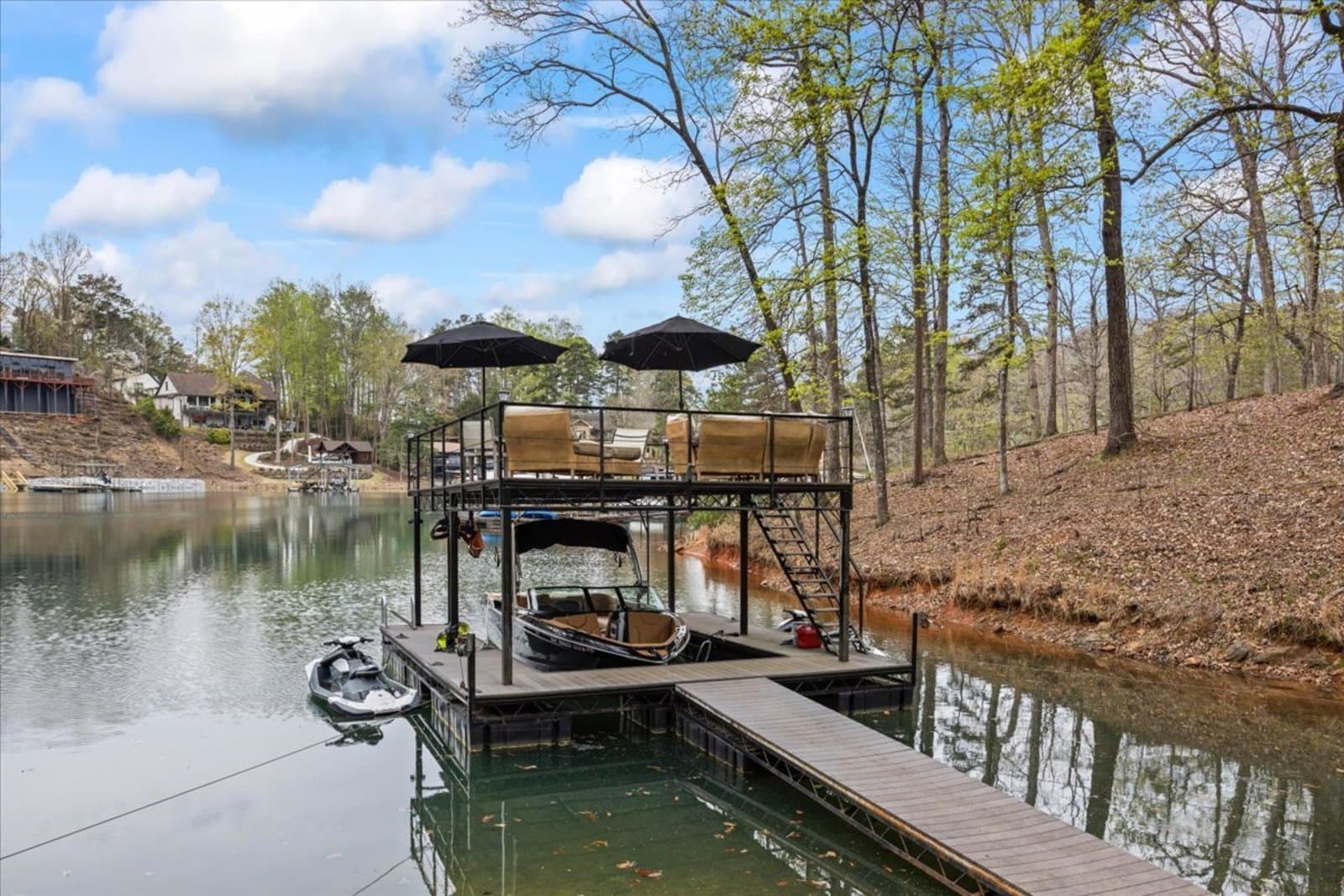
A Lake Lanier private dock home is a single-family residence with its own deeded shoreline-use permit issued by the U.S. Army Corps of Engineers (USACE) that authorizes one dock structure for the exclusive use of that one property. That distinguishes it from a community-dock home, where multiple owners share a permitted slip cluster, and from a marina boat-slip lease, where the slip is rented from a commercial operator. Private-dock status carries a measurable premium in Cumming, Buford, Gainesville, and Flowery Branch shoreline neighborhoods because the permit, the cove location, and the water depth all transfer with the deed at closing.
Why Private Dock Homes Are Different on Lake Lanier
A private dock on Lake Lanier is a USACE-permitted structure tied to a single residential parcel, not a shared facility or a leased slip. The permit, not the view, anchors the difference. Current market conditions require a dated MLS comparison that identifies the area, property type, reporting period, and sample before a buyer relies on it.
Private dock access as a scarce property feature
USACE permits and licenses are nontransferable. A new owner of an existing facility may apply through the Lake Lanier Operations Management Office, and approval is not automatic. Confirm the property-specific record and current requirements before closing.
How private docks differ from community slips and marina slips
A private dock is permitted to a single deeded parcel for the exclusive use of that one homeowner. A community dock is a permitted structure shared by a defined group of residential lots within an HOA or subdivision and governed by community rules on slip assignment, maintenance, and access. A marina slip is leased month-to-month or annually from a commercial marina operator such as Aqualand, Holiday, or Sunrise Cove, and the slip does not transfer with any residential property. The legal and economic exposure differs at each tier: only the private dock transfers with the property, subject to USACE permit reassignment through a change-of-owner filing.
Why dock status must be verified before contract deadlines
USACE permits and licenses are nontransferable. A new owner of an existing facility may apply through the Lake Lanier Operations Management Office, and approval is not automatic. Confirm the property-specific record and current requirements before closing.
What to Evaluate in a Private Dock Property
Evaluating a Lake Lanier private dock property is a four-part check on the dock structure, the cove water, the shoreline path, and the permit paperwork, and the four parts do not always agree. A permitted dock can sit in a cove that becomes unusable in October; a deep cove can carry a dock with electrical noncompliance that triggers a USACE corrective order. The price difference between two visually similar private-dock homes in Hall County or Forsyth County typically traces back to which of these four factors is strongest and which is weakest.
Dock type, condition, size, and electrical compliance
USACE permits docks by class — Class I single-slip, Class II double-slip, and a handful of legacy oversized structures grandfathered under earlier shoreline plans. Buyers should confirm the permitted class, the visible structural condition of the floats, pilings, and gangway, and whether electrical service to the dock meets the current USACE and Hall County or Forsyth County code. A noncompliant dock at closing becomes the buyer's repair obligation under the change-of-owner permit conditions, and the cost to bring an older structure into compliance can run from a few thousand dollars to a full rebuild.
Water depth, cove position, and seasonal usability
Lake Lanier operates between roughly 1,071 feet full pool and a USACE water-management operations that historically reaches the mid-1,060s by late fall, per USACE Mobile District lake-level data. A cove that floats a wakeboard boat in June at full pool can become marginal in October once the lake drops three to six feet. Buyers tracking year-round boating ability prioritize deeper coves on the south and main-channel sides of the lake near Buford Dam and Browns Bridge, where main-channel proximity preserves usable depth even during dry years.
Shoreline path, slope, and access from the home
The walk from the house to the dock matters as much as the dock itself. USACE rules govern the permitted path width, vegetation clearing, and any hardscape such as steps, retaining walls, or a tram. Steep-slope lots in parts of Gainesville and the north Hall County shoreline require longer permitted paths and sometimes a motorized lift to make the dock practical for daily use. A short, gentle path from a primary-level back door is one of the strongest non-price differentiators inside the private-dock tier, and it is one of the harder things to engineer after the fact.
Private Dock Homes by Area
Private dock inventory at Lake Lanier is distributed unevenly across the five shoreline counties, with each submarket carrying its own depth profile, price band, and dominant build vintage. Buyers shortlisting private-dock properties almost always cross at least two of these submarkets before choosing, because the combination of cove depth, school district, and commute corridor varies sharply from the south end at Buford to the north end at Gainesville.
Cumming private dock homes
Cumming is the largest west-side concentration of Lake Lanier private dock homes, with shoreline along Forsyth County and direct access to GA-400. Private-dock inventory in Cumming skews toward newer waterfront construction on tear-down sites, with traditional and transitional architecture replacing the original 1970s and 1980s cottages. Forsyth County Schools serve most Cumming shoreline addresses, and the GA-400 corridor keeps Alpharetta and the north Perimeter office submarkets reachable for working-from-Atlanta buyers, which underwrites a steady demand floor for permitted-dock parcels in this submarket.
Gainesville private dock homes
Gainesville anchors the north end of the lake and the Hall County seat, with Lake Lanier Olympic Park, the 1996 Olympic rowing venue, sitting inside the city limits. Private-dock homes in Gainesville range from established mid-century lake cottages on quiet coves to recent custom waterfront builds in the Chestatee and Chattahoochee arms of the lake. Hall County Schools serve most addresses. Commute access runs east to I-985 and south to Atlanta, and main-channel proximity in several Gainesville coves preserves usable dock depth even during late-summer drawdown conditions.
Buford, Flowery Branch, and Dawsonville private dock homes
Buford sits at the south end of the lake against Buford Dam and includes some of the deepest-water private-dock inventory on the entire reservoir, with the Buford City Schools attendance area overlapping a closely watched stretch of south-lake shoreline. Flowery Branch on I-985 carries a growing private-dock cohort in mid-tier waterfront neighborhoods served by Hall County Schools. Dawsonville on the lake's northwest shoulder offers a quieter, lower-density private-dock submarket with Dawson County Schools attendance and longer commutes to Atlanta, which is reflected in a different price band than the southern submarkets.
Frequently Asked Questions
- What is the difference between a private dock and a community dock on Lake Lanier?
- A private dock on Lake Lanier is a USACE-permitted structure deeded to a single residential parcel for the exclusive use of that one property. A community dock is a permitted structure shared by a defined group of homes inside a subdivision or HOA, with slip assignment and access controlled by community rules rather than by a single homeowner. The two structures appear similar from the water, but only the private dock transfers with the property at closing, subject to USACE permit reassignment through a change-of-owner filing, and only the private dock carries the scarcity premium associated with the capped USACE residential permit inventory.
- How do I verify that a Lake Lanier home has a private dock permit before closing?
- Ask the seller for the existing USACE Mobile District permit number, the as-built dock diagram, and the most recent shoreline inspection record. Confirm the permit class (Class I single-slip or Class II double-slip), the authorized slip count, the gangway length, and the electrical compliance status directly with the USACE Lake Lanier Project Management Office in Buford. Independent verification before due-diligence expiration is the only way to confirm that a 'private dock' listing description matches the deeded permit record.
- Does a Lake Lanier private dock permit transfer with the home at sale?
- Yes, but the transfer is not automatic. The USACE Mobile District requires a change-of-owner filing, signed by both seller and new owner, within a defined window after closing, and the permit must be in compliance at the time of transfer. Outstanding compliance issues, unpermitted modifications, or vegetation-clearing violations can delay the change-of-owner approval and become the buyer's repair obligation post-closing. Buyers and sellers should treat the dock transfer as a parallel transaction to the deed transfer, not an afterthought.
- What are the USACE setback and shoreline rules for a Lake Lanier private dock?
- The U.S. Army Corps of Engineers, Mobile District, governs all shoreline use at Lake Lanier under the Lake Sidney Lanier Shoreline Management Plan administered by the U.S. Army Corps of Engineers and its subsequent updates. The rules limit dock size, gangway length, slip count, electrical configuration, vegetation clearing, path width, and any hardscape between the home and the shoreline. Setbacks from adjoining permitted lots and from the federal shoreline contour are specified per permit and must be re-confirmed on any new build or rebuild. Buyers should reference the current USACE Shoreline Management Plan, not older versions, when evaluating a property.
- Why are Lake Lanier private dock homes priced higher than lake-access homes?
- Private-dock parcels on Lake Lanier are a capped, federally permitted inventory under the USACE Mobile District's Shoreline Management Plan, while lake-access homes share a community dock or community ramp. Scarcity, deeded transfer, and the ability to keep a full-size boat at the property year-round all drive the price premium. Current market conditions require a dated MLS comparison that identifies the area, property type, reporting period, and sample before a buyer relies on it.
- Can I build a new private dock on a Lake Lanier home that does not have one?
- USACE permits and licenses are nontransferable. A new owner of an existing facility may apply through the Lake Lanier Operations Management Office, and approval is not automatic. Confirm the property-specific record and current requirements before closing.
Related
- Lake Lanier Community GuideFull neighborhood, market, school, and shoreline overview for Lake Lanier.
- Lake Lanier Homes with DockBroader inventory including community-dock and shared-slip properties.
- Deep-Water Dock Homes on Lake LanierPrivate-dock parcels in coves with year-round usable water depth.
- Lake Lanier Dock Permits GuideUSACE Mobile District rules, permit classes, and compliance basics.
- How to Transfer a Lake Lanier Dock PermitChange-of-owner procedure, documents, fees, and timing for buyers and sellers.
- Buford Waterfront HomesSouth-lake shoreline with the deepest-water private-dock inventory on the reservoir.