
Compare
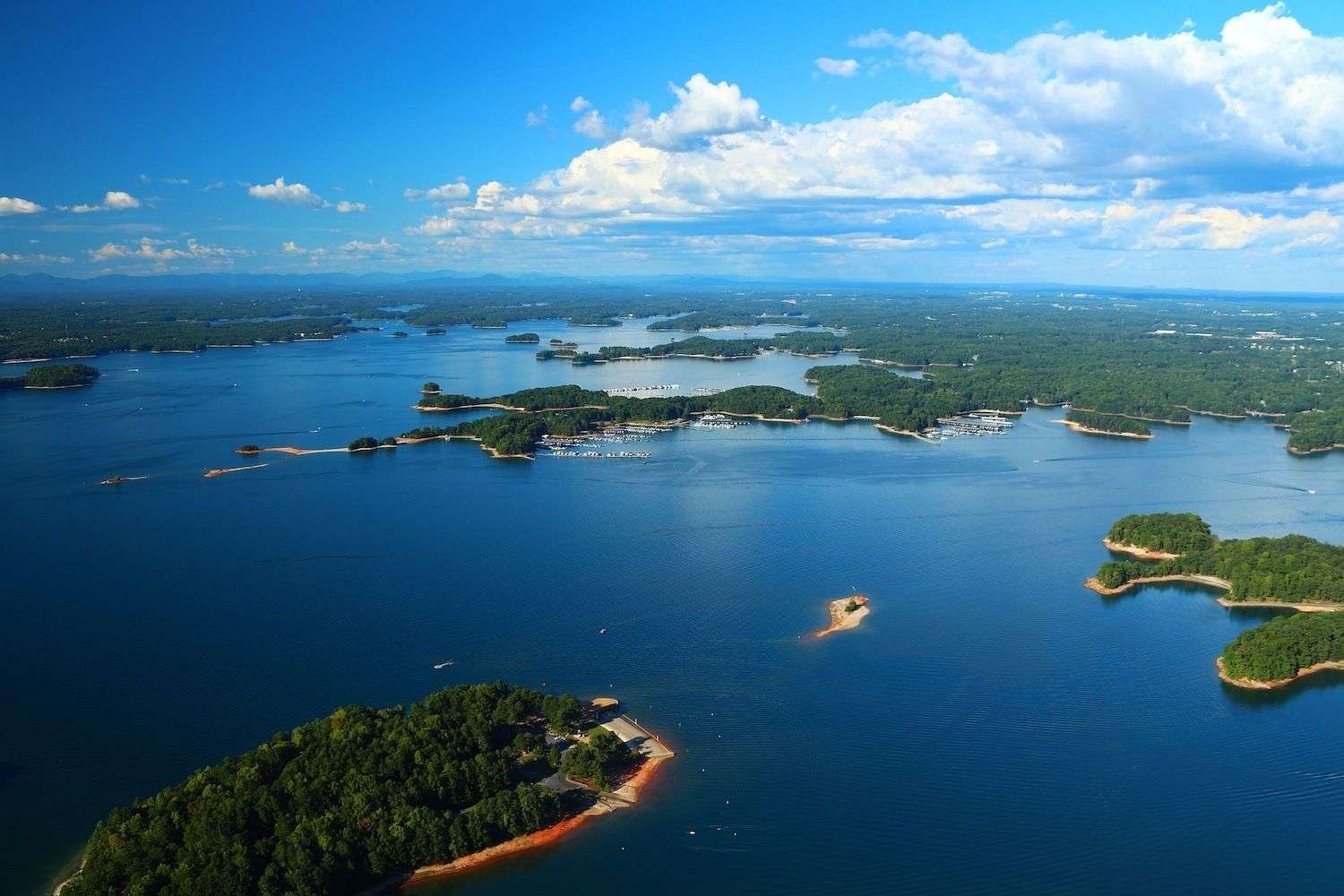
Main-channel and quiet-cove homes on Lake Lanier represent the two structural ends of the waterfront-living spectrum on this U.S. Army Corps of Engineers reservoir behind Buford Dam. Main-channel parcels sit on open shoreline near Browns Bridge, Lanier Islands, and the Buford Dam pool, delivering big-water views, deeper consistent water at the dock, and a high-energy boating culture. Quiet-cove parcels sit up the Chestatee River arm toward Dawson County and Lumpkin County, in narrow sub-coves off Forsyth County and Hall County water, and in dendritic backwaters where wake is suppressed by geometry. Choosing between them depends on boating style, noise tolerance, dock depth, and household use pattern.
Quick Answer: Main Channel or Quiet Cove?
The right Lake Lanier configuration is the one whose water surface, boat traffic, and view geometry match how a household actually uses the lake on a Saturday afternoon. Main-channel and quiet-cove parcels both sit on the same USACE Mobile District shoreline and both carry permitted private docks under the 2004 Lake Sidney Lanier Shoreline Management Plan, but the lived experience of each differs sharply by season, hour, and use case.
Main-channel homes often offer bigger views and stronger boating energy
Main-channel parcels sit on open shoreline where the lake widens into recreational pool: the Browns Bridge corridor, the open water in front of Lanier Islands, the Buford Dam pool, and the broader reaches of the Chattahoochee River channel through the main basin. The unobstructed view across two to three miles of water is the defining feature of this configuration, and it carries through sunrise and sunset because the sightline is not bounded by a cove wall. Listings marketed as big-water views, big-water lots, or main-channel frontage on the Forsyth County and Hall County shoreline almost always sit in this geometry. Water depth at the dock is the second main-channel advantage. The Chattahoochee River channel runs through the central basin of Lake Lanier at full pool elevation of 1,071 feet above mean sea level (USACE Mobile District, Final Environmental Impact Statement for Lake Sidney Lanier, current as of May 2026), and parcels on the open shoreline near that channel typically hold useful slip depth through normal USACE water-management operations. That depth supports larger watercraft, double-slip dock configurations, and the wakeboard and ski boats that drive main-channel boating culture. Boating energy on main-channel water is high through the May-to-October peak season. Wakeboard boats, ski boats, pontoon traffic, and the Saturday raft-up crowd concentrate on the open water near the Lanier Islands resort, the Aqualand Marina basin, and the Holiday Marina approach. Households whose Saturday plan is wake sports, dockside dining at Pig Tales Lakeside or Fish Tales Lakeside Grille, or a multi-boat sandbar gathering treat that energy as the point of buying lakefront, not as a cost.
Quiet-cove homes often offer privacy, calmer water, and a more relaxed setting
Quiet-cove parcels sit inside narrow sub-coves and tributary arms where the cove geometry itself filters out the wake, the noise, and the through-traffic that characterize main-channel water. The Chestatee River arm extending toward Dawson County and Lumpkin County, the long sub-coves off the Flat Creek and Mud Creek drainages in Hall County, and the dendritic backwaters off the larger Forsyth County bodies are the parts of Lake Lanier most associated with this configuration. The opposite shore is close, the line-of-sight from the dock is short, and the boat traffic is limited to the boats slipped in the cove itself. Water surface in a quiet cove calms in the evening because there is no through-traffic. Kayakers and paddleboarders launched from the dock can paddle for an hour without crossing a recreational ski lane, swimmers off the gangway do not have to time the gap between passing boats, and bank fishermen working the cove edge are not contending with wake bouncing off retaining walls. The daily-use pattern that supports a quiet-cove purchase is the morning paddle, the after-work swim, and the evening dock fishing, none of which work on main-channel water during peak season. Privacy in a quiet cove is structural rather than aspirational. Posted no-wake zones in marina approaches and bridge corridors as enforced by the USACE Lake Lanier Project Management Office in Buford reinforce the quieter water surface, and the narrow cove mouth means casual through-boaters do not enter unless they have a destination inside the cove. The tradeoff is a longer boat run to open water for wake sports and a thinner field of view from the dock, but for households whose use pattern lives inside the cove, the tradeoff is the point of the purchase.
The right choice depends on your boating, swimming, noise, and privacy preferences
The cleanest sorting variable between the two configurations is the household's primary on-water activity. Wakeboard, slalom ski, and pontoon-cruising households route toward main-channel water because the open shoreline gives immediate access to the deeper water, the wake-sport lanes, and the marina dining bench that define how they use the lake. Paddling, fishing, and dock-based households route toward quiet-cove water because the calmer surface, the suppressed wake, and the short boat-to-bank distance match the daily-use pattern that justifies the carrying cost. Noise tolerance is the second sorting variable, and it changes by hour. Main-channel water is loud through midday on summer weekends, with consistent engine noise from wakeboard boats and ski boats and intermittent music from raft-ups, before easing after sunset. Quiet-cove water is quiet across the same hours and stays quiet through the weekend, which makes it the configuration that supports dinner on the dock, late paddles, and night-fishing patterns. Households with children, dogs, or work-from-home schedules often weight the noise differential heavily once they live with it across a full peak season. Privacy preference is the third sorting variable, and it cuts on lot geometry as much as on cove geometry. Main-channel parcels with deep setbacks, mature buffer plantings, and a wide frontage can read as private despite the open shoreline; cove parcels with shallow setbacks and short front-to-back lot depth can read as exposed despite the calm water. The decision is rarely a clean main-versus-cove choice in practice; it is a parcel-specific overlay of cove or shoreline geometry, lot size, slope, dock class, and the household's actual use pattern.
Lifestyle Tradeoffs
Lifestyle on a Lake Lanier waterfront parcel is shaped less by the address and more by the cove geometry, the water depth at the dock, and the distance from the main channel. The same Hall County, Forsyth County, or Dawson County ZIP code can carry both main-channel and quiet-cove inventory, and the on-the-ground experience of ownership tracks the geometry rather than the political boundary.
Big-water views, wakes, traffic, and exposure
Big-water views are the defining feature of main-channel inventory and the single most-cited reason buyers underwrite the higher price tier on the open shoreline. The view geometry runs across one to three miles of open water in front of the Browns Bridge corridor, the Lanier Islands shoreline, and the central basin near Aqualand Marina, and it carries through every season because no cove wall interrupts the sightline. Sunrise and sunset across the open water are the moments that often anchor a buyer's emotional case for the parcel. Wake exposure is the structural cost of that view. Recreational wake from wakeboard boats, ski boats, and pontoons concentrates on main-channel water through the May-to-October peak season, and the wake bounces off retaining walls, riprap, and dock pilings on exposed shoreline. Riprap installations along the USACE shoreline buffer, permitted under the 2004 Lake Sidney Lanier Shoreline Management Plan, are common on main-channel lots specifically to manage that wake. Buyers should expect the lapping and washing pattern to be a permanent feature of main-channel ownership, not a seasonal one. Boat traffic and weekend congestion are the other costs. Lake Lanier carries more than 7 million annual visitors across the federal recreation system (USACE Mobile District, Lake Sidney Lanier project page, current as of May 2026), and the visitor density concentrates on main-channel water near the Lanier Islands resort, the Aqualand Marina basin, and the Holiday Marina approach. Weekday and shoulder-season use is dramatically lighter, but households planning to use a main-channel dock on summer Saturdays should plan around the traffic rather than against it. Current market conditions require a dated MLS comparison that identifies the area, property type, reporting period, and sample before a buyer relies on it.
Quiet water, kayaking, paddleboarding, and privacy
Quiet-cove water is the configuration that supports daily low-wake recreation on Lake Lanier. The cove geometry suppresses through-traffic, the narrow mouth filters casual boaters out, and the water surface calms within the cove regardless of activity on the main channel. Kayakers and paddleboarders launched from a dock in a quiet sub-cove off the Chestatee River arm or off the upper Chattahoochee arm can complete a one- to two-hour paddle loop without crossing a recreational ski lane, which is the structural reason quiet-cove parcels read as paddling-first inventory. Anglers value quiet coves on Lake Lanier for the predictable habitat at feeder-creek mouths and along submerged structure. Largemouth bass, spotted bass, striped bass, and bream populations hold near these features, and the calm surface in the cove supports both bank fishing and dock fishing patterns that are impractical on main-channel water during peak hours. The Georgia Department of Natural Resources Wildlife Resources Division manages the Lake Lanier fishery under its statewide reservoir program, and the quiet-cove segments of the lake are the ones most often referenced in angler reports of consistent bite patterns. Dock-based fishing in a quiet cove rewards a routine: a morning session at sunrise when the surface is glassy, an evening session at sunset when feeder-creek inflow concentrates baitfish along the cove edge, and an opportunistic session after a summer thunderstorm when oxygen levels rise in the upper water column. Households who treat fishing as a daily activity rather than a destination outing usually find quiet-cove water indispensable. Privacy in a quiet cove is a function of the cove width, the boat-traffic pattern, and the line-of-sight from the dock. A long narrow sub-cove off a tributary arm often sees only the boats slipped on its own docks, which means the parcel reads as private even when neighboring homes are visible across the water. Buyers who want a contemplative water surface, daily paddling and swimming use, and a dock that supports evening fishing without timing it around boat traffic consistently route toward this configuration rather than toward main-channel inventory.
Dock depth, silt, and seasonal usability
Dock depth on Lake Lanier varies with the original topography of the impounded Chattahoochee River valley and with sediment deposited at feeder-creek mouths since the 1956 impoundment. Main-channel parcels near the central river channel typically hold useful slip depth through normal USACE water-management operations because the channel runs deep through the basin at full pool elevation of 1,071 feet above mean sea level (USACE Mobile District, Final Environmental Impact Statement for Lake Sidney Lanier, current as of May 2026). Deep sub-coves off the main body of the lake often hold similar depth, while shallow cove heads near feeder-creek inflows can silt in over time and run too shallow for routine boating use. USACE Mobile District lake-level records show Lake Lanier draws down through normal seasonal cycles and can fall into the mid-1,060-foot elevation range during dry late-fall periods, as of Q1 2026 (USACE Mobile District Lake Lanier lake-level public records, Q1 2026). That drawdown leaves the shallowest cove docks effectively beached for weeks at a time, while main-channel docks and docks in deep sub-coves remain functional. The 2007 to 2008 drought drew Lake Lanier down to approximately 1,050 feet above mean sea level at its low point, well below full pool (USACE Mobile District drought operations records, historical), and the institutional memory of that event still shapes how Lanier buyers underwrite slip depth. Seasonal usability is the practical translation of the depth and drawdown patterns. A main-channel dock typically supports boat-in and boat-out access twelve months a year because the underlying channel depth absorbs the USACE water-management operations. A quiet-cove dock in a deep sub-cove typically does the same. A quiet-cove dock at a shallow cove head near a feeder creek may sit on mud for weeks during late-fall and winter low pool. Buyers should confirm slip depth at full pool and at typical drawdown rather than relying on a peak-season listing photo, and should review the existing USACE shoreline-use permit and dock-class assignment as part of standard waterfront diligence.
How to Compare Properties
Comparing a main-channel parcel against a quiet-cove parcel on Lake Lanier requires more than a side-by-side spreadsheet because the variables that determine livability — wake exposure, slip depth, view geometry, and noise pattern — are time-of-day and season-dependent and do not show on a listing sheet. The diligence is parcel-specific and is best confirmed in person against USACE documentation and at multiple seasons.
Visit at different times and seasons
A single visit during a quiet weekday in October says almost nothing about what a main-channel parcel feels like on a summer Saturday at 2 p.m. Buyers underwriting main-channel inventory should walk the parcel at least once during a summer weekend at peak traffic and at least once during a winter weekday at off-season conditions to anchor both ends of the use spectrum. The wake pattern, the engine noise from the Lanier Islands shoreline, and the boat density in front of the dock are all dramatically different across those two visits, and either alone gives a misleading picture. Quiet-cove parcels deserve the same multi-visit pattern but for a different reason. Cove water on Lake Lanier is consistently calm, but the boat run to open water, the marinas, and the dockside dining bench is what changes across seasons. A 15-minute run on flat water in October becomes a 25-minute run against summer wake in July, and the run feels different again at sunset versus midday. Households whose primary lake use is paddling and dock-based time will not care; households who plan to leave the cove regularly will. Lake-level conditions are the third dimension. A quiet-cove dock that sits in three feet of water at the slip during late-fall drawdown is a meaningfully different asset from one that sits in eight feet at full pool, and the photographs in a peak-season listing rarely capture the difference. Buyers should pull USACE Lake Lanier lake-level public records for the prior 36 months, look at the typical seasonal range, and ideally visit the parcel at both full pool and drawdown before underwriting an offer.
Evaluate dock access, water depth, and noise patterns
Dock access on a Lake Lanier parcel is governed by the existing USACE shoreline-use permit issued under the 2004 Lake Sidney Lanier Shoreline Management Plan by the Lake Lanier Project Management Office in Buford. The permit travels with the parcel and sets the dock class — single slip, double slip, party deck, covered, uncovered — along with any compliance conditions tied to the Exhibit C electrical inspection cycle and the shoreline-use category. Buyers should review the permit, the dock-class assignment, the most recent inspection results, and any open compliance correspondence as part of standard waterfront diligence on both main-channel and quiet-cove parcels. Water depth at the slip is measurable rather than inferable. A buyer or buyer's agent can sound the slip with a tape measure, a depth finder, or the marina's measuring tools at both full pool and at typical drawdown, and the result is what underwrites the long-term usability of the dock. Main-channel slips near the Chattahoochee River channel typically read in the high single digits to low double digits at full pool. Deep sub-cove slips typically read in the six-to-ten-foot range. Shallow cove-head slips can read in the two-to-four-foot range during drawdown, which is the configuration most likely to leave the dock beached. Noise patterns are the variable that buyers most often skip in diligence and most often regret after closing. Main-channel noise from wakeboard and ski boats, pontoon traffic, and marina activity is consistent across summer weekends. Quiet-cove noise is consistently minimal. Buyers should stand on the dock during peak-traffic hours in summer to hear the actual baseline rather than relying on the showing-time impression. Households sensitive to engine noise should weight this variable heavily before committing to main-channel inventory, and households who weight the boating energy as a feature should confirm they enjoy it at the actual decibel level rather than the imagined one.
Ask Ashley Smith for a lifestyle-specific lake search
Lake Lanier inventory across Hall County, Forsyth County, Dawson County, Gwinnett County, and Lumpkin County does not segment neatly by ZIP code or by school zone; it segments by cove geometry, dock class, slope to water, and distance from the main channel. A buyer searching the FMLS and Georgia MLS data using only price and bedroom filters will surface a mix of main-channel, quiet-cove, big-water-view, deep-water-cove, shallow-cove, and lake-access inventory that does not match the household's actual use pattern. The filter that matters is the lifestyle filter, and it sits on top of the listing data rather than inside it. A lifestyle-specific lake search starts from the household's primary on-water activity, the noise tolerance, the seasonal use pattern, and the carrying-cost ceiling, and walks backward into the cove geometry, the dock class, and the parcel slope that support those inputs. Buyers solving for wake sports and main-channel access work a different inventory list than buyers solving for paddling, fishing, and contemplative water, even when the headline price band is identical. Ashley Smith, real estate agent with The Dream Smith Team at Compass, organizes Lake Lanier buyer searches around this lifestyle filter rather than around generic waterfront inventory queries. A structured consultation typically covers the household's actual planned weekend cadence, the dock-class requirements, the slip-depth tolerance through USACE water-management operations, the commute pattern from the household's primary address along Interstate 985 or Georgia State Route 400, and the carrying-cost layer beyond mortgage and tax. Buyers underwriting a Lake Lanier purchase benefit from running the lifestyle filter early in the search rather than after a property tour has already biased the inventory set, and the resulting candidate list is usually shorter, more usable, and more aligned with the household's actual use pattern.
Frequently Asked Questions
- What is the difference between main-channel and quiet-cove homes on Lake Lanier?
- Main-channel homes on Lake Lanier sit on open shoreline near the Chattahoochee River channel, the Browns Bridge corridor, and the Lanier Islands area, delivering big-water views, deeper slip depth, and a high-energy boating culture. Quiet-cove homes sit inside narrow sub-coves and tributary arms off the main channel, where cove geometry suppresses wake and through-traffic and produces a calmer water surface. Both configurations sit on the USACE Mobile District shoreline and carry permitted private docks under the 2004 Lake Sidney Lanier Shoreline Management Plan, but the lived experience of each differs sharply.
- Are main-channel homes more expensive than quiet-cove homes on Lake Lanier?
- Quiet-cove parcels span a wider price range depending on cove depth, slope to water, dock class, and distance from main amenities. Pricing is parcel-specific rather than category-specific, and buyers should compare specific listings rather than rely on a category-level average. Current market conditions require a dated MLS comparison that identifies the area, property type, reporting period, and sample before a buyer relies on it.
- How does boat traffic differ between main-channel and quiet-cove water on Lake Lanier?
- Main-channel water on Lake Lanier carries consistent recreational boat traffic through the May-to-October peak season, concentrated near the Lanier Islands resort, the Aqualand Marina basin, and the Holiday Marina approach. Lake Lanier sees more than 7 million annual visitors across the federal recreation system (USACE Mobile District, Lake Sidney Lanier project page, current as of May 2026). Quiet-cove water sees dramatically less through-traffic because the narrow cove mouth filters casual boaters out and only the boats slipped inside the cove move regularly within it.
- Which configuration is better for kayaking and paddleboarding on Lake Lanier?
- Quiet-cove water is the configuration that supports daily kayaking and paddleboarding on Lake Lanier because the cove geometry suppresses through-traffic and the water surface calms within the cove regardless of activity on the main channel. Kayakers and paddleboarders launched from a quiet-cove dock can complete a one- to two-hour paddle loop without crossing a recreational ski lane. Main-channel water during summer weekends carries continuous wake and engine traffic that is generally incompatible with daily paddling use.
- Do quiet-cove docks have water-depth problems during drawdown on Lake Lanier?
- Some quiet-cove docks on Lake Lanier do, particularly those at shallow cove heads near feeder-creek inflows where sediment has accumulated since the 1956 impoundment. USACE Mobile District lake-level records show Lake Lanier can draw down into the mid-1,060-foot elevation range during dry late-fall periods, as of Q1 2026 (USACE Mobile District Lake Lanier lake-level public records, Q1 2026). Deep sub-coves off the main body of the lake typically hold useful slip depth through normal drawdown. Buyers should confirm slip depth at full pool and at typical drawdown rather than rely on a peak-season listing photo.
- How should a buyer decide between a main-channel and a quiet-cove home on Lake Lanier?
- The decision should start from the household's primary on-water activity, the noise tolerance, the seasonal use pattern, and the carrying-cost ceiling, then work backward into the cove geometry, the dock class, and the parcel slope that support those inputs. Wake-sport households generally weight main-channel inventory; paddling, fishing, and dock-based households generally weight quiet-cove inventory. Buyers should visit candidate parcels at multiple seasons and at peak traffic hours rather than only at the listing-side showing time, and should review the existing USACE shoreline-use permit and lake-level records as part of standard diligence.
Related
- Lake Lanier Quiet Cove HomesInventory and buyer guide for quiet-cove waterfront homes on Lake Lanier.
- Lake Lanier Big-Water View HomesMain-channel and open-water view inventory on Lake Lanier.
- Lake Lanier Waterfront HomesActive waterfront listings across Lake Lanier ZIP codes and counties.
- Lake Lanier Dock Permits GuideUSACE shoreline management, dock classes, and Exhibit C inspection on Lake Lanier.
- Lake Lanier Water Levels and Full Pool 1071USACE water-management operations patterns and dock depth implications on Lake Lanier.
- Lake Lanier Real Estate OverviewFull overview of the Lake Lanier market, communities, and waterfront inventory.