
Buyer Guide
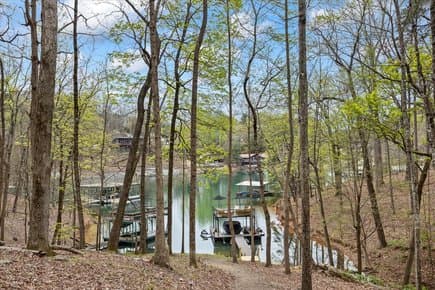
A Lake Lanier quiet-cove home is a waterfront residence on the U.S. Army Corps of Engineers shoreline where the parcel sits inside a narrow, sheltered cove or sub-cove off the main channel, producing noticeably lower boat traffic, lighter wake, and a more contemplative water surface than the open-water shoreline near Browns Bridge, Buford Dam, and Lake Lanier Islands. Quiet-cove parcels concentrate up the Chestatee River arm extending toward Dawson County and Lumpkin County, in the northern reaches of the lake near Gainesville and Hall County's North Lake area, and in deep sub-coves off larger Forsyth County bodies, where cove geometry and distance from the main channel together suppress recreational wake.
What Makes a Quiet Cove Appealing
A quiet cove on Lake Lanier is appealing because the cove geometry itself does the work of filtering out the wake, noise, and weekend congestion that characterize the open-water shoreline, which lets a waterfront household use the dock for paddling, fishing, and swimming on a daily basis rather than only during off-peak boating windows. The U.S. Army Corps of Engineers Mobile District impounded Lake Lanier in 1956 in the southern Appalachian foothills, and the resulting shoreline includes long narrow arms, dendritic sub-coves, and posted no-wake segments where the lake reads more like a river backwater than a recreational reservoir.
More privacy and less boat traffic than main-channel areas
Privacy on a quiet cove is a function of two compounding factors: the cove is narrow enough that the opposite shore is close, which limits the number of homes with line-of-sight to the dock, and the cove is far enough from the main channel that pass-through boat traffic is minimal. Main-channel shorelines along Browns Bridge, the Lanier Islands area, and the open water in front of Buford Dam carry steady recreational wake from wakeboard boats, ski boats, and pontoon traffic during summer weekends, with marked no-wake zones in marina approaches and bridge corridors as posted by USACE Lake Lanier Project Management Office in Buford. A long narrow sub-cove off the Chestatee River arm, by contrast, often sees only the boats slipped on its own docks, which is the structural reason quiet-cove parcels read as private even when neighboring homes are visible across the water.
Kayaking, paddleboarding, swimming, and peaceful lake use
Quiet-cove water is the configuration that supports daily low-wake use. Kayakers and paddleboarders launched from a dock in a sheltered cove can paddle for an hour without crossing a recreational ski lane, families can swim off the gangway without timing the gap between passing boats, and bank fishermen working the cove edge are not contending with wake bouncing off retaining walls. Anglers in particular value quiet coves on Lake Lanier for largemouth bass, spotted bass, striped bass, and bream populations that hold near submerged structure and feeder creeks where USACE-managed water levels and Chestatee tributary inflow create predictable habitat. The daily-use pattern of a quiet-cove household — morning paddle, after-work swim, evening dock fishing — is incompatible with a main-channel position during peak season, which is what produces the segment-level demand for cove inventory.
How quiet-cove living differs from high-energy boating areas
High-energy boating areas on Lake Lanier — the broad water in front of Lanier Islands, the Browns Bridge corridor, the open water near the Buford Dam pool — are organized around wake sports, marina dining, and multi-boat raft-ups, with high summer traffic densities and visible wake patterns extending into adjacent coves. Quiet-cove living is organized around the opposite: a small set of slipped boats, predictable neighbors, and a water surface that calms in the evening because there is no through-traffic. Households shopping the two configurations are usually self-selected by use case. Wakeboard and ski households prioritize main-channel proximity; paddling, fishing, and contemplative-water households prioritize cove depth and distance from the main channel. The tradeoff is real and shows up in resale narrative when either configuration returns to market.
Quiet Cove Buyer Tradeoffs
Quiet-cove waterfront on Lake Lanier carries a specific set of tradeoffs that buyers should evaluate before writing an offer, because the same cove geometry that produces the privacy and the low-wake water surface also produces longer boat runs to open water, shallower slip depths in some sub-coves, and silt patterns where feeder creeks drain into the cove head. The diligence is cove-specific and is best confirmed in person and against USACE lake-level records.
Water depth and silt concerns in some coves
Cove depth on Lake Lanier varies with the original topography of the impounded valley and with sediment deposited at feeder-creek mouths over the decades since the 1956 impoundment. Deep sub-coves off the main body of the lake often hold useful depth at the slip even during USACE water-management operations, while shallow cove heads near feeder-creek inflows can silt in over time and run too shallow for routine boating use. USACE Mobile District lake-level records have shown Lake Lanier drawn into the mid-1,060-foot elevation range during dry late-fall periods, as of Q1 2026 (USACE Mobile District Lake Lanier lake-level public records, Q1 2026), which can leave the shallowest cove docks effectively beached for weeks. Buyers should confirm slip depth at full pool and at typical drawdown rather than relying on a peak-season listing photo.
Dock usability during seasonal lake-level changes
Dock usability in a quiet cove is the practical translation of slip depth, cove geometry, and the existing USACE shoreline-use permit. A dock permitted in a deep sub-cove off the Chestatee River arm typically maintains boat-out access through normal USACE water-management operations, while a dock permitted in a shallow cove head near a feeder creek may sit on muddy bottom during late-fall low pool. Dock class — single slip, double slip, party deck, covered, uncovered — is set by the existing shoreline-use permit issued by the USACE Lake Lanier Project Management Office in Buford under the 2004 Lake Lanier Shoreline Management Plan, and the permit travels with the parcel. Buyers should review the permit, the dock-class assignment, and any compliance correspondence as part of standard waterfront diligence.
Longer boat ride to marinas, restaurants, and open water
The structural cost of quiet-cove water is the boat run. A dock in a deep sub-cove far from the main channel may sit 10 to 25 minutes by boat from full-service marinas, dockside dining, and the open water suitable for wake sports, depending on the cove and the no-wake segments en route. Households that use the lake primarily for wakeboarding, slalom skiing, or main-channel sandbar gatherings often find the run incompatible with how they actually use a Saturday afternoon. Households that use the lake primarily for paddling, fishing, and dock-based time at home find the run irrelevant because most use never leaves the cove. Buyers should drive the boat run, not just look at it on a map, before committing to a quiet-cove parcel.
Search Quiet Cove Homes by Area
Quiet-cove inventory on Lake Lanier is unevenly distributed across the five lake counties, and the search is most efficient when it is structured around the lake geography rather than around county lines alone, because cove character is determined by where the cove sits relative to the main channel and the no-wake segments rather than by the political boundary above it.
North Lake and river-arm options
The North Lake area near Gainesville and the upper reaches of the Chestatee River arm extending toward Dawson County and Lumpkin County are the parts of Lake Lanier most often associated with quiet-cove character. The lake narrows as it moves north into its tributary arms, boat traffic thins because the main recreational hubs are on the southern half near Buford Dam and Lanier Islands, and the cove geometry tends toward long narrow sub-coves rather than broad open shoreline. Posted no-wake segments in marina approaches and bridge corridors reinforce the quieter water surface in these arms. Buyers searching specifically for the contemplative-water configuration usually start the search in the North Lake area and the Chestatee River arm and only move south when slope, dock class, or price drives them to consider other geography.
Dawsonville, Gainesville, and Hall County cove properties
Cove inventory in Dawsonville, Gainesville, and broader Hall County concentrates along the Chestatee River arm, the upper Chattahoochee arm, and the deep sub-coves that branch off both. Dawsonville cove parcels typically sit on the Chestatee side and read as upriver lake water rather than open reservoir. Gainesville cove parcels include shoreline along the upper Chattahoochee arm and the Flat Creek and Mud Creek drainages, with a mix of quiet sub-coves and busier open-water frontage depending on the specific parcel. Hall County's broader waterfront inventory across the FMLS and Georgia MLS systems includes both quiet-cove and main-channel positions, and the buyer-side filter is cove geometry and distance from the main channel rather than the county-level address.
Compare quiet-cove homes with Ashley Smith
Comparing quiet-cove parcels on Lake Lanier is a cove-by-cove exercise because no two coves read the same: cove length, cove width, distance from the main channel, slip depth, feeder-creek silt, and the surrounding shoreline density all vary parcel to parcel. Working with Ashley Smith of DreamSmith Realty on the buyer side allows a side-by-side comparison of active quiet-cove listings across Hall County, Forsyth County, Dawson County, and Lumpkin County, with on-the-ground confirmation of cove character, dock usability at typical drawdown, and the boat run to open water. The buyer is licensed in Georgia (license #424319), and the firm operates inside the Lake Lanier shoreline market. Side-by-side cove comparison is the most reliable way to match a household's use pattern to a parcel.
Frequently Asked Questions
- What counts as a quiet cove on Lake Lanier?
- A quiet cove on Lake Lanier is a sub-cove or narrow arm of the reservoir where cove geometry and distance from the main channel together suppress recreational boat wake, producing a calmer water surface than the open-water shoreline near Browns Bridge, Buford Dam, and Lanier Islands. There is no single regulatory definition; the practical test is the volume of pass-through boat traffic on a summer Saturday and the wake pattern reaching the dock. Long narrow sub-coves off the Chestatee River arm and the upper Chattahoochee arm near Gainesville are the geographies most often described in these terms by buyers and brokers familiar with the lake.
- Are there official no-wake zones on Lake Lanier?
- Yes. The U.S. Army Corps of Engineers Lake Lanier Project Management Office in Buford posts no-wake segments in marina approaches, bridge corridors, and other restricted areas, and those signs are enforced on the water. A quiet cove is not the same as a regulatory no-wake zone, but no-wake signage near the cove mouth or along the approach to the cove reinforces the quieter water surface because boats entering and leaving the area are required to operate at idle. Buyers should confirm the location of posted no-wake signage relative to the parcel as part of cove evaluation.
- Who typically buys quiet-cove homes on Lake Lanier?
- Quiet-cove inventory concentrates demand from households whose lake use is dock-based and low-wake rather than main-channel wake sports. The buyer pool skews to households with older children who swim and paddle independently, dedicated bass and bream anglers who fish from the dock and the cove edge, paddleboard and kayak users who launch off the gangway, and households that treat the dock as evening and weekend infrastructure rather than as a launching point for high-speed boating. Wakeboard and slalom-ski households generally prefer main-channel proximity and shortlist quiet-cove parcels only when other parcel features outweigh the boat run.
- How does the value of quiet-cove waterfront compare to main-channel waterfront on Lake Lanier?
- Quiet-cove waterfront and main-channel waterfront on Lake Lanier trade against each other rather than at a single uniform spread because the configurations serve different use cases. Main-channel parcels carry a premium for households that prioritize wake-sport access, marina proximity, and big-water views. Quiet-cove parcels carry a premium for households that prioritize privacy, lower boat traffic, and daily low-wake water. The pricing comparison between the two is most reliable inside the same cove or the same general lake segment because slip depth, dock class, slope, and view all vary parcel to parcel. Comparable-sales analysis should hold cove geometry and dock class roughly constant.
- What due diligence is specific to quiet-cove parcels?
- Cove-specific diligence on Lake Lanier centers on slip depth at full pool and at typical drawdown, silt accumulation near feeder-creek inflows, dock-class assignment under the existing USACE shoreline-use permit, the location of posted no-wake signage relative to the cove mouth, and the actual boat run to open water and to full-service marinas. Buyers should run the boat from the slip to the main channel rather than only viewing the route on a map, because the wake pattern, the marked navigation channel, and the seasonal water level are most accurately read on the water. The standard waterfront diligence on Corps Line location and dock-permit status applies on top of the cove-specific items.
- Where on Lake Lanier do quiet-cove parcels tend to concentrate?
- Quiet-cove parcels on Lake Lanier are not evenly distributed because boat traffic, cove geometry, and distance from the main recreational hubs vary lake-wide. Buyers and brokers familiar with the shoreline frequently point to the upper Chestatee River arm extending toward Dawson County and Lumpkin County, the North Lake area near Gainesville, the upper Chattahoochee arm, and deep sub-coves off larger Forsyth County bodies as the geographies where quiet-cove character is most consistently present. The southern half of the lake near Buford Dam and Lanier Islands carries higher main-channel traffic densities and is generally a less reliable source of quiet-cove inventory.
Related
- Lake Lanier Waterfront HomesFull waterfront inventory across Hall, Forsyth, Gwinnett, Dawson, and Lumpkin counties.
- Lake Lanier Private Dock HomesUSACE-permitted private-dock parcels and dock-class context.
- Lake Lanier Water View HomesHomes with direct lake views, including cove views and open-water orientations.
- Lake Lanier Community GuideFull neighborhood, market, school, and shoreline overview for Lake Lanier.
- Lake Lanier ListingsActive waterfront, lake-access, and land listings across the five lake counties.