
Journal
Lake Lanier dock sizes and types are governed by the U.S. Army Corps of Engineers (USACE) Mobile District under the Lake Sidney Lanier Shoreline Management Plan administered by the U.S. Army Corps of Engineers, which sorts permitted residential docks into single-slip, double-slip, and large covered party-dock classes, alongside community docks and commercial marina slips. The maximum permitted footprint, slip count, gangway length, and roof dimensions are fixed by permit class, not by lot size. Across Hall County, Forsyth County, Dawson County, Gwinnett County, and Lumpkin County shoreline parcels, the dock class on the active USACE permit determines what the structure can legally include and how it conveys at closing on Lake Lanier.
Common Dock Types on Lake Lanier
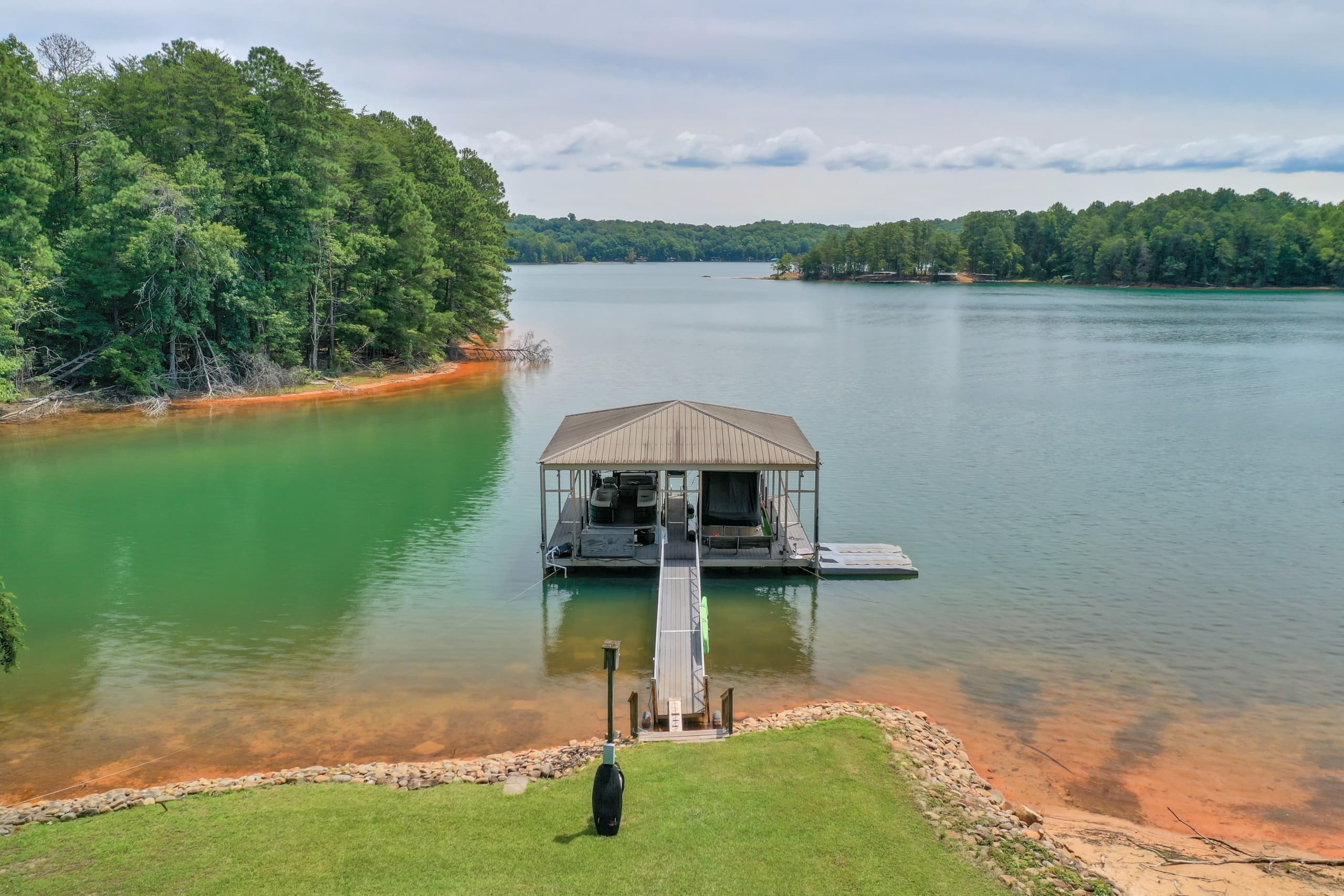
Common dock types on Lake Lanier fall into four practical buckets that buyers will see in Georgia MLS listings across Cumming, Buford, Gainesville, Flowery Branch, and Dawsonville: single-slip private docks, double-slip private docks, covered party docks with upper sundecks, and shared community or marina slips. Each category corresponds to a different USACE Mobile District permit class with its own footprint, slip count, and roof rules under the Lake Sidney Lanier Shoreline Management Plan administered by the U.S. Army Corps of Engineers. The dock class on the active permit, not the visible structure on the water, controls what conveys at closing and what an inspector can flag.
Single-slip, double-slip, covered, party, and platform-style docks
A single-slip dock on Lake Lanier is the most common residential structure permitted by the USACE Mobile District, typically authorized under a Class I permit with one covered or uncovered boat slip, a gangway, and a modest walkway path from the federal shoreline contour. Most ZIP code 30518 (Buford), 30519 (Buford), 30506 (Gainesville), 30542 (Flowery Branch), and 30040 (Cumming) residential coves are dominated by single-slip docks because that class fits inside the standard residential setback and footprint rules under the Shoreline Management Plan. Double-slip docks step up to a Class II permit, which authorizes two adjacent boat slips, usually with a shared roof, an expanded electrical service, and a slightly larger gangway and walkway footprint. Covered docks within either class add a metal or shingled roof over the slip, which the USACE Lake Lanier Project Management Office in Buford permits to specific height, overhang, and pitch limits. Party docks sit at the top of the residential permit ladder under a Class 2 or Class III authorization and combine multiple covered slips on the lower level with a finished upper sundeck. Platform-style docks are smaller structures permitted in coves where water depth or shoreline classification will not support a full slip; they typically include a fixed deck with a swim ladder, swim platform, or kayak rack and are common on shallower north-end coves around Lumpkin County. Each style carries a different price implication at resale because each represents a different permit class and a different operating envelope on the water.
Private docks, community docks, and marina slips
A private dock on Lake Lanier is a USACE-permitted structure tied to one single-family deeded parcel for that owner's exclusive use, and the USACE permit is reassigned to the new owner through a change-of-owner filing submitted to the Lake Lanier Project Management Office in Buford. A community dock is a shared multi-slip cluster permitted to an HOA, subdivision, or condominium association rather than to an individual homeowner, with slip assignment, fees, and maintenance governed by the community's covenants and not by the resident's deed. Marina slips at Aqualand Marina, Holiday Marina, Sunrise Cove Marina, Habersham Marina, and Lan Mar Marina are commercial leases held by the marina operator under a separate USACE concession agreement. A marina slip does not transfer with any residential property and ends when the lease term ends or the lessee assigns it back to the marina. The distinction is significant at closing because only the private dock is a deeded, capitalized waterfront right; the community slip is a covenant-controlled access right; and the marina slip is a contract right with no real-estate attachment. USACE permits and licenses are nontransferable. A new owner of an existing facility may apply through the Lake Lanier Operations Management Office, and approval is not automatic. Confirm the property-specific record and current requirements before closing.
Why dock type affects value and buyer demand
Current market conditions require a dated MLS comparison that identifies the area, property type, reporting period, and sample before a buyer relies on it. Inside the private-dock tier itself, party-dock and covered double-slip homes trade at a further premium over single-slip homes, because covered roof structures, upper-deck entertaining space, and Class 2 or Class III footprint authorizations are even more scarce than the standard Class I permit. Cove location, water depth at USACE water-management operations, and proximity to main-channel access at Buford Dam, Browns Bridge, and Lanier Bridge layer on top of dock class to set the final premium. Buyer demand follows usage profile. Households running a single wakeboat or pontoon usually anchor on a single-slip private dock; multi-boat households with a tritoon, a fishing skiff, and a personal watercraft anchor on a double-slip or party dock; lower-utilization buyers prioritizing lock-and-leave ownership often accept a community slip or lake-access listing in exchange for lower carrying cost. The dock type therefore sorts the buyer pool as much as it sorts the price.
Dock Size and Compliance Questions
Dock size and compliance on Lake Lanier are not measured against lot dimensions or owner preference; they are measured against the active USACE permit class, the as-built diagram on file at the Lake Lanier Project Management Office in Buford, and the Lake Sidney Lanier Shoreline Management Plan administered by the U.S. Army Corps of Engineers. The Mobile District inspects permitted docks on a rotating schedule and writes noncompliance items into a documented notice, which transfers to the new owner under the change-of-owner permit conditions when the deed conveys.
USACE rules and property-specific permit conditions
The maximum permitted dock footprint on Lake Lanier is set by permit class under the Lake Sidney Lanier Shoreline Management Plan administered by the U.S. Army Corps of Engineers and Engineer Pamphlet EP 1130-2-406, with additional property-specific conditions written into the individual permit by the USACE Mobile District. A Class I single-slip permit caps slip count, gangway length, roof dimensions, and walkway path width at one set of values; a Class II double-slip permit raises those values; and a Class 2 or Class III party-dock authorization sits at the upper bound the Mobile District will issue in residential coves. The largest residential dock structures on Lake Lanier are almost always legacy permits issued before the 2004 plan tightened the framework, and the USACE has effectively closed expansion above the standard envelope across most of the developed shoreline. Property-specific conditions can include setback distances from adjoining permitted docks, a defined permitted-path corridor, electrical and grounding requirements, vegetation-modification limits, and a fixed shoreline-contour reference for floating-dock elevation. These conditions are written into the permit and override any owner assumption about what is allowed. The active permit at the Lake Lanier Project Management Office in Buford is the controlling document, and the as-built diagram is the visual reference for what the permit actually authorized.
Electrical, structural, flotation, walkway, and lift considerations
Electrical service on a Lake Lanier dock has to meet the current USACE standard and the county code for the parcel's jurisdiction, which means Hall County for ZIP code 30506, Forsyth County for ZIP code 30040, Gwinnett County for ZIP code 30518, Dawson County for parcels in Dawsonville, and Lumpkin County for parcels at the north end. Common electrical issues include outdated service panels without current ground-fault protection, ungrounded lighting circuits, and unpermitted electrical expansions to support upper-deck entertaining loads on party docks. Structural condition covers piling integrity, deck framing, roof condition, gangway hardware, and railing systems, all of which a USACE shoreline inspector and a licensed marine contractor will evaluate against the as-built. Flotation refers to the dock's floats: as polyethylene or foam floats age, they lose buoyancy and the dock sits lower than the permitted elevation, which becomes a documented compliance issue at the next inspection. Walkway path width and surface material are controlled by the permit and the Shoreline Management Plan. Boat lifts are a separate consideration. A lift inside a permitted slip is generally allowed within the slip footprint, but a lift extending beyond the as-built dock perimeter, or a lift installed without electrical permitting, can create both a USACE compliance issue and a county electrical code issue. Lift hardware also adds load to the dock structure, which the underlying floats and piling have to be sized to carry.
Why buyers should verify the actual permit file
Reviewing the actual USACE permit file at the Lake Lanier Project Management Office in Buford is the only reliable way for a buyer to confirm what is permitted on a given Lake Lanier parcel, because the structure on the water can drift from the as-built over time through informal additions, replacements, or relocations that were never re-permitted. The Mobile District's documentary record, not the visible dock, is what governs at the change-of-owner step and at the next routine shoreline inspection, and a clean documentary record is what allows the change-of-owner filing to clear without conditional repair requirements attached. Buyers should request the active USACE permit number, the permit class designation, the as-built diagram, the most recent shoreline inspection notice, any open compliance correspondence with the Mobile District, and the electrical inspection record from the applicable Hall County, Forsyth County, Dawson County, Gwinnett County, or Lumpkin County inspector before the due-diligence period closes on a Lake Lanier waterfront contract. A licensed Georgia marine contractor and a licensed Georgia electrician should be retained for the structural and electrical confirmation, separate from the standard home inspection used for the residence itself. The dock is functionally a second permitted asset attached to the same parcel and warrants its own diligence track in any Cumming, Buford, Gainesville, Flowery Branch, or Dawsonville closing where the dock carries a material share of the home's overall lake-premium value, because a problem found after closing transfers to the new owner along with the deed.
Choosing a Property by Dock Type
Choosing a Lake Lanier property by dock type starts with the household's actual boating and entertaining profile rather than the dock class label, because each USACE permit class corresponds to a different operating envelope, a different maintenance burden, and a different price tier across Cumming, Buford, Gainesville, Flowery Branch, and Dawsonville. The right match aligns the dock type with how the household will use the lake on a typical weekend, not with the highest-tier inventory available.
Best dock types for serious boaters
Serious-boater households on Lake Lanier, defined here as households running multiple vessels, larger boats, or frequent overnight use, typically anchor on a Class II double-slip private dock or a Class 2 or Class III party-dock authorization with a covered roof and an upper sundeck. The double-slip footprint accommodates a primary boat and a secondary watercraft side by side, and the party-dock footprint adds covered shade for warm-weather use and storage capacity for water-sports equipment. Both classes concentrate in deeper main-channel coves near Buford Dam, Browns Bridge, and Lanier Bridge where year-round water depth supports larger draft. The trade-off is acquisition price, carrying cost, and maintenance scope. A Class II or Class III dock is a larger structural asset with more electrical load, more roof and float area, and more compliance exposure at the routine USACE inspection cycle. Buyers in this segment should also evaluate cove depth at USACE water-management operations, because USACE Mobile District lake-level records show drawdown into the mid-1,060s by late fall (USACE Mobile District lake-level records, as of April 2026), which can affect the practical usability of a heavy vessel in a shallow cove even when the dock is permitted.
Best options for lower-maintenance lake access
Lower-maintenance lake access on Lake Lanier usually points toward a Class I single-slip private dock, a community-slip arrangement in an HOA-governed neighborhood, or a lake-access listing without a private dock. A Class I single-slip dock has the smallest maintenance footprint inside the private-dock tier: one slip, one set of floats, a modest roof if covered, and a smaller electrical service than a Class II or Class III structure. Community slips inside subdivisions around Cumming, Gainesville, and Flowery Branch reduce the homeowner's structural-maintenance role further, because the HOA carries the permit, the inspection cycle, and the repair budget under shared covenants. Lake-access homes without a private dock trade at a meaningfully lower price point than permitted-dock homes and are the natural choice for lower-utilization buyers, second-home buyers who only run the lake on summer weekends, or buyers who prioritize lock-and-leave ownership over private slip rights. Public boat ramps operated by the USACE and the marinas around the reservoir give these households a usable path to the water without the dock-permit overhead. The trade-off is shared use, seasonal congestion at the ramps, and the absence of a deeded shoreline-use right at the parcel.
Ask Ashley Smith to compare dock features before you offer
Comparing dock features across two or three candidate Lake Lanier waterfront listings before submitting an offer is the most reliable way to align the dock class with the household's actual usage, and the comparison has to look at the active USACE permit, the as-built diagram, the cove depth profile, and the compliance history of each structure rather than the photo set in the MLS listing. Ashley Smith with DreamSmith Realty, Georgia real estate license #441859, can pull the dock-class comparison together against Georgia MLS inventory and USACE Lake Lanier Project Management Office permit lookups in Buford as part of a buyer consultation. The consultation pairs the home's interior comparables with a dock-tier comparable set, identifies any visible-versus-permitted gap on each candidate, and flags compliance exposure that would attach to the change-of-owner filing after closing. That two-track diligence keeps the dock from becoming a post-closing surprise on what is usually the highest-value waterfront purchase a household will make in Cumming, Buford, Gainesville, Flowery Branch, or Dawsonville. Reach DreamSmith Realty at the office number listed on the contact page to schedule a dock-focused walkthrough of current inventory.
Frequently Asked Questions
- What is the maximum dock size allowed on Lake Lanier?
- The maximum permitted dock footprint on Lake Lanier is set by USACE Mobile District permit class under the Lake Sidney Lanier Shoreline Management Plan administered by the U.S. Army Corps of Engineers and Engineer Pamphlet EP 1130-2-406, with a Class 2 or Class III party-dock authorization sitting at the upper bound the Mobile District will issue in residential coves. The largest residential structures on the reservoir are almost always legacy permits predating the 2004 plan. New expansion above the standard envelope is closed across most of the developed shoreline, so a Class I single-slip permit cannot be field-upgraded into a party-dock footprint without USACE authorization that is rarely granted today.
- What dock types are available on Lake Lanier?
- Dock types available on Lake Lanier sort into single-slip private docks (USACE Class I), double-slip private docks (Class II), covered party docks with upper sundecks (Class 2 or Class III), platform-style docks for shallower or restricted coves, community docks held by HOAs and subdivisions, and commercial marina slips at operators such as Aqualand Marina, Holiday Marina, Sunrise Cove Marina, Habersham Marina, and Lan Mar Marina. Each type corresponds to a different USACE Mobile District permit class or concession agreement and conveys differently at closing.
- Does a covered party dock cost more than a single-slip dock at resale?
- Yes. Current market conditions require a dated MLS comparison that identifies the area, property type, reporting period, and sample before a buyer relies on it.
- Can a Class I single-slip dock be upgraded to a party dock on Lake Lanier?
- In most coves on Lake Lanier, no. The USACE Mobile District has effectively closed footprint expansion above the standard residential envelope across the developed shoreline under the Lake Sidney Lanier Shoreline Management Plan administered by the U.S. Army Corps of Engineers, so a Class I single-slip permit cannot be informally enlarged into a Class 2 or Class III party-dock structure. Buyers who want party-dock features should shortlist homes that already carry the larger permit class rather than counting on upgrading the permit after closing.
- What is the difference between a community dock and a private dock on Lake Lanier?
- A private dock requires property-specific USACE review. Permits and licenses are nontransferable; a new owner of an existing facility may apply through the Lake Lanier Operations Management Office. Community-dock access is governed by its association documents.
- Do marina slips on Lake Lanier transfer with a home sale?
- No. Marina slips at Aqualand Marina, Holiday Marina, Sunrise Cove Marina, Habersham Marina, and Lan Mar Marina are commercial leases between the slip user and the marina operator under a separate USACE concession agreement. The slip does not attach to any residential parcel and does not convey with a deed at closing. The lease ends when the term ends or when the lessee assigns it back to the marina, and a new homeowner who wants a marina slip applies directly to the marina rather than inheriting one through the real-estate transaction.
Related
- Lake Lanier Dock Permits GuideUSACE Mobile District permit framework, change-of-owner process, and compliance basics.
- Lake Lanier Private Dock HomesSingle-family parcels with a deeded USACE permit and exclusive dock use.
- Lake Lanier Party Dock HomesClass 2 and Class III covered double-decker docks with upper sundecks.
- Lake Lanier Single-Slip Dock HomesClass I private-dock inventory across Cumming, Buford, Gainesville, and Flowery Branch.
- Waterfront Homes by Dock TypeHow private, community, single-slip, double-slip, and party docks differ on Lake Lanier.
- Lake Lanier Marina Slip CostsLease pricing and waitlist context for Aqualand, Holiday, Sunrise Cove, and Habersham marinas.