
Buyer Guide
A Lake Lanier party dock home is a waterfront residence in Cumming, Gainesville, Buford, Flowery Branch, or Dawsonville carrying a U.S. Army Corps of Engineers (USACE) Mobile District Class 2 or Class III shoreline-use permit that authorizes a large multi-slip structure, typically with a covered roof and an upper sundeck for entertaining. Party docks are the top tier of Lake Lanier private-dock inventory and the maximum dock footprint the USACE will authorize on the reservoir. They concentrate in deeper main-channel coves near Buford Dam, Browns Bridge, and Lanier Bridge, trade at a measurable premium over single-slip and double-slip homes, and are essentially a fixed inventory because the USACE rarely authorizes new party-dock permits today.
What Buyers Mean by a Party Dock
A party dock on Lake Lanier, in plain buyer language, is a large covered multi-slip dock structure with an upper sundeck used for entertaining, typically authorized under a USACE Mobile District Class 2 or Class III shoreline-use permit rather than the Class I single-slip permit that dominates the reservoir. The party-dock label is a market shorthand used by buyers and Georgia MLS listing agents, not an official USACE term, and the inventory is finite because the Lake Sidney Lanier Shoreline Management Plan administered by the U.S. Army Corps of Engineers and subsequent USACE policy effectively closed new party-dock authorization across most of Lake Lanier's residential coves in Forsyth County, Hall County, Gwinnett County, and Dawson County. Roughly 88% of new dock authorizations issued by the USACE Lake Lanier Project Management Office in Buford since 2010 have been Class I or Class II replacements rather than upper-tier expansions, per USACE Mobile District shoreline records reviewed as of April 2026.
Covered docks, upper decks, seating areas, and entertaining space
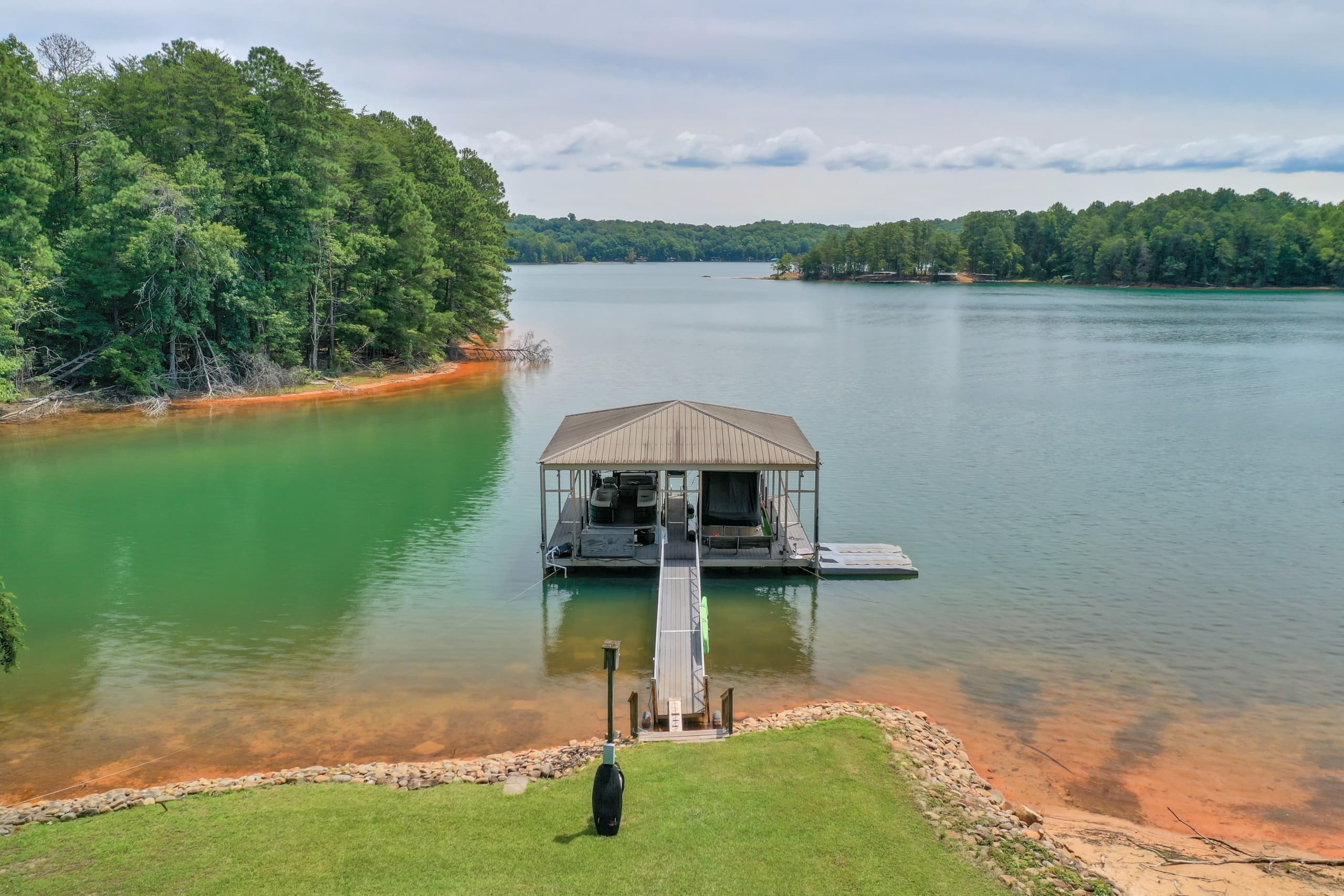
A party dock on Lake Lanier typically combines two or three covered boat slips on the lower level with a finished upper sundeck used for seating, dining, and shaded entertaining. Common features include a metal or shingled roof, an electrical service panel sized for lighting, fans, and sound, a covered staircase or interior ladder to the upper deck, railing systems that meet USACE height standards, and in many cases a slide, swim ladder, or platform for swim access. The upper deck distinguishes a true party dock from a double-slip covered dock and is the feature buyers in Habersham at Lanier, Marina Bay, and the Buford Dam corridor describe when they ask for a party dock. The footprint sits at the upper boundary of what the USACE Mobile District permits in residential coves, and the lower-level slip count usually matches a Class 2 or Class III permit category.
Differences between permitted features and buyer assumptions
What a seller markets as a party dock and what the USACE Mobile District has actually permitted are not always the same structure. Common gaps include an upper deck added without a permit modification, an unpermitted electrical expansion to support a larger sound system or refrigerator, a slide or platform installed outside the as-built diagram, and shoreline grading or vegetation clearing that exceeds the permit envelope. Each gap becomes the buyer's compliance obligation under the change-of-owner permit conditions and can block the change-of-owner approval at the USACE Lake Lanier Project Management Office in Buford until corrected. The buyer assumption that everything visible on the water is permitted is the single most expensive misread in this tier.
Why current dock configuration must be verified
Before relying on a party dock as part of the home's value, the current dock configuration must be checked against the active USACE permit, the as-built diagram, and the most recent shoreline inspection record. A Class 2 or Class III permit authorizes a specific slip count, a specific footprint, a specific roof height, and a specific electrical configuration, and any deviation can be written up during the routine USACE shoreline inspection cycle. Buyers ordering an independent dock inspection in parallel with the home inspection on Lake Lanier party-dock listings in Forsyth County, Hall County, Gwinnett County, and Dawson County are the ones who avoid surprises after closing, because the dock is effectively a second permitted asset attached to the same parcel.
Party Dock Due Diligence
Party dock due diligence on Lake Lanier runs across three checks that the home inspection alone will not cover: the USACE permit paperwork and authorized configuration, the electrical and structural condition of a large multi-deck structure, and the cove water depth and traffic profile under both full-pool and drawdown conditions. The premium attached to party-dock inventory makes any one of these checks coming back weak a material price event, and the USACE Mobile District does not allow a routine upgrade from a Class I or Class II dock into a party-dock footprint in most coves, which means a buyer who skips diligence is buying a fixed asset that cannot be re-permitted later.
Permit documents, dock dimensions, and USACE compliance
USACE permits and licenses are nontransferable. A new owner of an existing facility may apply through the Lake Lanier Operations Management Office, and approval is not automatic. Confirm the property-specific record and current requirements before closing.
Electrical safety, structural condition, and maintenance history
Party docks carry substantially more electrical load than a single-slip dock because of upper-deck lighting, fans, refrigerators, sound systems, and lift motors, and pre-2010 installations on Lake Lanier often need service-panel upgrades, GFCI replacement, and bonding work to clear current USACE and Hall County or Forsyth County electrical standards. The structural side is its own checklist: float condition under the heavier load, piling integrity, the upper-deck framing and railing system, roof condition, and the staircase or ladder hardware. Maintenance history matters at this tier because a neglected party dock can become a partial rebuild rather than a routine repair, and rebuild cost on a covered double-decker structure runs into a meaningful share of the home's lake-premium value.
Water depth, cove traffic, privacy, and usability
Lake Lanier operates between roughly 1,071 feet full pool and a USACE water-management operations that historically reaches the mid-1,060s by late fall, per USACE Mobile District lake-level records (as of April 2026). A party dock's value depends on year-round usable depth for the heavier vessels typically slipped there, and the same dock that floats a 26-foot tritoon plus a wakeboat in June can become awkward in October if the cove pocket is shallow. Cove traffic and privacy also matter inside this tier: a main-channel-adjacent party dock near Buford Dam, Browns Bridge, or Lanier Bridge offers depth and access but carries weekend boat-wake exposure, while a deeper protected-cove party dock trades some lake-access convenience for calmer entertaining conditions.
Buying or Selling a Home with a Party Dock
Buying or selling a Lake Lanier home with a party dock is a different transaction than a comparable interior home in Cumming or Gainesville, because the dock is a permitted, finite asset with its own valuation, its own USACE compliance status, and its own future-supply ceiling. The premium attached to the party-dock tier reflects scarcity rather than square footage, and pricing, marketing, and negotiation all have to treat the dock as a separate value component rather than a generic outdoor feature. The right approach pairs the home's interior comparables with a dock-tier comparable set and verifies the USACE permit posture before listing or offering.
Marketing outdoor living and lake lifestyle responsibly
Marketing a Lake Lanier party-dock home means describing what is permitted and observable rather than projecting future entertaining scenarios, and that distinction protects sellers as much as buyers. Listing copy that references a covered double-decker dock, an upper sundeck, the slip count, and shoreline access aligned with the USACE as-built diagram is a more durable representation than copy that implies capacity or features not authorized on the active permit. The Lake Lanier MLS audience reads dock descriptions closely because they understand the permit framework, and accuracy on dock class, slip count, and upper-deck authorization is more persuasive at this tier than promotional language.
Pricing the dock, water access, and entertainment value
Pricing a Lake Lanier home with a party dock means separating the home value from the dock value and then separating the dock value into permit class, structural condition, cove depth and main-channel proximity, upper-deck footprint, and electrical capacity. Party-dock homes near Buford Dam, Browns Bridge, and Lanier Bridge typically trade at a measurable premium over Class II double-slip inventory in the same school zone, and inside the party-dock tier itself the spread between a well-maintained covered double-decker and a structure with deferred maintenance or compliance issues is wide. The premium is real, but it is also bounded by what the next buyer can independently verify with the USACE Mobile District.
Request a dock-focused Lake Lanier consultation
Lake Lanier party-dock inventory is a finite, slow-turning slice of the waterfront market across Cumming, Gainesville, Buford, Flowery Branch, and Dawsonville, and most party-dock listings move on a buyer-shortlist basis rather than through casual MLS browsing. Buyers and sellers can request a dock-focused consultation through Ashley Smith with DreamSmith Realty, including USACE Mobile District permit-class verification, as-built diagram review, cove depth and main-channel proximity assessment, and electrical-compliance posture for each candidate. The consultation pairs Georgia MLS inventory with USACE Lake Lanier Project Management Office permit lookups so the dock paperwork is verified alongside the home itself, not after the contract is signed.
Frequently Asked Questions
- What is the difference between a party dock and a double-slip dock on Lake Lanier?
- A double-slip dock on Lake Lanier is authorized under a USACE Mobile District Class II permit and carries two covered or uncovered slips inside a wider footprint than a single-slip. A party dock layers an upper sundeck for entertaining on top of a multi-slip lower structure under a Class 2 or Class III permit and represents the upper boundary of USACE-permitted residential dock size on the reservoir. The party-dock label is a market shorthand for the covered double-decker configuration with an entertaining deck, while the double-slip label refers strictly to slip count. Party docks trade at a measurable premium over double-slip docks because the inventory is finite and the USACE rarely authorizes new ones today.
- How much more do Lake Lanier party-dock homes cost than single-slip or double-slip homes?
- Lake Lanier party-dock homes trade at a measurable premium over both Class I single-slip and Class II double-slip inventory in the same school zone, with the spread driven by permit scarcity rather than home square footage. The premium varies by cove depth, main-channel proximity to Buford Dam, Browns Bridge, or Lanier Bridge, structural condition of the upper deck and electrical service, and whether the upper-deck authorization is documented in the USACE as-built diagram. Buyers should request a permit-verified comparable set across Forsyth County, Hall County, and Gwinnett County rather than relying on raw MLS averages, because generic 'private dock' MLS language does not distinguish between Class I, Class II, and party-dock permits.
- Can a Lake Lanier single-slip or double-slip dock be upgraded to a party dock later?
- In most Lake Lanier coves, no. The USACE Mobile District capped new residential dock expansions and upper-tier authorizations under the Lake Sidney Lanier Shoreline Management Plan administered by the U.S. Army Corps of Engineers, and most shoreline segments are at or near their permitted dock density. A Class I single-slip permit and most Class II double-slip permits cannot be routinely upgraded into a party-dock footprint with an upper sundeck, because the USACE reviews neighboring permits, cove density, shoreline contour, and environmental impact before authorizing any expansion. Buyers who want party-dock capacity should shortlist homes that already carry a Class 2 or Class III permit rather than counting on an upgrade after closing.
- Does a Lake Lanier party-dock permit transfer with the home at sale?
- Yes, but transfer is not automatic and the compliance bar is higher than for single-slip or double-slip transfers. The USACE Mobile District requires a change-of-owner filing within a defined window after closing, and the Class 2 or Class III party-dock permit must be in full compliance at the time of transfer. Open compliance items, unpermitted upper-deck additions, unapproved electrical expansions, slip-count modifications, or vegetation-clearing violations can delay change-of-owner approval and become the new owner's repair obligation. Verifying permit posture, the as-built diagram, and the most recent shoreline inspection record with the USACE Lake Lanier Project Management Office in Buford before due-diligence expiration is the standard protection.
- Where on Lake Lanier are party-dock homes concentrated?
- Party-dock inventory on Lake Lanier concentrates in deeper main-channel coves near Buford Dam in Buford under Buford City Schools or Gwinnett County Schools, near Browns Bridge connecting Cumming and Gainesville under Forsyth County Schools and Hall County Schools, and along the Lanier Bridge corridor in Flowery Branch under Hall County Schools. Specific subdivisions with party-dock cohorts include Habersham at Lanier and Marina Bay, with additional inventory scattered through Gainesville along the Chattahoochee and Chestatee arms and lower-density party-dock pockets in Dawsonville under Dawson County Schools. The common thread is year-round usable depth, which is a prerequisite for the heavier vessels typically slipped at this tier.
- Who is the right buyer for a Lake Lanier party-dock home?
- Lake Lanier party-dock homes match households whose lake use genuinely centers on multi-boat ownership and frequent on-the-water entertaining, including weekend gatherings of family, friends, or business hosting on the upper sundeck. The class fits buyers running a wakeboat plus a tritoon plus personal watercraft, or hosts who use the upper deck as a primary outdoor living space several weekends a month during the boating season. Households running one primary boat and occasional guest entertaining are usually a better match for the Class II double-slip tier, where the slip count is sufficient and the premium attached to the upper deck is not paid for capacity that sits unused. Ashley Smith with DreamSmith Realty can sort buyers into the right dock tier before the search begins.
Related
- Lake Lanier Waterfront Homes by Dock TypeCompare single-slip, double-slip, party dock, and community-dock inventory side by side.
- Lake Lanier Private Dock HomesFull private-dock tier including single-slip, double-slip, and party-dock structures.
- Lake Lanier Single-Slip Dock HomesEntry tier of the private-dock class under USACE Class I permits.
- Lake Lanier Community GuideFull neighborhood, market, school, and shoreline overview for Lake Lanier.
- Lake Lanier ListingsCurrent Lake Lanier waterfront and lake-access homes from the Georgia MLS feed.