
Buyer Guide
Lake Lanier waterfront homes are sold by dock type, not by lake frontage, because the U.S. Army Corps of Engineers (USACE) Mobile District controls every shoreline structure on the reservoir under the Lake Sidney Lanier Shoreline Management Plan administered by the U.S. Army Corps of Engineers. The dock classification attached to a parcel — private single-slip, private double-slip, party dock, community dock shared through an HOA, marina-leased boat slip, or no-dock lake-access — determines what transfers at closing, what the owner can use the water for, and where the property sits in the Cumming, Buford, Gainesville, Flowery Branch, and Dawsonville price bands. Dock type is the single largest driver of value math on Lake Lanier.
Compare Lake Lanier Dock Types
Private single-slip, private double-slip, party dock, community dock, marina boat slip, and no-dock waterfront are not interchangeable categories. Buyers comparing them across Forsyth County, Hall County, Dawson County, Gwinnett County, and Lumpkin County shoreline are effectively shopping six different property products that happen to share the same lake. Current market conditions require a dated MLS comparison that identifies the area, property type, reporting period, and sample before a buyer relies on it.
Private docks, single-slip docks, double-slip docks, and party docks
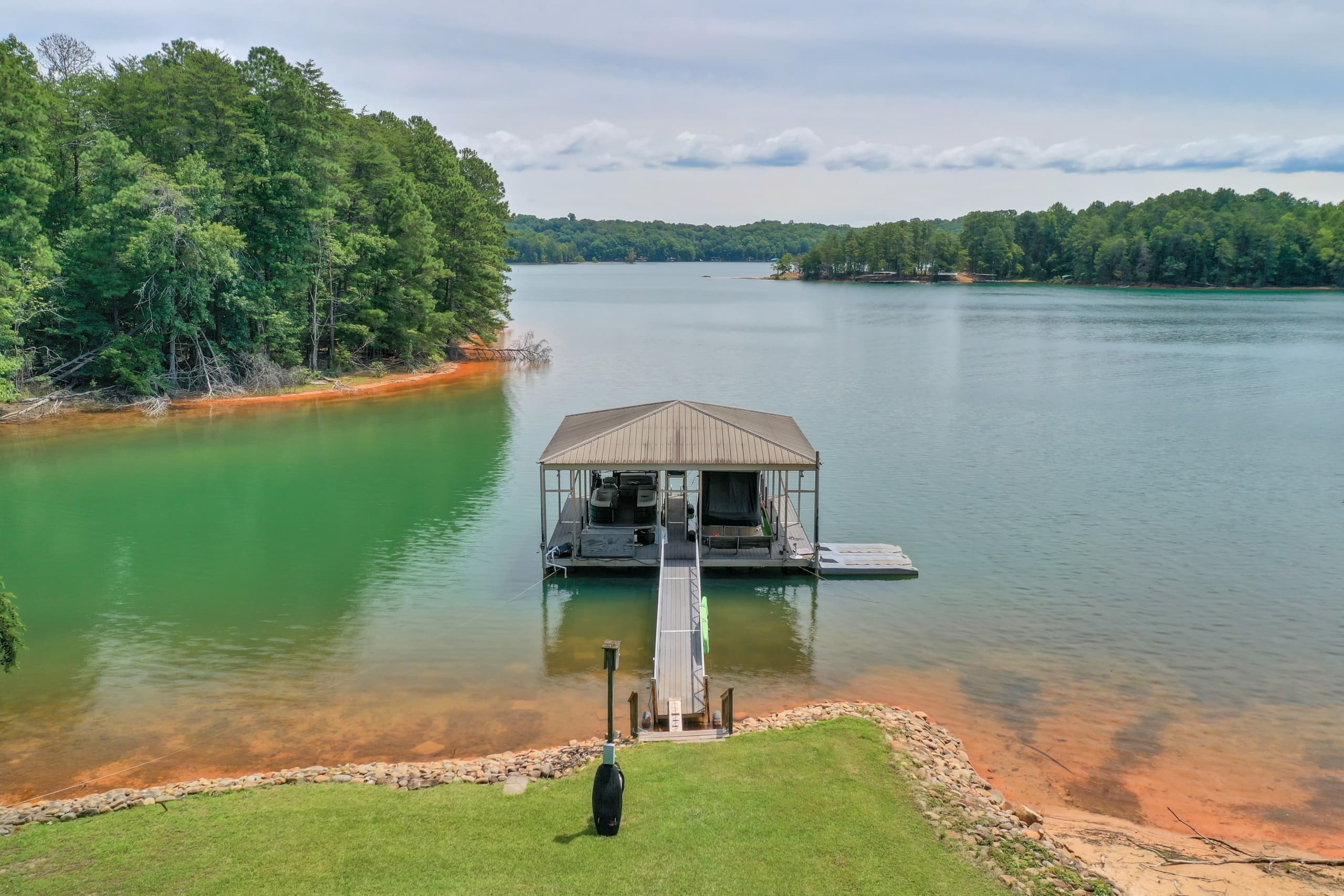
Private docks are USACE-permitted to a single residential parcel and convey with the deed. A Class I single-slip private dock authorizes one covered slip and is the most common permitted structure across Cumming and Flowery Branch coves. A Class II double-slip private dock authorizes two covered slips, which raises both the upfront price and the carrying cost of insurance and electrical compliance. A party dock is a larger legacy private structure — typically a covered slip plus an oversized sundeck — and most party docks on Lake Lanier are grandfathered under pre-2004 permits, meaning the current footprint cannot be enlarged and may not be replicable if destroyed. Across all three private classes, the permit, the cove, and the water depth transfer together at closing.
Community docks, marina slips, and lake-access alternatives
Community docks are USACE-permitted structures shared by a defined group of homes inside a subdivision or HOA, common in mid-1990s and 2000s developments around Flowery Branch and south Forsyth. Slip assignment, maintenance reserves, and lift rights are governed by the HOA, not by the homeowner, and the slip is rarely separately deeded. A marina boat slip is leased month-to-month or annually from a commercial operator such as Aqualand Marina, Holiday Marina, Sunrise Cove Marina, or Lanier Islands; the slip does not convey with any residential property and the lease can be non-renewed. A no-dock lake-access home typically sits on a USACE buffer-adjacent lot with walking access to the water but no permitted structure, and it trades at a significant discount to any of the dock-permitted tiers.
How dock type affects usability, value, and buyer demand
Dock type drives three things at once on Lake Lanier: how the water can actually be used, how the property is valued, and how deep the buyer pool runs at resale. A private double-slip with a year-round-usable cove near Buford Dam attracts serious boaters running two large craft and trades at a premium over a single-slip in the same school zone. A community dock with a guaranteed slip but no exclusive control fits buyers who want lake access without dock maintenance and trades closer to a non-waterfront price band. A no-dock lake-access home has the smallest premium and the narrowest buyer pool because the use case — paddleboards, kayaks, occasional swimming — does not justify a waterfront purchase for most luxury buyers.
What Buyers Should Verify
Verifying a Lake Lanier dock is a three-layer check on the permit, the physical structure and water, and the governing community or marina rules — and the failure mode is different at each layer. A permit can be technically valid but out of compliance; a structure can be physically sound but sit in a cove that dries out by October; a community slip can be assigned today but reassigned next season. Buyers who confirm only one of these layers before due-diligence expiration regularly discover the other two at closing or worse.
Dock permit status and USACE compliance
Every dock on Lake Lanier is registered with the USACE Mobile District Lake Lanier Project Management Office in Buford, and the permit carries a class designation (Class I, Class II, or legacy), an authorized slip count, a gangway length, an electrical configuration, and a vegetation-clearing footprint. Buyers should pull the permit number, the as-built diagram, and the most recent shoreline inspection record, then confirm the change-of-owner filing path before due-diligence expiration. Outstanding compliance issues — unpermitted modifications, expired electrical, vegetation violations — do not stop closing but transfer as the new owner's repair obligation, and the cost ranges from a few thousand dollars to a full structural rebuild.
Water depth, cove location, electrical condition, and shoreline access
Lake Lanier operates between approximately 1,071 feet full pool and a USACE water-management operations that historically reaches the mid-1,060s by late fall, per USACE Mobile District lake-level data as of 2025. A cove that floats a wakeboard boat in June can become marginal by October once the lake drops three to six feet. Buyers should confirm year-round water depth at the dock, the cove's exposure to main-channel wave action, the dock's electrical service rating, and the slope, path width, and surface of the walk from the home to the shoreline. Steep-slope lots in north Hall County and parts of Dawsonville often require a motorized tram, which itself requires a separate USACE path permit.
HOA, marina, and community-slip rules
When the dock is not private, the governing document is not the deed — it is the HOA covenants or the marina lease. For community-dock homes, buyers should request the current HOA budget, the dock-reserve account balance, the slip-assignment rules, and any pending special assessments for dock repair or rebuild. For marina-leased slips, buyers should request the current lease term, the renewal history, the waitlist length at marinas such as Aqualand or Holiday, and confirm in writing whether the slip is tied to the residence or to the leaseholder. Without these confirmations, the 'lake access' described in the listing is not yet verified at the level a private dock would be.
Choosing the Right Lake Lanier Property
Choosing the right Lake Lanier dock type is a fit question, not a ranking question, because each class serves a different boating intensity, maintenance tolerance, and budget profile. Buyers shortlisting waterfront across Cumming, Buford, Gainesville, Flowery Branch, and Dawsonville almost always reorder their list once they cost out the dock-specific carrying differences. The right starting point is to define the use case first — how often the boat actually runs, how many craft, what season — and then narrow the dock-type filter rather than the other way around.
Best fit for serious boaters
Serious boaters running two craft year-round generally fit private double-slip Class II properties in deep-water coves near Buford Dam, Browns Bridge, or the Chestatee arm, where main-channel proximity preserves usable depth through late-summer drawdown. Owners running a single large wake or pontoon boat with overnight cruising in season typically fit private single-slip Class I parcels in the same depth-protected coves. A legacy party dock fits a buyer who wants the larger sundeck footprint and accepts that the structure cannot be enlarged and may not be replicable if a future storm or fire destroys it under the current USACE Shoreline Management Plan.
Best fit for lower-maintenance lake access
Lower-maintenance buyers — owners who want lake views and weekend access without the carrying cost of a private structure — generally fit community-dock homes in HOA-managed subdivisions or marina-leased slip arrangements at Aqualand, Holiday, Sunrise Cove, or Lanier Islands. Community-dock homes trade closer to a non-waterfront price band, transfer with a defined slip assignment governed by HOA rules, and share repair costs across the membership. No-dock lake-access homes fit paddle-sport users and seasonal swimmers, trade at the lowest waterfront premium, and have the narrowest resale buyer pool because the use case does not extend to a powered boat at the property.
Work with Ashley Smith to compare dock options
USACE permits and licenses are nontransferable. A new owner of an existing facility may apply through the Lake Lanier Operations Management Office, and approval is not automatic. Confirm the property-specific record and current requirements before closing.
Frequently Asked Questions
- What dock types exist on Lake Lanier and how do they differ in value?
- Lake Lanier dock types fall into six classes: private single-slip (Class I), private double-slip (Class II), legacy party dock, community dock shared through an HOA, marina-leased boat slip, and no-dock lake-access. Community docks transfer through HOA rules, marina slips transfer through commercial leases, and no-dock parcels trade closest to non-waterfront pricing. Current market conditions require a dated MLS comparison that identifies the area, property type, reporting period, and sample before a buyer relies on it.
- Does a private dock permit always transfer with a Lake Lanier home?
- Yes for Class I and Class II private dock permits, but the transfer is not automatic. The USACE Mobile District requires a change-of-owner filing signed by both parties within a defined window after closing, and the permit must be in compliance at the time of transfer. Outstanding compliance issues, unpermitted modifications, or expired electrical work can delay the change-of-owner approval and become the buyer's repair obligation. Legacy party docks transfer the same way but cannot be enlarged or replicated under the current Lake Sidney Lanier Shoreline Management Plan administered by the U.S. Army Corps of Engineers.
- How do community docks transfer when a Lake Lanier home is sold?
- Community docks are USACE-permitted to the HOA or subdivision rather than to a single homeowner, so the slip transfers through the HOA covenants and not through the USACE change-of-owner process. Buyers should request the current HOA budget, the dock-reserve account balance, the slip-assignment rules, the maintenance history, and any pending special assessments for dock repair or rebuild. The slip assignment is rarely separately deeded and can be governed by rotation, seniority, or lottery rules depending on the subdivision.
- What should I verify about a marina-leased slip on Lake Lanier?
- Marina slips at Aqualand Marina, Holiday Marina, Sunrise Cove Marina, and Lanier Islands are leased month-to-month or annually from the commercial operator and do not convey with any residential property. Buyers should confirm the current lease term, the renewal history, the waitlist length, the lease rate, and whether the slip is assigned to the residence or to the leaseholder. The lease can be non-renewed at the marina's discretion, which means a marina-leased slip is functionally a separate transaction from the home purchase.
- Can a no-dock Lake Lanier home add a private dock later?
- USACE permits and licenses are nontransferable. A new owner of an existing facility may apply through the Lake Lanier Operations Management Office, and approval is not automatic. Confirm the property-specific record and current requirements before closing.
- Which dock type holds value best on Lake Lanier at resale?
- Private Class I single-slip docks in deep-water coves with year-round usable depth typically hold value best on Lake Lanier because they match the broadest buyer demand and carry the lowest carrying cost inside the private-dock tier. Class II double-slip docks command a higher absolute price but a narrower buyer pool. Legacy party docks attract a specific buyer who values the larger footprint. Community-dock and marina-leased homes track closer to non-waterfront comparables, and no-dock lake-access homes carry the narrowest resale pool of the waterfront tiers.
Related
- Lake Lanier Private Dock HomesDeeded USACE-permitted private dock parcels across all five shoreline counties.
- Lake Lanier Single-Slip Dock HomesClass I single-slip private dock inventory and what drives value in this tier.
- Lake Lanier Dock Permits GuideUSACE Mobile District permit classes, transfer rules, and compliance basics.
- Lake Lanier Community GuideFull neighborhood, market, school, and shoreline overview for Lake Lanier.
- Lake Lanier ListingsActive waterfront and lake-access inventory across Forsyth, Hall, Dawson, Gwinnett, and Lumpkin counties.