
Journal
Clearing trees on Lake Lanier shoreline is restricted, not a homeowner decision. Lake Lanier is a U.S. Army Corps of Engineers reservoir managed by the USACE Mobile District, and most of the wooded land between a private parcel and the water sits on federally owned shoreline inside a vegetated buffer protected under the Lake Sidney Lanier Shoreline Management Plan administered by the U.S. Army Corps of Engineers and Title 36 of the Code of Federal Regulations. A homeowner who cuts, limbs, sprays, or removes vegetation in that buffer without an authorized Vegetation Modification Permit issued through the Lake Lanier Project Management Office in Buford is exposed to federal enforcement, fines, restoration costs, and permit consequences.
The Short Answer Buyers Need to Know
The short answer is that most of the trees a Lake Lanier buyer can see from a back deck are on federal land, not private land, and the right to cut them is not implied by the deed. Where private ownership ends, USACE shoreline jurisdiction begins, and the boundary between the two is defined by the Corps line, not by a tree line or a sight line to the water.
Why Lake Lanier shoreline trees may be on USACE-managed land
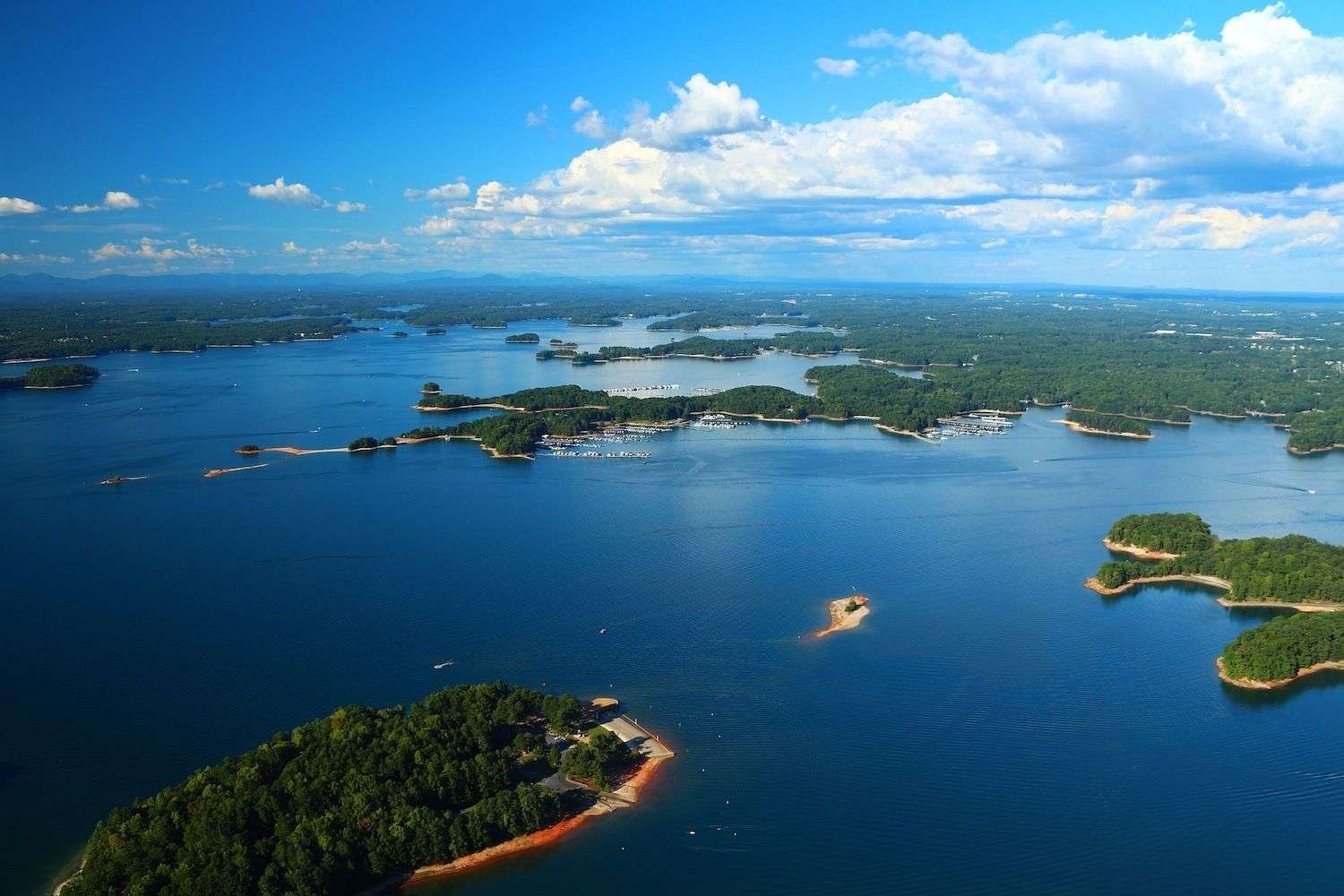
Lake Lanier was created when the U.S. Army Corps of Engineers built Buford Dam on the Chattahoochee River, and the federal government acquired a wide perimeter of land around the projected reservoir before the lake filled in 1957. That perimeter, today administered by the USACE Mobile District under the Lake Sidney Lanier Shoreline Management Plan administered by the U.S. Army Corps of Engineers, sits between most private lots in Hall County, Forsyth County, Dawson County, Gwinnett County, and Lumpkin County and the water itself. The trees, undergrowth, and shoreline vegetation in that perimeter are federal property and are governed by federal rules, not by the homeowner's deed. The practical effect is that a buyer touring a Lake Lanier waterfront home in Cumming, Buford, Gainesville, Flowery Branch, or Dawsonville is usually looking through a vegetated USACE buffer to reach the water. The wooded slope in the photograph is rarely the homeowner's slope. The Corps line, which is the surveyed boundary between private fee ownership and federal shoreline, can sit dozens of feet uphill from the visible waterline depending on contour, cove geometry, and the original land acquisition during the Buford Dam project. Without a current survey identifying that line, a buyer cannot tell where private rights end.
Why improving a view is not the same as owning the shoreline
Improving a view by cutting trees, limbing for sight lines, or removing understory in the USACE buffer is a regulated activity on Lake Lanier, not an aesthetic choice the homeowner controls. The Mobile District issues Vegetation Modification Permits in limited circumstances tied to a permitted dock pathway, a defined access corridor, or a specific safety or hazard tree determination, and the permit defines exactly what can be cut, what method is allowed, and what restoration is required. A permit does not convert federal land into private land, and it does not authorize the homeowner to keep clearing on the same parcel after the approved scope is completed. Listings, neighbors, and informal community lore on the lake sometimes treat a cleared shoreline as evidence that clearing is allowed. It is not. A cleared buffer in a neighboring cove may reflect an authorized modification under a specific permit, a legacy condition predating current rules, a structure built before the Lake Sidney Lanier Shoreline Management Plan administered by the U.S. Army Corps of Engineers, or an unresolved enforcement matter. The visible condition of one parcel is not a permission slip for another, and the USACE record, not the line of sight, controls what can be cut on Lake Lanier.
Why buyers should verify before assuming any clearing rights
Before assuming any clearing rights, a buyer should confirm three documents through due diligence: a current parcel survey showing the Corps line, the USACE shoreline classification for the parcel, and any existing dock permit or Vegetation Modification Permit on file at the Lake Lanier Project Management Office in Buford. Shoreline classifications under the Lake Sidney Lanier Shoreline Management Plan administered by the U.S. Army Corps of Engineers include Limited Development, Public Recreation, Protected Shoreline, and Prohibited Access, and the classification determines whether any vegetation modification is even reviewable for that parcel. The USACE Mobile District is the only authoritative source for what can be cut on a Lake Lanier parcel. County records, MLS remarks, prior listing photographs, and the seller's recollection of past clearing are not substitutes for the federal file. A buyer who relies on a listing's view description or a verbal assurance from a neighbor about what was cut last season has no defense against an enforcement notice issued later. The verification step is documentary, and it happens before binding the contract, not after closing.
Common Tree-Clearing Mistakes
The recurring tree-clearing mistakes on Lake Lanier follow a pattern: buyers and owners treat the wooded shoreline as private land, act on assumption rather than documentation, and discover the federal jurisdiction only after the cutting is done. Each mistake has measurable downstream cost, and most surface during ownership rather than during the listing window.
Buying a wooded lot assuming it can become a big-water view property
Some Lake Lanier buyers tour a wooded waterfront lot and price it against an open big-water view comparable, planning to clear the trees after closing. That plan is structurally exposed on a federal reservoir. The wooded slope between the building envelope and the water is almost always inside the USACE buffer, the Lake Sidney Lanier Shoreline Management Plan administered by the U.S. Army Corps of Engineers controls whether any vegetation can be removed, and the Mobile District is not in the business of converting Protected Shoreline classifications into open-view parcels on request. The market reflects this reality. A buyer who pays the wooded-lot price is buying a wooded lot; a buyer who pays the big-water-view price should be buying a parcel where the existing view is supported by USACE documentation, not by post-closing plans. Current market conditions require a dated MLS comparison that identifies the area, property type, reporting period, and sample before a buyer relies on it.
Cutting vegetation before understanding USACE rules
Cutting first and asking later is the most common shoreline mistake on Lake Lanier and the most expensive to undo. Removing trees, limbing canopy, spraying herbicide, mowing native understory, or pulling shoreline vegetation inside the USACE buffer without a Vegetation Modification Permit can trigger an enforcement file under Title 36 of the Code of Federal Regulations and the Lake Sidney Lanier Shoreline Management Plan administered by the U.S. Army Corps of Engineers. The file follows the parcel, not the person who did the cutting, and surfaces at the next change-of-owner review. The federal restoration standard runs in the opposite direction from the homeowner's original intent. Where an authorized clearing might permit selective removal under a defined plan, an enforcement-driven restoration typically requires the owner to replant native species in a specified density, monitor establishment, and submit to USACE re-inspection before the file is closed. The replanting is at the owner's expense, the timeline is set by the Mobile District, and the underlying dock permit, if there is one, can be suspended while the restoration is open. The lesson is not that vegetation can never be modified on Lake Lanier; it is that modification belongs upstream of the chainsaw, not downstream of it.
Ignoring possible fines, restoration costs, and permit consequences
Unauthorized shoreline clearing on Lake Lanier creates three separate exposures that compound on the same parcel. The first is a civil monetary penalty assessed by the USACE Mobile District under federal regulations, scaled to the area cleared, the species removed, and whether the clearing affected a Protected Shoreline classification. The second is a restoration order requiring replanting, erosion control, and ongoing monitoring at the owner's cost, with the work performed to a USACE-approved plan rather than the owner's landscaping preferences. The third is a permit consequence, which can include suspension or revocation of an existing dock permit, denial of an after-the-fact Vegetation Modification Permit, or a hold on the next change-of-owner filing. The permit consequence is the one most often overlooked at the closing table. A Lake Lanier dock permit is a privilege tied to compliance with the Shoreline Management Plan; an open enforcement file on the parcel is grounds for the Mobile District to decline transfer of that permit. A buyer who inherits a parcel with an open vegetation enforcement matter can therefore lose the dock permit at the same time as inheriting the restoration obligation, and neither outcome is reflected in the county tax record or the MLS listing.
What to Do Before Buying or Selling
Before buying or selling a Lake Lanier home where trees, view, or shoreline vegetation are part of the value story, the work is documentary and runs in parallel with the standard home inspection. The questions to answer are which land is private, which is federal, what the current shoreline classification allows, and whether any vegetation modification has been authorized in the past.
Review survey, Corps line, buffer, and shoreline documents
The first documentary review is the parcel survey. A current survey identifies the deed boundary, the Corps line, the building setbacks, easements, and the relationship between the building envelope and the federal shoreline. If the survey on file is older than the most recent USACE shoreline reclassification for the cove, a new survey is the safer document for a buyer's decision. The survey is what makes the rest of the file readable, because the rest of the file refers to lines that only the survey shows on the ground. The second documentary review is the USACE shoreline file. The Lake Lanier Project Management Office in Buford holds the shoreline classification for each parcel, any existing dock permit, the as-built diagram, prior Vegetation Modification Permits, and any open enforcement correspondence. A buyer's agent should request copies through the listing agent and confirm directly with the Mobile District during the due-diligence period. The third document set is the county record, including Hall County, Forsyth County, Dawson County, Gwinnett County, or Lumpkin County tax records, building permits, and any tree-protection or land-disturbance ordinances that overlay the USACE buffer on the private portion of the parcel.
Consult USACE and qualified professionals before changes
Independent confirmation from the USACE Mobile District is the only authoritative source for what can be cut on a Lake Lanier parcel. The Lake Lanier Project Management Office in Buford can confirm the shoreline classification, the existing permit status, any open enforcement matters, and the eligibility window for a Vegetation Modification Permit on that specific parcel. That confirmation is what a buyer or owner takes to the next professional in the sequence rather than the listing's view description or a neighbor's recollection. USACE permits and licenses are nontransferable. A new owner of an existing facility may apply through the Lake Lanier Operations Management Office, and approval is not automatic. Confirm the property-specific record and current requirements before closing.
Ask Ashley Smith how shoreline rules affect buyer strategy
Shoreline rules surface in the buying decision as questions the standard home inspection does not answer. Where the wooded slope on the listing's hero photograph stops being private property, whether the existing view is supported by a Vegetation Modification Permit on file, whether the cove's shoreline classification under the Lake Sidney Lanier Shoreline Management Plan administered by the U.S. Army Corps of Engineers would permit any further clearing, and whether the dock permit is conditioned on a maintained vegetation buffer are documentary questions that belong inside the inspection and financing contingencies, not after them. Ashley Smith, real estate agent with The Dream Smith Team at Compass, advises Lake Lanier buyers to treat tree and view questions as a separate diligence track tied to the USACE record rather than a landscaping conversation tied to the seller's preferences. Final shoreline determinations come from the USACE Mobile District, surveys from a licensed Georgia land surveyor, tree assessments from a certified arborist, and contract language from a Georgia closing attorney. The agent's role is to align those professionals with the due-diligence period so the buyer's offer reflects the parcel that actually exists under federal rules, not the parcel implied by a wide-angle drone photograph.
Frequently Asked Questions
- Can I cut trees on the shoreline of my Lake Lanier home?
- Usually not without an authorized Vegetation Modification Permit from the USACE Mobile District. Most of the wooded shoreline between a Lake Lanier home and the water is federally owned land inside a vegetated buffer regulated under the Lake Sidney Lanier Shoreline Management Plan administered by the U.S. Army Corps of Engineers and Title 36 of the Code of Federal Regulations. The deed to the upland parcel does not convey clearing rights on the federal buffer, and the only authoritative source for what can be cut is the Lake Lanier Project Management Office in Buford.
- Where does my private property end and the USACE land begin on Lake Lanier?
- The boundary is the Corps line, a surveyed contour established when the federal government acquired land around the reservoir for the Buford Dam project before Lake Lanier filled in 1957. The Corps line is identified on a current parcel survey and rarely matches the visible waterline. Depending on contour and cove geometry in Hall County, Forsyth County, Dawson County, Gwinnett County, or Lumpkin County, the line can sit dozens of feet uphill from the water, which means trees a homeowner can see from the deck are often on federal land.
- What is a USACE Vegetation Modification Permit and when is it required?
- A Vegetation Modification Permit is a written authorization from the USACE Mobile District that allows specific, defined clearing on the federal shoreline buffer of Lake Lanier. It is required before any cutting, limbing, herbicide application, or vegetation removal inside the buffer. The permit defines what species can be cut, what method is allowed, what restoration is required, and the scope ends when the approved work ends. A neighbor's prior clearing does not extend to an adjacent parcel without that parcel's own permit.
- What happens if I cut trees on Lake Lanier without a permit?
- Unauthorized clearing inside the USACE buffer can trigger a federal enforcement file under the Lake Sidney Lanier Shoreline Management Plan administered by the U.S. Army Corps of Engineers and Title 36 of the Code of Federal Regulations. Typical outcomes include a civil monetary penalty scaled to the area cleared, a restoration order requiring replanting with native species at the owner's cost, ongoing monitoring by USACE staff, and a permit consequence that can include suspension of an existing dock permit or denial of a future Vegetation Modification Permit. The file follows the parcel and surfaces at the next change-of-owner review.
- Can I buy a wooded Lake Lanier lot and clear it for a big-water view after closing?
- Not reliably. The wooded slope between a Lake Lanier lot and the water is almost always inside the USACE buffer, and the Lake Sidney Lanier Shoreline Management Plan administered by the U.S. Army Corps of Engineers controls whether any vegetation can be removed under the parcel's shoreline classification. Current market conditions require a dated MLS comparison that identifies the area, property type, reporting period, and sample before a buyer relies on it.
- Who should I talk to before cutting any trees on a Lake Lanier waterfront parcel?
- Start with the Lake Lanier Project Management Office in Buford to confirm the shoreline classification, any existing permits, and any open enforcement matters on the parcel. Engage a licensed Georgia land surveyor to identify the Corps line, a certified arborist for hazard tree assessment, and a Georgia closing attorney if the cutting is contemplated as part of a contract negotiation. A real estate agent who works Lake Lanier regularly can sequence those professionals against the due-diligence period before any clearing decisions are bound to a purchase contract.
Related
- Understanding the Corps Line on Lake LanierWhere federal shoreline jurisdiction ends and private fee ownership begins.
- Lake Lanier Dock Permits GuideHow USACE Mobile District residential dock permits work on Lake Lanier.
- Lake Lanier Big-Water View HomesParcels with established open views supported by USACE documentation.
- Lake Lanier Survey and Title GuideSurveys, the Corps line, and what closes the documentary loop at the table.
- Buying a Lake Lanier Home With an Unpermitted DockFederal compliance risk on dock structures with no USACE permit on file.
- Lake Lanier Community GuideFull neighborhood, market, school, and shoreline overview for Lake Lanier.