
Journal
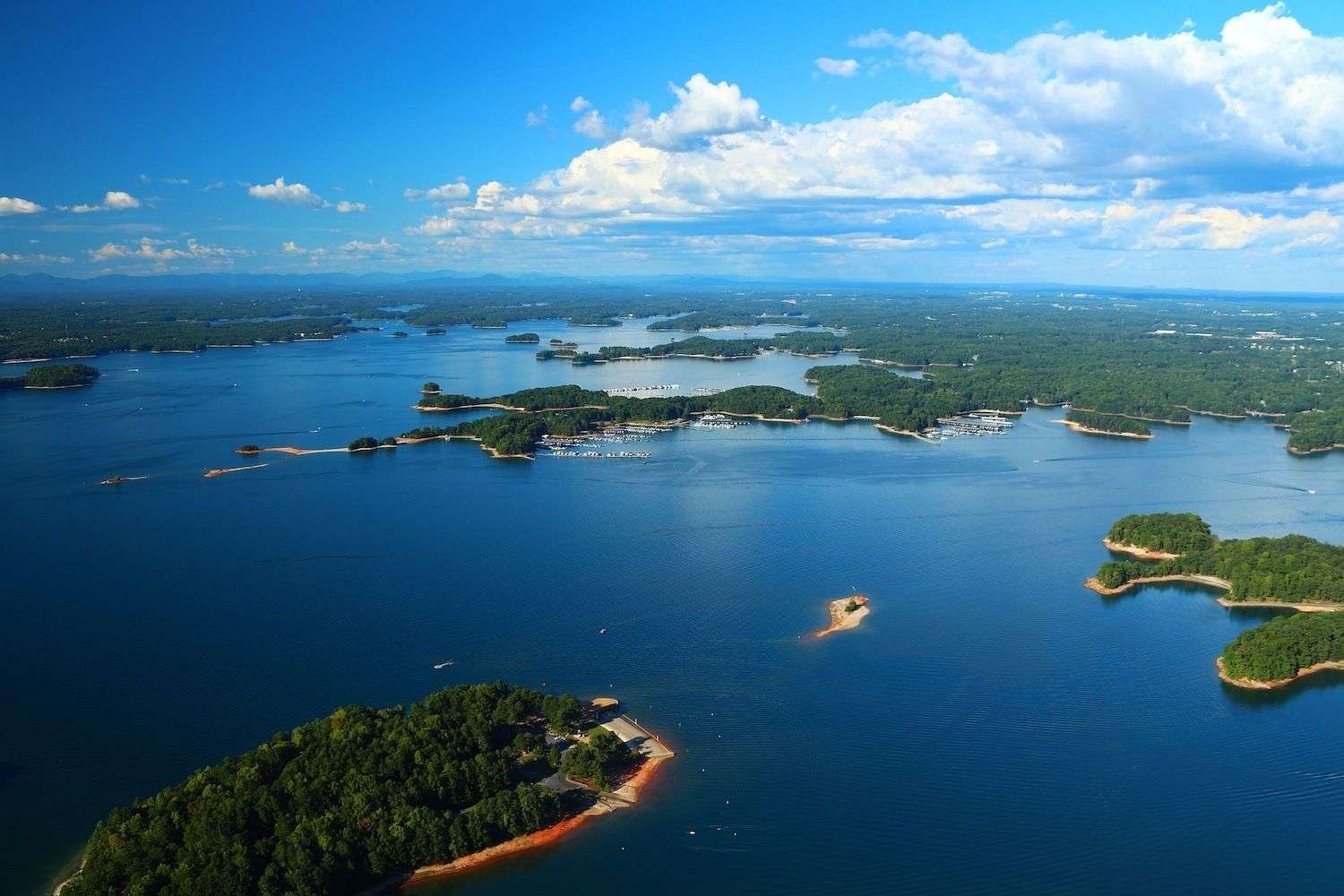
The Corps line on Lake Lanier is the boundary that separates privately owned land from the federally owned shoreline strip managed by the U.S. Army Corps of Engineers, Mobile District. Almost every waterfront parcel in Hall County, Forsyth County, Dawson County, Gwinnett County, and the city limits of Cumming, Buford, Gainesville, Flowery Branch, and Dawsonville stops short of the water itself, with the last several yards held by the federal government as project land. Understanding where the Corps line falls on a specific parcel determines what a buyer may clear, build, or access along the shoreline, and it is one of the most misunderstood facts in Lake Lanier real estate.
What Is the Corps Line on Lake Lanier?
The Corps line is the surveyed boundary between privately deeded land and the federal project land that wraps Lake Lanier. The U.S. Army Corps of Engineers, Mobile District, acquired the project land in the 1950s when Buford Dam was built, and that strip has remained federally owned ever since under the Lake Sidney Lanier Shoreline Management Plan administered by the U.S. Army Corps of Engineers and the Flood Control Act authorities that created the reservoir. The exact location of the Corps line on any given parcel is fixed by federal survey records, not by where grass meets gravel, where a homeowner's lawn appears to end, or where the seller assumes the property goes.
Private property vs. USACE-managed shoreline
A typical Lake Lanier waterfront deed conveys land down to the Corps line, not down to the water. Below that line, the federally managed strip of project land is held by the United States Army Corps of Engineers, Mobile District, and is governed by the USACE Lake Sidney Lanier Shoreline Management Plan. The width of the federal strip varies from a few feet on steep, rocky shorelines to a much wider band in flatter coves, depending on the original 1956 federal acquisition contour around full pool elevation 1071.
Why the land near the water may not be privately owned
When Congress authorized Buford Dam and Lake Sidney Lanier under the Flood Control Act, the federal government purchased a buffer of land above the planned full-pool elevation rather than only the land that would be inundated. That buffer is what creates the Corps line. A homeowner in Cumming, Buford, Gainesville, or Flowery Branch whose lawn appears to slope all the way to the water is typically maintaining federal land under a USACE shoreline use permit, not their own deeded property.
How the Corps line affects access, clearing, and improvements
The Corps line is the boundary that decides what a homeowner can legally do without USACE authorization. Anything on the private side of the line is subject to local code in Hall County, Forsyth County, Dawson County, or Gwinnett County. Anything on the federal side is governed by the Lake Sidney Lanier Shoreline Management Plan and requires a USACE Mobile District shoreline use permit for vegetation clearing, paths, steps, retaining walls, dock gangways, electrical service, or any other improvement that touches project land.
Buyer Questions About Shoreline Control
Most buyer questions at Lake Lanier eventually circle back to the Corps line, because the line is what governs the view, the path to the water, and any future improvement plan. A clear answer requires looking at the permit record, the federal survey, and the existing USACE-approved vegetation modification on the parcel before assuming what a new owner can change.
Can I clear trees for a better view?
Vegetation clearing on the federal side of the Corps line is regulated under the Lake Sidney Lanier Shoreline Management Plan, and unauthorized cutting is a violation that can carry civil penalties, mitigation requirements, and a permit hold on the parcel. Limited view corridors are sometimes allowed under a USACE Mobile District vegetation modification permit, but the corridor width, the species that may be removed, the diameter limits, and the replanting obligations are defined by federal shoreline policy rather than by buyer preference or by general Hall County, Forsyth County, or Dawson County tree rules. A new owner inherits any existing unauthorized clearing on a Lake Lanier parcel as a compliance issue, which is why the question should be answered with a permit search through the USACE Lake Sidney Lanier Project Management Office in Buford before closing. Buyers in Cumming, Buford, Gainesville, Flowery Branch, and Dawsonville often discover that a long-settled view corridor is actually undocumented clearing the federal record does not authorize.
Can I add a path, tram, dock, or shoreline improvement?
Any improvement that crosses the Corps line, including a path, steps, retaining wall, motorized tram, gangway, electrical conduit, or new dock structure, requires a USACE Mobile District shoreline use permit. The Lake Sidney Lanier Shoreline Management Plan administered by the U.S. Army Corps of Engineers capped most residential dock density, meaning a parcel without an existing permitted dock is generally not eligible for a new one in most coves. Paths and other modifications follow narrower rules but still require pre-approval. Buyers planning improvements should confirm what the parcel already carries on its permit, and what USACE will and will not authorize, before writing a contract that depends on a future change.
What should be confirmed before buying?
Before closing on a Lake Lanier waterfront home, buyers should request the existing USACE shoreline use permit, the as-built dock diagram, the most recent shoreline inspection record, and a copy of the federal survey showing the Corps line location on the parcel. A licensed Georgia land surveyor familiar with USACE project land, a real estate attorney, and the USACE Lake Sidney Lanier Project Management Office in Buford are the three sources that can confirm where the line falls and what the parcel is permitted to do at the shoreline. Verbal assurances from a seller or listing description language do not substitute for those records.
Seller Questions About Corps Line Issues
Sellers along Lake Lanier face the Corps line from a different angle, because what looks like a long-settled yard arrangement can become a contract problem when a buyer's inspector or attorney asks for the permit history. Anticipating the questions before listing protects the contract timeline and the price.
How shoreline misunderstandings affect buyer confidence
A listing that markets a waterfront home as having a private lawn down to the water can lose buyer confidence the moment a survey or USACE permit search shows the Corps line cutting through the middle of that lawn. Buyers and their attorneys read the discrepancy as either a misunderstanding or a misrepresentation, and either reading slows the contract. Clear, documented language about where the Corps line falls and what the seller is and is not conveying allows buyers to evaluate the property on accurate terms.
Documents to gather before listing
Sellers should assemble the existing USACE shoreline use permit, the as-built dock diagram if a dock is present, any vegetation modification authorization, the most recent USACE shoreline inspection record, and the federal survey or plat showing the Corps line location on the parcel. Records held by the previous owner, the listing brokerage from the prior sale, or the USACE Lake Sidney Lanier Project Management Office in Buford are typical starting points. A complete document set at list date avoids a mid-contract scramble when the buyer's due diligence reaches the shoreline.
When to involve surveyors, USACE, attorneys, or other licensed professionals
If the Corps line location is unclear, if a dock or path appears to encroach beyond the permitted footprint, or if vegetation has been cleared without a documented USACE authorization, the seller is past the point at which a Realtor alone can resolve the question. A licensed Georgia land surveyor, the USACE Mobile District shoreline office in Buford, and a Georgia real estate attorney are the licensed professionals positioned to confirm the legal facts before the issue reaches the buyer. Bringing those parties in before listing converts an unknown into a documented condition that the contract can address.
Frequently Asked Questions
- What is the Corps line on Lake Lanier?
- The Corps line is the surveyed boundary between privately deeded land and the federal project land managed by the U.S. Army Corps of Engineers, Mobile District, around Lake Lanier. It was set when the federal government acquired land above the planned full-pool elevation in the 1950s for Buford Dam and Lake Sidney Lanier. The line varies in width from a narrow strip on steep shorelines to a wider band in flatter coves and is fixed by federal survey records rather than by the visible edge of a homeowner's yard.
- Who owns the shoreline on Lake Lanier?
- The shoreline itself is federally owned. The United States Army Corps of Engineers, Mobile District, holds the strip of project land between privately deeded parcels and the water under the authorities that created the reservoir. Homeowners may use that strip only under a USACE shoreline use permit governed by the Lake Sidney Lanier Shoreline Management Plan, which is why the lawn between a Cumming, Buford, Gainesville, Flowery Branch, or Dawsonville home and the water is rarely private property.
- Can I cut trees between my Lake Lanier house and the water?
- Only with a USACE Mobile District vegetation modification permit, and only within the corridor, species, and replanting rules defined under the Lake Sidney Lanier Shoreline Management Plan. Unauthorized cutting on federal project land can carry civil penalties, mitigation requirements, and a hold on future permits for the parcel. Buyers planning view work should confirm the existing permit, the approved corridor, and any prior unauthorized clearing before closing rather than after.
- How do I find where the Corps line is on a specific Lake Lanier property?
- Request the federal survey or plat showing the Corps line, the existing USACE shoreline use permit, and the as-built dock diagram if a dock is present. A licensed Georgia land surveyor familiar with USACE project land and the USACE Lake Sidney Lanier Project Management Office in Buford can confirm the location on the ground. The line is fixed by federal records and does not move with landscaping changes, retaining walls, or eroded soil.
- Can I add a new dock if my Lake Lanier home does not already have one?
- USACE permits and licenses are nontransferable. A new owner of an existing facility may apply through the Lake Lanier Operations Management Office, and approval is not automatic. Confirm the property-specific record and current requirements before closing.
- Do Corps line issues affect property value on Lake Lanier?
- Yes. Parcels with a clear federal survey, a current and compliant USACE shoreline use permit, and documented vegetation and dock authorizations typically support stronger buyer confidence and cleaner contracts than parcels where the Corps line, permit status, or compliance history is unclear. Unresolved encroachments, unauthorized clearing, or missing permit records can slow due diligence, narrow the buyer pool, and surface as price negotiation points before closing.
Related
- Lake Lanier Water Levels and the 1071 Full-Pool LineHow USACE-managed reservoir levels and the 1071 full-pool reference shape shoreline use and dock depth.
- Lake Lanier Homes with DockPermitted-dock inventory across private, community, and shared-slip configurations.
- Lake Lanier Private Dock HomesSingle-parcel USACE-permitted dock homes across the five-county shoreline.
- Lake Lanier Non-Dockable Waterfront HomesWaterfront parcels that cannot host a new permitted dock under current USACE rules.
- Lake Lanier Community GuideFull neighborhood, market, school, and shoreline overview for Lake Lanier.
- Buford Waterfront HomesSouth-lake shoreline adjacent to the USACE Lake Sidney Lanier Project Management Office and Buford Dam.