
Compare
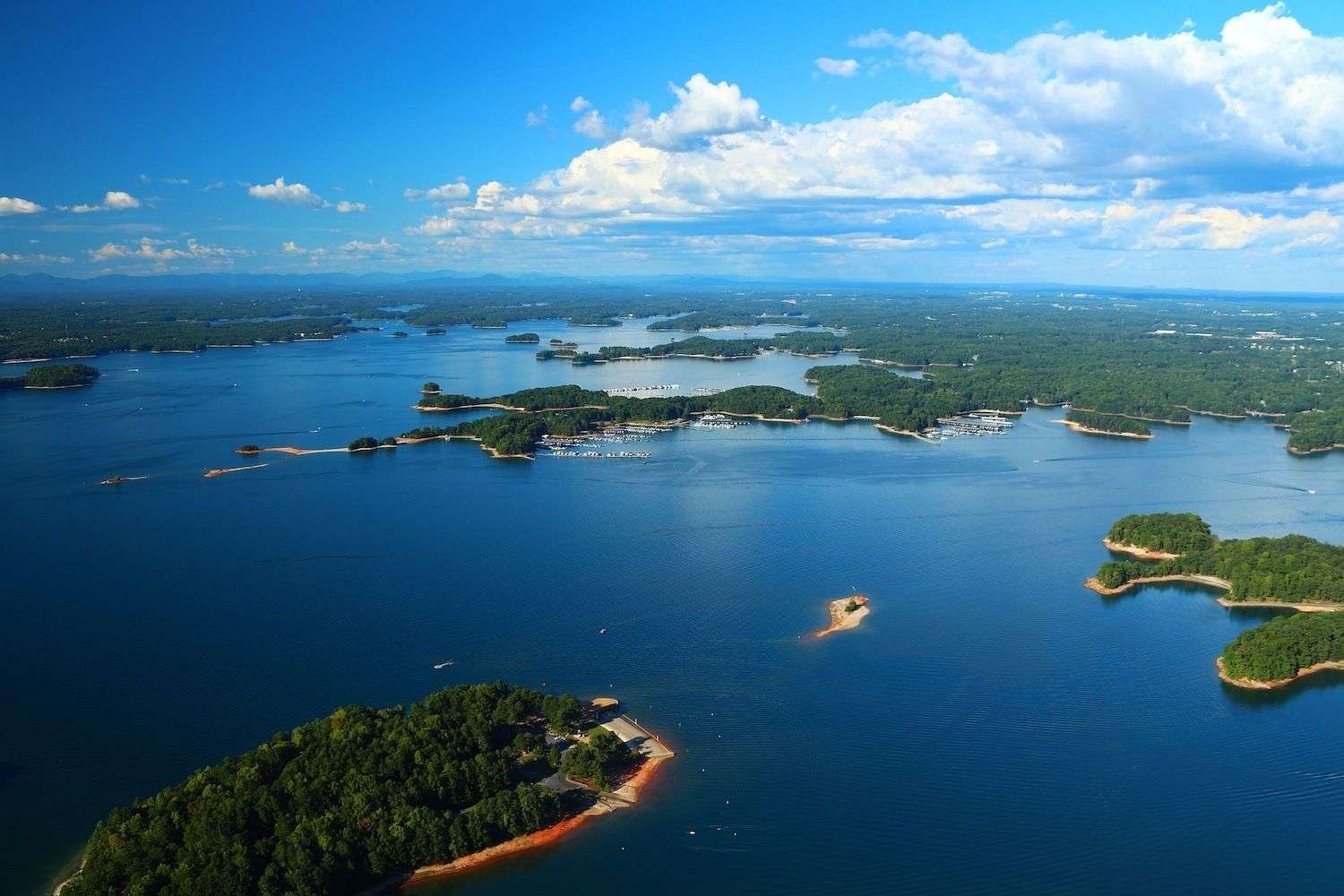
Lake Lanier and Lake Hartwell are both U.S. Army Corps of Engineers reservoirs in Georgia, but they sit in different markets, different USACE districts, and different price tiers. Lake Lanier, managed by the USACE Mobile District and centered on Buford Dam, is roughly a 45-minute drive north of Atlanta and serves the metro as a primary-residence and weekend lake. Lake Hartwell, managed by the USACE Savannah District on the Georgia-South Carolina border, sits about two hours east of Atlanta along Interstate 85 and trades convenience for a quieter pace and broadly lower waterfront pricing. Choosing between them is mostly a tradeoff among drive time, budget, inventory depth, and the lake culture buyers actually want.
Quick Answer: Lake Lanier or Lake Hartwell?
The short answer is that Lake Lanier favors buyers who need Atlanta access, a deeper luxury inventory, and a broader services bench, while Lake Hartwell favors buyers who want a lower price point, a quieter shoreline, and a slower lake culture. Both lakes are federally managed reservoirs with private-dock permitting, but they sit in different USACE districts, different counties, and different drive-time bands from the metro.
Choose Lake Lanier for Atlanta access, deeper luxury inventory, and more services
Lake Lanier sits roughly 45 minutes north of downtown Atlanta along Interstate 985 and Georgia State Route 400, and that proximity is the single feature that drives most of the market differential between the two lakes. Buyers who want a primary residence within reach of an Atlanta office, a weekend home that does not require a Friday-night trek, or a second home that grandparents can use without coordinating a long drive consistently choose Lanier for that reason. The lake fronts Hall County, Forsyth County, Dawson County, Gwinnett County, and Lumpkin County, and the surrounding municipalities of Buford, Cumming, Gainesville, Flowery Branch, and Dawsonville carry the dining, retail, healthcare, and private-school inventory of a mature metro Atlanta suburb. Luxury inventory on Lanier runs materially deeper than on Hartwell. Current market conditions require a dated MLS comparison that identifies the area, property type, reporting period, and sample before a buyer relies on it. The services bench around Lanier is also denser. Northeast Georgia Medical Center in Gainesville and Northside Hospital Forsyth in Cumming anchor the medical infrastructure, the I-985 and GA-400 corridors carry the chain and independent retail, and the school districts of Forsyth County Schools, Hall County Schools, and Gwinnett County Public Schools cover the bulk of the shoreline. Marina inventory at Aqualand Marina, Holiday Marina, Sunrise Cove Marina, Lanier Islands marinas, and Habersham Marina supports rental, slip, and storage demand year-round.
Choose Lake Hartwell for value, quieter setting, and broader affordability
Lake Hartwell is the larger of the two lakes by surface area and shoreline, with 55,950 acres of water and 962 miles of shoreline at full pool (USACE Savannah District, Hartwell Dam and Lake Facts and Figures, current as of May 2026). Despite the greater size, prices run materially lower than on Lanier. Hartwell, GA waterfront listings showed a median list price of approximately $250,000 with 71 active listings as of May 2026 (Redfin), and lakefront property across Hart County averaged $748,052 across 85 listings as of May 2026 (Land.com). The spread between Hartwell's waterfront median and Lanier's permitted-dock waterfront median is the clearest single signal of the value differential between the two markets. The quieter setting is the second draw. Hartwell sits along the Georgia-South Carolina border across Hart County, Franklin County, Stephens County, and Elbert County in Georgia and Anderson County, Oconee County, and Pickens County in South Carolina, with the towns of Hartwell, Lavonia, Toccoa, and Anderson, South Carolina as the primary service hubs. Weekend boat traffic is generally lighter than on Lanier, the shoreline density is lower, and many coves feel less developed because the surrounding counties are less urbanized than Forsyth, Hall, and Gwinnett. Affordability extends past the purchase price. Property tax millage in Hart County, Franklin County, and the neighboring Georgia counties typically runs at or below the rates in Hall County and Forsyth County, dock and shoreline contractor labor rates tend to run lower than in metro Atlanta, and the inventory of older lake cottages and modest-finish waterfront homes creates entry points that simply do not exist on Lanier at any meaningful scale. Buyers underwriting a value-driven retirement plan, a true second home, or a fishing-focused lake property often find a workable parcel on Hartwell at a price that would not buy a permitted dock on Lanier.
How drive time, budget, and lifestyle priorities shape the decision
The decision between the two lakes sorts cleanly along three axes: drive time from Atlanta, total budget, and the kind of lake culture the buyer wants. Drive time is the simplest to evaluate, because the Atlanta-to-Lanier trip runs roughly 45 minutes to the southern end of the lake and 60 to 90 minutes to the upper coves, while the Atlanta-to-Hartwell trip runs roughly two hours along Interstate 85 to the Lavonia and Hartwell exits. That difference moves the calculus on weekend use, on grandparent access, and on whether the home can serve as a primary residence with a metro commute. Budget is the second axis. The median sale price differential between a permitted-dock Lanier home and a Hartwell waterfront listing is roughly five-to-one at the headline level, and the gap remains meaningful even after adjusting for lot size, finish level, and dock configuration. Buyers with a sub-$500,000 lake-home budget have a workable inventory on Hartwell and effectively no inventory of private-dock waterfront on Lanier; buyers with a $2M-plus budget have deep luxury inventory on Lanier and a much thinner luxury bench on Hartwell. Lifestyle priorities settle the rest. Buyers who value short trips, a denser dining and retail bench, year-round events, and proximity to private schools and the Atlanta airport almost always weight Lanier. Buyers who value a quieter shoreline, lower carrying costs, a slower pace, and a lake culture closer to fishing, family reunions, and weekend-only use often weight Hartwell. Neither pattern is wrong; they reflect different uses of the same federal-reservoir asset class.
Comparing Real Estate and Lake Lifestyle
Real estate and lifestyle on the two lakes diverge on pricing, dock and shoreline rules, marina and dining infrastructure, and the typical use case. Both lakes are federally managed reservoirs with permitted private docks, but the USACE district, the shoreline allocation system, and the surrounding municipal services create meaningfully different ownership experiences.
Waterfront pricing, dock access, and inventory
Waterfront pricing is where the two markets diverge most clearly. Buyers underwriting a Lanier purchase against a Hartwell alternative should run both scenarios against the same carrying-cost model rather than headline list price alone. Current market conditions require a dated MLS comparison that identifies the area, property type, reporting period, and sample before a buyer relies on it. Dock access and shoreline rules are administered differently. Lake Lanier docks are permitted through the USACE Mobile District under the Lake Sidney Lanier Shoreline Management Plan administered by the U.S. Army Corps of Engineers, with the Lake Lanier Project Management Office in Buford as the day-to-day point of contact. Lake Hartwell docks are permitted through the USACE Savannah District under the Hartwell Master Plan and Shoreline Management Plan, most recently revised in October 2021 (USACE Savannah District, Hartwell Master Plan, October 2021). Both districts use shoreline allocation systems and shoreline-use permits, but the categories, application process, and inspection cadence are not identical, and an owner who has worked through one system should not assume the other works the same way. Inventory depth is the third differentiator. Lanier carries a deeper bench of permitted-dock luxury homes, new construction, and tear-down candidates, and the active for-sale count tends to refresh more quickly because the metro Atlanta buyer pool is larger. Hartwell carries a deeper bench of entry-level and mid-tier waterfront homes and lake-view lots, with luxury inventory more concentrated in select coves on the Anderson, South Carolina side and along the deeper-water sections of the Georgia shoreline.
Boating, marinas, dining, and recreation infrastructure
Lake Lanier covers 39,038 acres of water surface and 693 miles of shoreline at full pool elevation of 1,071 feet above mean sea level (USACE Mobile District, Final Environmental Impact Statement for Lake Sidney Lanier, current as of May 2026). Lake Hartwell covers 55,950 acres of water surface and 962 miles of shoreline at full pool elevation of 660 feet above mean sea level (USACE Savannah District, Hartwell Dam and Lake Facts and Figures, current as of May 2026). Hartwell is the larger reservoir on paper, but Lanier carries higher boat density and more concentrated weekend traffic because of the Atlanta-adjacent population it serves. Marina and dining infrastructure mirrors the population density around each lake. Lanier supports a dense set of full-service marinas including Aqualand Marina, Holiday Marina, Sunrise Cove Marina, Lanier Islands marinas, and Habersham Marina, plus a robust waterfront dining bench that includes Pig Tales Lakeside, Fish Tales Lakeside Grille, Twisted Oar, and the dining options at Margaritaville at Lanier Islands. Hartwell carries marinas such as Portman Marina, Big Water Marina, and Hartwell Marina, with a smaller waterfront-restaurant bench concentrated near the dam, the Lavonia area, and the South Carolina side near Anderson. Recreation infrastructure also reflects the difference in surrounding development. Lanier carries Lake Lanier Olympic Park in Gainesville, used for the 1996 Olympic rowing and canoe-kayak events, plus Don Carter State Park, Margaritaville at Lanier Islands as a resort and water-park destination, and a dense calendar of seasonal events. Hartwell carries Hart State Park, Tugaloo State Park, the Hartwell Lake Visitor Center near the dam, and a calendar weighted more toward fishing tournaments and lower-density recreation, including the Bassmaster Classic events that have used the lake.
Second-home, retirement, and full-time living considerations
Second-home use favors whichever lake matches the household's drive-time tolerance. A buyer who plans to use the property forty or more weekends a year typically prefers Lanier because the 45-minute drive does not consume the weekend, while a buyer who plans to use the property fifteen to twenty weekends a year, or as a destination summer home, often prefers Hartwell because the cost savings outweigh the longer drive. The carrying-cost differential compounds over a multi-year hold and can be the deciding factor for buyers underwriting a true second home rather than a primary residence. Retirement living trades on a different mix. Retirees who value medical access often weight Lanier because Northeast Georgia Medical Center in Gainesville and Northside Hospital Forsyth in Cumming sit close to most lake communities, and Hartsfield-Jackson Atlanta International Airport is reachable in roughly 75 to 90 minutes for family travel. Retirees who prioritize lower property taxes, lower cost of living, and a slower pace often weight Hartwell, where the surrounding Hart, Franklin, Stephens, and Elbert counties offer a measurably lower headline cost basis at the expense of distance from the metro hospital system and the major airport. Full-time living tilts more strongly toward Lanier for households tied to an Atlanta employer, a private-school enrollment, or a metro-based small business, simply because the commute math works. Full-time living on Hartwell is workable for retirees, remote workers, and households tied to Anderson, South Carolina or the Greenville, South Carolina corridor, where Hartwell sits a much shorter drive away than Atlanta. Buyers should pressure-test the commute, the school plan, the healthcare plan, and the airport access against the actual use case before treating either lake as a substitute for the other.
Which Lake Fits Your Goals?
Which lake fits depends on whether the buyer is solving for convenience and resale depth, value and lower density, or a long-term investment and rotation strategy. Both Lake Lanier and Lake Hartwell are durable federal-reservoir assets, but they reward different priorities and different time horizons.
Buyers prioritizing convenience and resale depth
Buyers who weight convenience and resale depth most heavily generally land on Lake Lanier. The 45-minute drive from Atlanta, the dense services bench in Buford, Cumming, Gainesville, Flowery Branch, and Dawsonville, the strength of the Forsyth County Schools and Hall County Schools districts, and the deep permitted-dock waterfront inventory each contribute to a property that is easier to use during the hold and easier to resell at exit. The metro Atlanta buyer pool is large, and a Lanier waterfront home with a current USACE permit, current Exhibit C electrical inspection, and a well-documented dock service history typically draws active interest at listing. Resale depth matters more than buyers anticipate at acquisition. A market with active comparable transactions every quarter, multiple ready buyers at each price tier, and a consistent absorption rate is structurally different from a market with thin comparables and longer days on market. The Lanier waterfront market across ZIP codes 30518, 30519, 30506, 30542, and 30040 carried meaningful transaction volume through 2025 and into Q1 2026 (Georgia MLS), and that depth tends to support faster exits and tighter pricing dispersion than a thinner market. Buyers in this category should still pressure-test the carrying-cost model. Dock maintenance, the USACE Exhibit C electrical inspection, shoreline-compliant landscaping, watercraft insurance, septic service, and either HOA dues or marina-slip fees stack into a recurring budget several thousand dollars above the equivalent inland home. Convenience and resale depth are real advantages of the Lanier market, but they do not eliminate the waterfront carrying-cost layer.
Buyers prioritizing value and lower density
Buyers who weight value and lower density most heavily generally land on Lake Hartwell. Current market conditions require a dated MLS comparison that identifies the area, property type, reporting period, and sample before a buyer relies on it. Lower density is the second draw. Hartwell's larger surface area, 55,950 acres versus Lanier's 39,038 acres at full pool, and the less urbanized surrounding counties produce a quieter shoreline experience on most weekends. Boat traffic concentrates near the dam, the major marinas, and the Anderson, South Carolina side during peak summer weekends, but many coves carry a meaningfully lower density profile than the comparable Lanier coves. Buyers who value quiet water, evening sunsets without throttle noise, and a less curated lake culture often find Hartwell a better fit. The tradeoffs deserve honest accounting. The drive from Atlanta is roughly two hours each way along Interstate 85, the dining and retail bench is thinner than around Lanier, the healthcare infrastructure is centered in Anderson, South Carolina and Toccoa rather than at the scale of Northeast Georgia Medical Center, and resale comparables refresh more slowly than on Lanier. Buyers who can absorb those tradeoffs gain a materially lower cost basis and a quieter lake experience; buyers who cannot tend to regret the distance within the first 24 months.
Investors and second-home buyers comparing long-term plans
Investors and second-home buyers comparing long-term plans should evaluate both lakes against a multi-year horizon rather than the first-year affordability check. On Lanier, the structural advantages are metro-Atlanta proximity, a deep luxury bench, and consistent resale comparables; the structural disadvantages are higher acquisition cost, higher property taxes in Hall County and Forsyth County, and the carrying-cost stack on a permitted-dock home. On Hartwell, the structural advantages are a lower cost basis, a quieter shoreline, and broader entry-level inventory; the structural disadvantages are the two-hour drive from Atlanta, a thinner luxury comp set, and a slower resale velocity. Short-term rental and revenue plans need to be tested against each county's specific rules. Hall County, Forsyth County, Dawson County, Gwinnett County, and Lumpkin County around Lanier and Hart County, Franklin County, Stephens County, and Elbert County around Hartwell each carry their own short-term-rental ordinances, lodging tax rules, and HOA-level restrictions, and a property that pencils on Lanier may not pencil on Hartwell or vice versa. Buyers should confirm the current local short-term-rental rules with the county directly rather than assuming a prior-year regulatory regime still applies. The long-term plan should also account for federal management changes. Both the USACE Mobile District and the USACE Savannah District periodically revise their Shoreline Management Plans and Master Plans, and changes to permitted-dock rules, footprint limits, electrical inspection cadence, or shoreline-use categories can affect both ownership cost and resale value. Ashley Smith, real estate agent with The Dream Smith Team at Compass, advises investors and second-home buyers to anchor the comparison on documented USACE and county records rather than category assumptions before treating either lake as a long-term position.
Frequently Asked Questions
- How does waterfront pricing compare between Lake Lanier and Lake Hartwell?
- The headline gap reflects the Atlanta proximity, the depth of the metro buyer pool, and the dock permitting and luxury inventory differential between the two markets. Current market conditions require a dated MLS comparison that identifies the area, property type, reporting period, and sample before a buyer relies on it.
- Which lake is closer to Atlanta?
- Lake Lanier is roughly a 45-minute drive from downtown Atlanta along Interstate 985 and Georgia State Route 400 to the southern end of the lake, with 60 to 90 minutes to the upper coves in Hall County, Forsyth County, and Dawson County. Lake Hartwell sits about two hours east of Atlanta along Interstate 85 near the Georgia-South Carolina border, with the Lavonia and Hartwell exits as the primary access points. The drive-time gap is the single biggest reason buyers split between the two markets.
- Are dock permits handled the same way on Lake Lanier and Lake Hartwell?
- Both lakes are federally managed reservoirs with permitted private docks, but they sit in different USACE districts and operate under different shoreline management documents. Lake Lanier is administered by the USACE Mobile District under the Lake Sidney Lanier Shoreline Management Plan administered by the U.S. Army Corps of Engineers through the Lake Lanier Project Management Office in Buford. Lake Hartwell is administered by the USACE Savannah District under the Hartwell Master Plan and Shoreline Management Plan, most recently revised in October 2021 (USACE Savannah District). The categories, application processes, and inspection cadence differ between the two districts.
- Which lake is bigger, Lake Lanier or Lake Hartwell?
- Lake Hartwell is the larger reservoir, with 55,950 acres of water surface and 962 miles of shoreline at full pool elevation of 660 feet above mean sea level (USACE Savannah District, Hartwell Dam and Lake Facts and Figures, current as of May 2026). Lake Lanier covers 39,038 acres of water surface and 693 miles of shoreline at full pool elevation of 1,071 feet above mean sea level (USACE Mobile District, Final Environmental Impact Statement for Lake Sidney Lanier, current as of May 2026). Despite the size difference, Lanier carries higher boat density because of the Atlanta-adjacent population.
- Which lake is better for retirement?
- Retirees who value medical access, airport proximity, and a denser services bench typically weight Lake Lanier because Northeast Georgia Medical Center in Gainesville, Northside Hospital Forsyth in Cumming, and Hartsfield-Jackson Atlanta International Airport are reachable within a reasonable drive. Retirees who prioritize lower property taxes, lower cost of living, and a slower pace often weight Lake Hartwell because the surrounding Hart, Franklin, Stephens, and Elbert counties carry a lower headline cost basis. The right answer depends on whether the household's plan weights healthcare and travel access above carrying-cost savings.
- Can I use either lake as a short-term rental investment?
- Both lakes have active short-term rental activity, but the rules vary by county and HOA. Hall County, Forsyth County, Dawson County, Gwinnett County, and Lumpkin County around Lake Lanier and Hart County, Franklin County, Stephens County, and Elbert County around Lake Hartwell each carry their own short-term-rental ordinances, lodging tax rules, and HOA-level restrictions. Buyers should confirm the current local rules with the county directly and review any HOA covenants before underwriting a rental plan, because a property that pencils on one lake may not pencil on the other.
Related
- Lake Lanier Real Estate OverviewFull overview of the Lake Lanier market, communities, and waterfront inventory.
- Lake Lanier Cost of OwnershipCarrying-cost layer on a Lake Lanier home beyond mortgage, tax, and insurance.
- Lake Lanier Commute to AtlantaDrive-time, route, and traffic patterns for Lake Lanier to Atlanta commutes.
- Lake Lanier Waterfront HomesActive waterfront listings across Lake Lanier ZIP codes and counties.
- Lake Lanier Second HomesSecond-home and weekend-use guidance for the Lake Lanier market.
- Lake Lanier vs. Lake BurtonComparison of Lake Lanier and Lake Burton real estate for buyers comparing Georgia lakes.