
Community Guide
Homes here generally run smaller and lower-maintenance than the deep-water estate inventory on the southern basin, and the buyer profile skews toward second-home, lock-and-leave, and right-sized retirement use. Current market conditions require a dated MLS comparison that identifies the area, property type, reporting period, and sample before a buyer relies on it.
Living at The Cottages at Lake Lanier
Daily life at The Cottages at Lake Lanier centers on lake-direct recreation without the operating overhead of a large estate home. The community profile favors smaller floor plans, shared or community-managed amenities, and proximity to the Lake Lanier marina belt, with most cottage-style developments sitting within a short drive of Aqualand Marina, Holiday Marina, or Sunrise Cove Marina.
Community setting, lake lifestyle, and property types
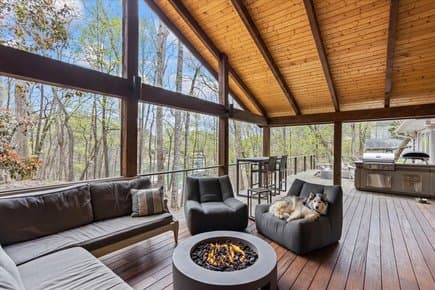
The Cottages-style communities on Lake Lanier are typically organized as small-lot or attached-product developments that emphasize lake access over private acreage. Floor plans commonly run from roughly 1,400 to 2,800 square feet across one- and two-story footprints, often with vaulted main living spaces, screened porches oriented toward the cove or wooded buffer, and primary bedrooms on the main level to support single-floor living. The cottage typology favors lower exterior maintenance with cement-fiber siding, metal-accent roofs, and compact landscapes that fit a second-home or right-sized primary-residence cadence. Lake lifestyle in cottage communities revolves around shared infrastructure rather than individual private estates. Many cottage developments hold a community dock, a community boat slip program, or assignable single-slip dock rights tied to specific cottage parcels under the U.S. Army Corps of Engineers Mobile District's Lake Sidney Lanier Shoreline Management Plan administered by the U.S. Army Corps of Engineers (USACE Mobile District, current as of May 2026). Owners typically launch from the community ramp or marina partnership, store boats in the community boatyard or a nearby marina, and use the cottage as the lake-direct base rather than the boat-storage base. Property types span detached cottages on small lots, attached cottage pairs, and a smaller share of townhome-style cottages where the development is denser. Lots commonly range from a tenth of an acre to a half acre, with shared open space, pathways to the lake, and community gathering areas absorbing the rest of the acreage. Buyers who want a sprawling private yard typically find the cottage typology too compact; buyers who want lake access without managing four acres of grass typically find the typology well matched.
Low-maintenance or second-home appeal where applicable
The low-maintenance profile is the primary reason buyers shortlist cottage communities. Exterior maintenance is generally handled at the HOA level rather than the homeowner level, with landscape mowing, common-area irrigation, and exterior touch-ups absorbed into the monthly assessment. Owners who travel frequently, who split time between a primary residence in Atlanta and a lake home on Lanier, or who want a lock-and-leave footprint typically value the HOA-managed exterior over the cost-saving but time-consuming self-managed model. Second-home appeal also rests on right-sized utility loads. A 1,800-square-foot cottage carries lower property tax across Forsyth County, Hall County, Dawson County, and Gwinnett County than a 5,000-square-foot estate, lower homeowners insurance, lower utility bills during the unoccupied weekday window, and lower interior maintenance overall (county tax assessor public records, current as of May 2026). Owners who plan to use the home roughly 150 to 200 nights per year find the carrying cost more proportional to the use than a full-size waterfront estate would deliver. Lock-and-leave operations are the third pillar of the second-home appeal. Many cottage communities offer optional or required monitoring, freeze-watch winterization checks, and concierge services that handle package receipt, contractor coordination, and pre-arrival readiness. Buyers should pull the specific HOA service menu for any cottage community under consideration before assuming the lock-and-leave services match expectations, because the service offering varies meaningfully across developments.
Nearby lake access, marinas, parks, and amenities
Lake access varies sharply by which cottage community a buyer is evaluating. Some cottage developments sit on the immediate shoreline with a community dock, a community boat slip program, or assignable private docks; others sit a short drive inland with a dedicated lake-access lot, ramp privileges, or a marina partnership. Buyers should request a written description of the lake-access tier for any specific cottage community rather than assuming any cottage community is waterfront in the dock-permitted sense. Marina infrastructure surrounding the cottage inventory is anchored by Aqualand Marina on the southern basin, Holiday Marina, Sunrise Cove Marina, Lake Lanier Islands marina facilities, and Habersham Marina on the upper arm in Hall County (USACE Mobile District / Lake Lanier marina operators, current as of May 2026). Many cottage communities partner with one of these marinas for transient slip access, dry storage, or seasonal slip rentals, which can be a more economical arrangement than a private community dock for owners who only need water access on a fraction of weekends. Parks and public amenities round out the lake-access picture. The U.S. Army Corps of Engineers operates day-use parks and campgrounds around the Lake Lanier shoreline, and Lake Lanier Islands operates resort-and-water-park facilities on the southern basin. Cottage owners frequently use these public assets alongside the community's own amenities. Nearby commercial centers in Cumming, Buford, Flowery Branch, Gainesville, Dawsonville, and Sugar Hill cover grocery, dining, and everyday errands within a typical 10-to-20-minute drive from most cottage communities.
Buyer Considerations
Buyers shortlisting The Cottages at Lake Lanier should underwrite the HOA structure, the lake-access tier, and the resale context before writing an offer. Cottage communities trade on community amenities and operating discipline more than estate inventory does, and the HOA quality is often a larger driver of long-term value than the cottage interior finishes.
HOA fees, rules, maintenance, and rental restrictions
Buyers should request the current annual budget, the reserve study, and any pending special assessment notice before closing, because cottage communities with dock infrastructure, shared boat ramps, or community pools carry larger capital reserve requirements than purely landscape-managed communities. The reserve study matters most on developments more than fifteen years old, where dock pilings, pool decks, and clubhouse roofs typically approach replacement cycles. A community with a thin reserve and an aging amenity package frequently produces a special assessment within three to five years of closing, and buyers should treat the reserve study as a primary diligence document rather than a closing-table formality. Current market conditions require a dated MLS comparison that identifies the area, property type, reporting period, and sample before a buyer relies on it. Community rules typically govern exterior modifications, landscape modifications inside fenced patios, parking, and dock or slip use. Many cottage HOAs maintain a list of approved exterior paint colors, prohibit short-term-rental conversion, and limit boat trailer storage to a designated community area. Buyers should read the covenants, conditions, and restrictions document carefully and confirm that any planned modifications are permitted under the architectural review process. Rental restrictions are particularly important for buyers considering a part-time-rental income offset. Many Lake Lanier cottage communities prohibit short-term rentals entirely, cap the number of investor-owned units, or require minimum lease terms of six or twelve months. Buyers underwriting an Airbnb or short-term-rental cash flow should confirm the specific rental policy in writing before signing a contract, because the rental rule typically does not appear on the listing page.
Lake access details and community amenities
Lake access details determine whether a cottage community is fundamentally a lake home or fundamentally a lake-adjacent home, and the answer materially affects pricing and resale. Communities with assignable USACE-permitted private docks attached to specific parcels carry the strongest lake-access tier, followed by communities with a community dock and slip-rotation program, followed by communities with a private community boat ramp or marina partnership, followed by lake-view communities without a dock or ramp arrangement (USACE Mobile District, current as of May 2026). Buyers should request the exact dock or slip arrangement in writing. Community amenities at Lake Lanier cottage developments typically include some combination of a community pool, a clubhouse, a fitness room, walking trails, a community dock or boat ramp, and a community boat or trailer storage area. Higher-tier cottage developments may also offer a community fishing dock, a kayak and paddleboard launch, a fire pit and gathering pavilion, or a dog park. The amenity package drives the HOA assessment more than the interior finishes do, so buyers should evaluate the package against actual planned use rather than against aspirational use. Water levels and seasonal access also matter. Lake Lanier operates with a full pool elevation of 1,071 feet above mean sea level, managed by the U.S. Army Corps of Engineers Mobile District at Buford Dam, and the lake fluctuates seasonally based on rainfall, downstream water needs, and drought conditions (USACE Mobile District, current as of May 2026). Cottage communities with shallower cove access can become functionally non-navigable for larger boats during sustained drawdown periods, while deeper-cove communities maintain navigable access through most of the year. Buyers should walk the dock or slip at the community during the actual visit, ideally during a low-pool window, before assuming year-round access.
Resale context and comparable communities
Buyers should pull the past six months of sold cottage comparables in the specific community before writing an offer. Current market conditions require a dated MLS comparison that identifies the area, property type, reporting period, and sample before a buyer relies on it. Current market conditions require a dated MLS comparison that identifies the area, property type, reporting period, and sample before a buyer relies on it. Comparable communities for resale benchmarking include other cottage-style developments along the Lake Lanier shoreline, smaller lake-access subdivisions in Forsyth County, Hall County, Dawson County, and Gwinnett County, and the broader Latitude Margaritaville Lake Lanier and Cresswind at Lake Lanier active-adult inventory where cottage-scale floor plans overlap. Buyers should evaluate whether their use pattern fits the cottage typology specifically or whether a different lake-access or active-adult product would deliver a better long-run match.
Buying or Selling at The Cottages
Buying or selling at The Cottages at Lake Lanier is more amenity-driven and HOA-driven than a typical waterfront estate transaction, and the marketing and due-diligence checklist reflect that. The right buyer fit and the right HOA fit drive a meaningful share of long-run value and resale velocity.
Current listings and recent sales context
Active listings at cottage-style Lake Lanier communities should be evaluated against the most recent comparable sales in the same development and against the broader cottage typology across the lake. Buyers shopping in the off-season often face fewer choices but less price competition. Current market conditions require a dated MLS comparison that identifies the area, property type, reporting period, and sample before a buyer relies on it. Recent sales context should be drawn from the past six to twelve months of closed transactions in the specific cottage community, adjusted for square footage, lake-access tier, dock arrangement, and finish level. Buyers should not anchor on the average Lake Lanier sale price or the average waterfront sale price, because cottage-scale inventory trades on a different basis than estate inventory. A request to the listing agent or buyer's agent for the trailing closed-sales report for the community is a standard due-diligence step. Pricing also reflects the broader Lake Lanier market cycle. Buyers should treat the two segments as distinct submarkets rather than as a single market. Current market conditions require a dated MLS comparison that identifies the area, property type, reporting period, and sample before a buyer relies on it.
Community-specific marketing and buyer questions
Community-specific marketing of a cottage listing should center on the amenity package, the HOA financial health, the lake-access tier, and the lock-and-leave operating model rather than only on the home's interior. Cottage buyers typically shortlist communities before they shortlist specific homes, and the marketing that wins the showing is the marketing that clearly answers what the community delivers and what the HOA covers. Listing photography should include the community dock, the clubhouse, the pool, and the lake-view amenity areas alongside the home interior. Common buyer questions at cottage communities cluster around six topics: monthly HOA assessment and what it covers, reserve study status and any pending special assessment, dock or slip rights tied to the specific unit, short-term-rental rules and any rental cap, exterior maintenance scope at the HOA level, and the typical resale window for the specific cottage floor plan. Sellers and listing agents who answer all six topics in the listing materials and the showing packet typically move inventory faster than sellers who leave the questions for the closing-table due diligence. School district context also surfaces in cottage-buyer questions, even when the buyer profile skews second-home. Cottage communities sit across Forsyth County Schools, Hall County Schools, Dawson County Schools, and Gwinnett County Public Schools depending on the parcel's address, and the assignment-by-address rules apply to cottage residents who have school-age occupants (GreatSchools and county school district public records, as of May 2026). Buyers should pull the specific elementary, middle, and high school assignment from the county before assuming a district based on the community's marketing name.
Schedule a Lake Lanier community consultation
A community consultation is the most efficient way to evaluate whether a cottage community at Lake Lanier matches a buyer's actual use pattern. The consultation typically covers the buyer's annual use cadence, the desired lake-access tier, the realistic HOA tolerance, the rental policy requirement, and the school assignment if relevant. Buyers who walk into a single community without that filtering work often spend a full day touring the wrong typology before recognizing the mismatch. The consultation also produces a shortlist drawn from active inventory rather than from the buyer's pre-shortlist assumptions. The shortlist should be cross-checked against the trailing twelve months of closed comparables in each community, the current HOA budget and reserve study, the current rental policy, and the current dock or slip arrangement before any showing visit. Pre-showing due diligence typically saves multiple weekends of in-person tour time. Ashley Smith, real estate agent with The Dream Smith Team at Compass, can run the cottage-community shortlist exercise against the current Lake Lanier inventory, layer in the HOA disclosure review, and coordinate with the U.S. Army Corps of Engineers Mobile District on any dock-related questions before the buyer commits to a community. The shortlist conversation is anchored in documented USACE shoreline data, county tax assessor records, Georgia MLS comparables, and HOA disclosure documents rather than category-average assumptions.
Frequently Asked Questions
- What is The Cottages at Lake Lanier?
- The Cottages at Lake Lanier refers to the smaller-footprint, cottage-style lake communities along the Lake Lanier shoreline across Forsyth, Hall, Dawson, and Gwinnett counties. These developments typically deliver lower-maintenance floor plans, shared amenities, and a community dock, community slip program, or assignable U.S. Army Corps of Engineers Mobile District dock arrangement rather than individual private estate docks. The buyer profile skews toward second-home, lock-and-leave, and right-sized primary-residence use.
- How much do homes at The Cottages at Lake Lanier cost?
- Buyers should pull the past six months of sold comparables in the specific community before writing an offer. Current market conditions require a dated MLS comparison that identifies the area, property type, reporting period, and sample before a buyer relies on it.
- What are typical HOA fees at Lake Lanier cottage communities?
- Buyers should also request the reserve study and any pending special assessment notice before closing, because cottage communities with dock or pool infrastructure carry larger capital reserve requirements. Current market conditions require a dated MLS comparison that identifies the area, property type, reporting period, and sample before a buyer relies on it.
- Do cottage homes at Lake Lanier come with a private dock?
- It depends on the specific community. Some cottage developments include assignable U.S. Army Corps of Engineers Mobile District private dock permits tied to specific parcels, others provide a community dock with a slip-rotation program, and others offer only a community boat ramp or marina partnership (USACE Mobile District, current as of May 2026). Buyers should request the exact dock arrangement in writing before assuming the cottage is waterfront in the permitted-dock sense, because the lake-access tier varies sharply across communities.
- Are short-term rentals allowed at The Cottages at Lake Lanier?
- Rental rules vary by community, and many Lake Lanier cottage HOAs either prohibit short-term rentals entirely, cap the number of investor-owned units, or require minimum lease terms of six or twelve months. Buyers underwriting any short-term-rental income offset should confirm the specific rental policy in writing before signing a contract. The rental rule typically does not appear on the listing page and is found in the community covenants and HOA disclosure documents.
- Which school districts serve Lake Lanier cottage communities?
- Cottage communities sit across Forsyth County Schools, Hall County Schools, Dawson County Schools, and Gwinnett County Public Schools depending on the parcel's address, with assignment-by-address rules applied at the elementary, middle, and high school levels (GreatSchools and county school district public records, as of May 2026). Buyers with school-age occupants should pull the specific assignment from the county school district website before assuming a district based on the community's marketing name.
Related
- Lake Lanier Condos and TownhomesAttached and lower-maintenance lake-area inventory across the Lanier shoreline.
- Lake Lanier Lock-and-Leave HomesCottage-scale and turnkey homes for second-home and lock-and-leave buyers on Lanier.
- Lake Lanier Second HomesSecond-home buyer guide covering carrying cost, dock arrangements, and seasonal use patterns.
- Lake Lanier Lake Access HomesLake-access subdivisions and community-dock inventory below the permitted-dock waterfront price band.
- Lake Lanier Retirement HomesRight-sized and active-adult homes on Lake Lanier including cottage-scale floor plans.
- Lake Lanier Real EstateFull Lake Lanier waterfront and lake-area inventory across Forsyth, Hall, Dawson, and Gwinnett counties.