
Compare
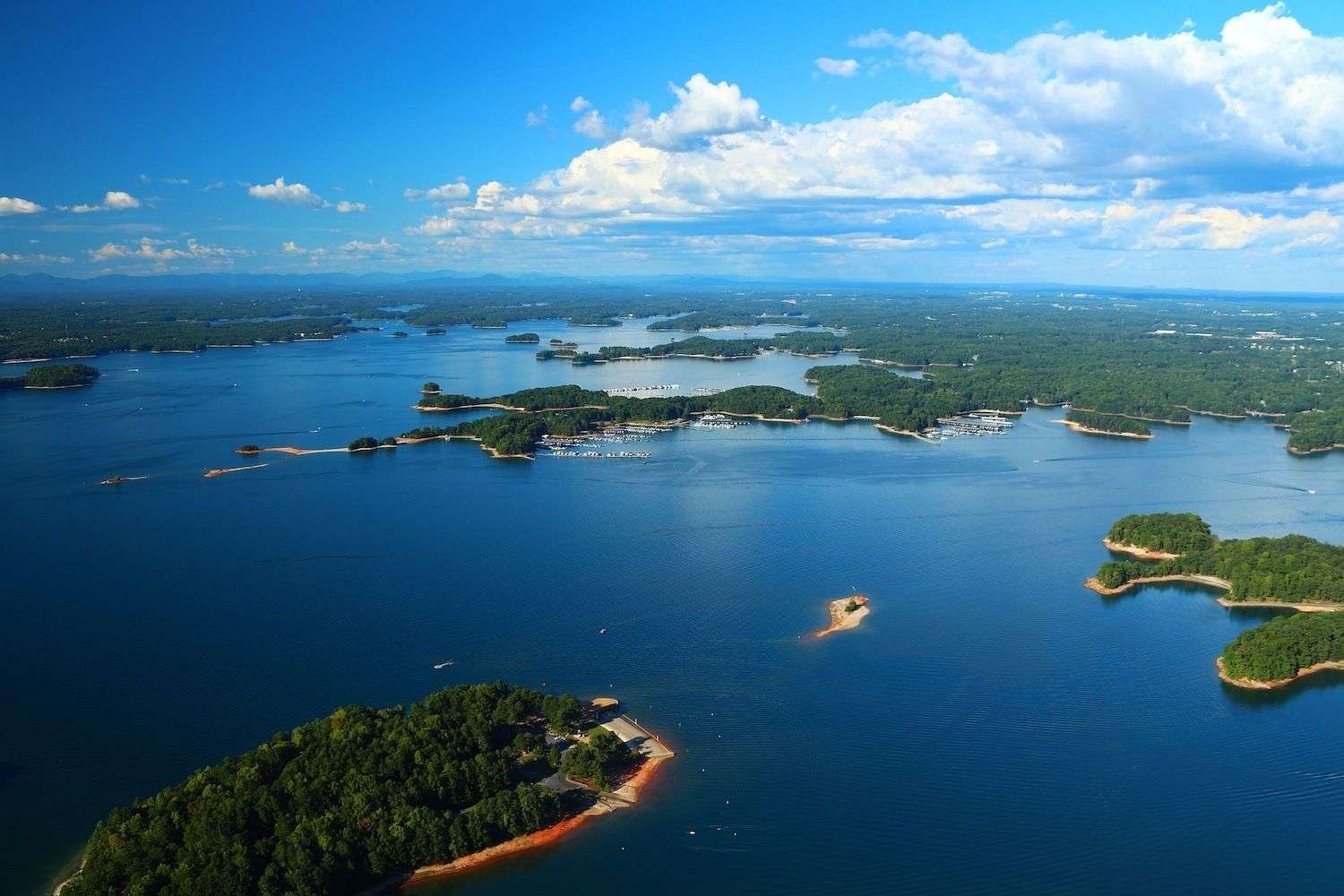
Lake Lanier and Lake Norman are the two largest lake-home markets in the Southeast, but they anchor to different metros and run on different regulatory frameworks. Lake Lanier is a 38,000-acre U.S. Army Corps of Engineers reservoir on the Chattahoochee River north of Atlanta, with roughly more than 600 miles of shoreline across Hall, Forsyth, Dawson, Gwinnett, and Lumpkin counties, managed by the USACE Mobile District at Buford Dam (USACE Mobile District, as of May 2026). Lake Norman is a 32,510-acre Duke Energy reservoir on the Catawba River north of Charlotte, with about 520 miles of shoreline across Mecklenburg, Iredell, Catawba, and Lincoln counties (Duke Energy and Lake Norman Marine Commission, as of May 2026). The choice usually comes down to metro proximity, dock regulation, and inventory mix.
Quick Answer: Lake Lanier or Lake Norman?
The fastest way to decide between Lake Lanier and Lake Norman is to start with the metro a buyer already lives or works in, because each lake is functionally a suburban extension of its anchor city. Lake Lanier sits 35 to 60 miles north of Atlanta along Interstate 985 and Georgia 400; Lake Norman sits 25 to 35 miles north of Charlotte along Interstate 77 and North Carolina Highway 16.
Choose Lake Lanier for Atlanta access and North Georgia lake lifestyle
Lake Lanier is the practical lake choice for buyers anchored to metropolitan Atlanta, Hartsfield-Jackson Atlanta International Airport, or the Georgia 400 corridor. The lake is reachable from intown Atlanta in roughly 45 minutes to 90 minutes depending on which side a buyer is targeting: Buford and Flowery Branch on the Hall and Gwinnett side, or Cumming and Dawsonville on the Forsyth and Dawson side. Lumpkin County frames the upper end of the lake near Dahlonega. The transaction market is shaped by USACE shoreline regulation rather than a private utility framework. Current market conditions require a dated MLS comparison that identifies the area, property type, reporting period, and sample before a buyer relies on it. Lake Lanier also fits buyers who want a federal shoreline framework rather than a private utility one. USACE permits, Exhibit C electrical inspections, and Corps Line boundaries set the rules of ownership; there is no Duke Energy equivalent in the Lake Lanier file.
Choose Lake Norman for Charlotte proximity and large lake-market scale
Lake Norman is the practical choice for buyers anchored to metropolitan Charlotte, Charlotte Douglas International Airport, or the Interstate 77 corridor. The Lake Norman shoreline is reachable from uptown Charlotte in roughly 29 to 45 minutes outside peak traffic (Visit Lake Norman, as of May 2026), with primary shoreline towns including Cornelius, Davidson, and Huntersville in Mecklenburg County, Mooresville and Troutman in Iredell County, Sherrills Ford and Terrell in Catawba County, and Denver in Lincoln County. The waterfront market runs at a higher median than Lake Lanier. Lake Norman waterfront homes carried a median price near $2,364,000 in Q1 2026 (LIST RE Group Charlotte waterfront market guide, Q1 2026), with a single Lake Norman estate listed at $18.5 million in May 2026 setting a recent Charlotte-area price ceiling (Hoodline, May 2026). Inventory concentrates in Cornelius, Mooresville, and Davidson, with newer construction extending into Sherrills Ford and Denver on the western shore. Lake Norman also delivers a larger primary-residence base. Many shoreline homes are full-time residences rather than weekend properties, which produces a different community texture: year-round HOAs, year-round restaurants, and year-round school enrollment that does not depend on seasonal occupancy.
How job centers, lifestyle, and ownership goals shape the choice
Job-center gravity is usually the first filter. A buyer working in Buckhead, Midtown, Sandy Springs, or Alpharetta typically maps better to Lake Lanier; a buyer working in Uptown Charlotte, SouthPark, Ballantyne, or the University Research Park corridor typically maps better to Lake Norman. The drive between the two metros runs roughly 244 miles and 4 to 5 hours along Interstate 85 through Greenville and Spartanburg, South Carolina (travel distance estimate, as of May 2026), which makes a cross-metro lake commute impractical for most working buyers. Lifestyle gravity is the second filter. Lake Lanier carries a North Georgia lake culture organized around USACE-permitted docks, Lanier Islands, and a mix of independent waterfront parcels. Lake Norman carries a Charlotte lake culture organized around Duke Energy-permitted docks, larger sailing and powerboating fleets, and denser year-round shoreline development. Ownership goals are the third filter. Buyers who want a federal shoreline framework, a North Georgia foothills setting, and Atlanta-tier inventory at a lower median entry usually lean Lake Lanier. Buyers who want a larger lake market, a Charlotte-tier inventory base, and a Duke Energy permitting framework usually lean Lake Norman.
Real Estate Market Comparison
Lake Lanier and Lake Norman differ in concrete, checkable ways across inventory, dock regulation, use mix, and boating culture. Buyers comparing the two should treat the lakes as different regulatory environments first and lifestyle environments second, because the regulatory layer drives what an owner can actually build, store, and use along the water.
Waterfront inventory, luxury homes, docks, and communities
Lake Lanier waterfront homes are governed by the USACE Mobile District through the Lake Lanier Project Management Office in Buford, with shoreline use, dock footprint, and electrical service controlled under the Lake Sidney Lanier Shoreline Management Plan administered by the U.S. Army Corps of Engineers, Title 36 of the Code of Federal Regulations, and Engineer Pamphlet EP 1130-2-406. A buyer evaluating a Lake Lanier home with an existing dock should verify the USACE permit number, the shoreline zone classification, the Exhibit C electrical inspection status, and the as-built diagram during due diligence rather than at closing. Lake Norman waterfront homes are governed by Duke Energy under the Catawba-Wateree Shoreline Management Plan, administered by Duke Energy Lake Services through the Lake Access Permit System (LAPS). Dock footprint is capped at the more restrictive of 120 feet from the 760-foot full-pond contour or one-third of the distance to the opposite shoreline (Duke Energy Lake Services, as of May 2026), and lake-use permits are issued for a one-year term rather than as a static record (Duke Energy Lake Services, as of May 2026). Luxury inventory exists on both lakes but distributes differently. On Lake Lanier, high-end inventory clusters in deep-water coves around Flowery Branch, Buford, and South Hall on standalone parcels. On Lake Norman, luxury inventory clusters in The Point, The Peninsula, and the established Cornelius and Davidson shoreline, with the recent $18.5 million Lake Norman listing illustrating the upper tier (Hoodline, May 2026).
Commute patterns, second-home use, and primary residence demand
Lake Lanier draws a higher share of second-home and weekend-use buyers because the lake operates as a North Georgia weekend market for the Atlanta metro. Buyers in Buckhead, Sandy Springs, Roswell, and Alpharetta commonly use a Lake Lanier home for Friday-night to Sunday-night use, returning to the city for the workweek. Permitted-dock cove homes in Flowery Branch and Buford and lake-access homes in Cumming, Gainesville, and Dawsonville fit that pattern. Lake Norman skews more heavily toward primary-residence demand. The shoreline towns of Cornelius, Davidson, Huntersville, and Mooresville function as full-service Charlotte suburbs in their own right, with year-round school enrollment, daily commuters into Uptown Charlotte along Interstate 77, and HOA structures geared to full-time occupancy. Population growth across the Lake Norman counties has been documented as significant by the Iredell Economic Development Corporation citing recent census data (Iredell EDC, as of May 2026). Commute math reflects the difference. A Lake Norman primary-residence buyer in Cornelius or Davidson can reach Uptown Charlotte in roughly 25 to 35 minutes outside peak traffic, which makes a daily commute realistic. A Lake Lanier buyer in Cumming or Buford faces a longer drive into Buckhead or Midtown Atlanta, which is why Lake Lanier tilts toward weekend rather than weekday use.
Boating culture, marinas, dining, and services
Boating density runs heavy on both lakes during summer weekends, but the boating mix differs. Lake Lanier carries a strong wakeboarding, ski-boat, pontoon, and cruiser fleet across its 38,000 acres, served by Aqualand Marina, Holiday Marina, Sunrise Cove Marina, Lanier Islands marinas, and Habersham Marina. Lake Norman runs a comparable density across 32,510 acres but with a meaningful sailing fleet, large-cruiser presence, and a long-standing yacht-club scene anchored by Lake Norman Yacht Club in Mooresville and the Peninsula Yacht Club in Cornelius. Waterfront dining follows the same Atlanta versus Charlotte pattern. Lake Lanier's lakefront dining ecosystem ties to the Atlanta-area population and includes Margaritaville at Lanier Islands, Pelican Pete's, Twisted Oar, and Fish Tales Lakeside Grille. Lake Norman's waterfront dining ties to the Charlotte-area population and includes Hello, Sailor and Port City Club in Cornelius, North Harbor Club in Davidson, and Eddie's on Lake Norman, Blue Parrot Grill, and Toucan's Lakefront in Mooresville (Visit Lake Norman and Morningstar Marinas, as of May 2026). Service networks differ too. Lake Lanier contractors, dock builders, and lake-service vendors organize around the USACE permit framework and Georgia licensing. Lake Norman contractors organize around Duke Energy's LAPS process and the Lake Norman Marine Commission, which coordinates safety, navigation, and water-quality issues across the four shoreline counties (Lake Norman Marine Commission, as of May 2026).
Which Market Fits Your Move?
Buyer fit is the most useful framing for choosing between Lake Lanier and Lake Norman, because each lake serves a different mix of weekend, primary-residence, luxury, and relocation buyers. A buyer who maps their actual use case against the two markets makes a different decision than a buyer who compares the lakes on surface amenities.
Atlanta vs. Charlotte employment and family logistics
Atlanta-based buyers usually fit Lake Lanier better than Lake Norman because the drive between Atlanta and Lake Norman runs roughly 4 to 5 hours and 244 miles along Interstate 85, which removes Lake Norman from the realistic weekend-use category for an Atlanta household. A Lake Lanier home in Cumming, Buford, Gainesville, Flowery Branch, or Dawsonville is reachable for a Friday-night arrival and a Sunday-night return without burning a vacation day. Charlotte-based buyers usually fit Lake Norman better than Lake Lanier for the inverse reason. A Lake Norman home in Cornelius, Davidson, Huntersville, or Mooresville sits inside the Charlotte commuter shed, with Interstate 77 connecting the shoreline towns to Uptown Charlotte, SouthPark, and Ballantyne. Lake Lanier sits beyond practical daily-commute range from Charlotte. Family logistics layer on top of the commute math. School enrollment, healthcare network, and aging-parent proximity often anchor a buyer to one metro or the other before the lake decision is even made. Atlanta Public Schools, Forsyth County Schools, Hall County Schools, and Gwinnett County Schools serve the Lake Lanier shoreline; Charlotte-Mecklenburg Schools, Iredell-Statesville Schools, Mooresville Graded School District, Catawba County Schools, and Lincoln County Schools serve the Lake Norman shoreline. The school-district map is usually a more durable input than dock photos.
Luxury second-home and relocation buyers
Luxury second-home buyers split between the two lakes based on metro affinity rather than absolute price. A turnkey custom home in a Flowery Branch deep-water cove and a turnkey custom home in The Point on Lake Norman can both deliver a comparable interior at different total costs. Current market conditions require a dated MLS comparison that identifies the area, property type, reporting period, and sample before a buyer relies on it. Relocation buyers tend to anchor to the metro first, the lake second. A buyer relocating into a Charlotte-based finance, healthcare, motorsports, or research role typically lands on Lake Norman because Cornelius, Davidson, Huntersville, and Mooresville sit inside the commute shed. A buyer relocating into an Atlanta-based corporate, logistics, or aviation role typically lands on Lake Lanier or in an inside-the-perimeter neighborhood like East Lake, with Lake Lanier serving as the weekend extension. Luxury inventory texture also differs. Lake Lanier's high end is dominated by standalone waterfront estates with private USACE-permitted docks; Lake Norman's high end mixes standalone estates with gated communities like The Point and The Peninsula and a long-running luxury new-construction pipeline tied to Charlotte's growth.
Long-term ownership and resale considerations
Long-term ownership on Lake Lanier sits inside a federal shoreline framework that does not change with utility ownership. The USACE Mobile District manages Lake Lanier under federal law, and a buyer's dock permit, Exhibit C electrical inspection, and shoreline zone classification carry forward across ownership changes when the file is clean. Resale value on Lake Lanier hinges heavily on whether the dock permit, electrical inspection, and shoreline zone are documented and current at closing. Long-term ownership on Lake Norman sits inside Duke Energy's private utility framework under a Federal Energy Regulatory Commission license, with the Catawba-Wateree Shoreline Management Plan setting the day-to-day rules. Duke Energy lake-use permits are issued for one-year terms, which means a buyer purchasing a Lake Norman home with a dock should verify the current permit status and the LAPS file rather than rely on a single legacy approval (Duke Energy Lake Services, as of May 2026). Resale on Lake Norman hinges on the same documentation discipline plus the broader Charlotte market trajectory. The extractable buyer-fit summary for these two lakes can be stated cleanly. Atlanta-anchored buyers usually choose Lake Lanier; Charlotte-anchored buyers usually choose Lake Norman; cross-metro relocation rewrites the math. Current market conditions require a dated MLS comparison that identifies the area, property type, reporting period, and sample before a buyer relies on it.
Frequently Asked Questions
- Is Lake Lanier or Lake Norman bigger?
- Lake Lanier is larger by surface area. Lake Lanier covers roughly 38,000 acres with about more than 600 miles of shoreline across five Georgia counties (USACE Mobile District, as of May 2026), while Lake Norman covers about 32,510 acres with roughly 520 miles of shoreline across four North Carolina counties (Duke Energy and Lake Norman Marine Commission, as of May 2026). Lake Norman is North Carolina's largest manmade lake; Lake Lanier is one of the most-trafficked USACE reservoirs in the Southeast.
- Which lake is closer to its anchor city?
- Lake Norman is closer to its anchor city. The shoreline towns of Cornelius, Davidson, and Huntersville sit roughly 25 to 35 minutes north of uptown Charlotte along Interstate 77 (Visit Lake Norman, as of May 2026). Lake Lanier's shoreline towns of Cumming, Buford, Gainesville, Flowery Branch, and Dawsonville sit roughly 45 minutes to 90 minutes north of intown Atlanta along Interstate 985 and Georgia 400, depending on traffic and which side of the lake a buyer is targeting.
- How do dock permits work differently on Lake Lanier and Lake Norman?
- Lake Lanier dock permits are issued by the U.S. Army Corps of Engineers Mobile District through the Lake Lanier Project Management Office in Buford under the Lake Sidney Lanier Shoreline Management Plan administered by the U.S. Army Corps of Engineers, Title 36 of the Code of Federal Regulations, and Engineer Pamphlet EP 1130-2-406. Lake Norman dock permits are issued by Duke Energy Lake Services under the Catawba-Wateree Shoreline Management Plan through the Lake Access Permit System (LAPS), with dock footprint capped at 120 feet from the 760-foot full-pond contour or one-third of the distance to the opposite shoreline, and lake-use permits issued for one-year terms (Duke Energy Lake Services, as of May 2026).
- Is Lake Norman more expensive than Lake Lanier?
- The spread reflects Charlotte-area pricing, a larger primary-residence base, and a deeper luxury new-construction pipeline on Lake Norman, not a quality ranking between the two lakes. Current market conditions require a dated MLS comparison that identifies the area, property type, reporting period, and sample before a buyer relies on it.
- Can a buyer realistically own on one lake and commute to the other metro?
- No. The drive between the Atlanta metro and the Charlotte metro runs roughly 244 miles and 4 to 5 hours along Interstate 85 through Greenville and Spartanburg, South Carolina (travel distance estimate, as of May 2026). That distance removes Lake Lanier from the realistic Charlotte commuter shed and removes Lake Norman from the realistic Atlanta commuter shed. Cross-metro lake ownership generally only makes sense for second-home or seasonal-use buyers, not for daily commuters.
- Which lake has more full-time primary residences along the shoreline?
- Lake Norman carries a higher share of primary-residence shoreline homes. The towns of Cornelius, Davidson, Huntersville, and Mooresville function as full-service Charlotte suburbs with year-round school enrollment, daily commuter traffic into Uptown Charlotte, and HOA structures geared to full-time occupancy. Lake Lanier carries a higher share of second-home and weekend-use shoreline homes because the Atlanta metro is far enough south that many Lake Lanier homes serve as Friday-to-Sunday properties rather than daily-commute residences.
Related
- Lake Lanier Community GuideFull neighborhood, market, school, and shoreline overview for Lake Lanier.
- Lake Lanier Real EstateActive waterfront, dock, and lake-access listings across the Lake Lanier market.
- Lake Lanier Waterfront HomesPermitted-dock and shoreline-frontage homes across Hall, Forsyth, Dawson, Gwinnett, and Lumpkin counties.
- Lake Lanier Dock Permits GuideHow USACE Mobile District residential dock permits work on Lake Lanier.
- Lake Lanier Commute to AtlantaDrive times, corridors, and second-home logistics for Atlanta-based buyers.
- Lake Lanier Cost of OwnershipCarrying-cost breakdown for waterfront, lake-access, and tear-down properties.