
Compare
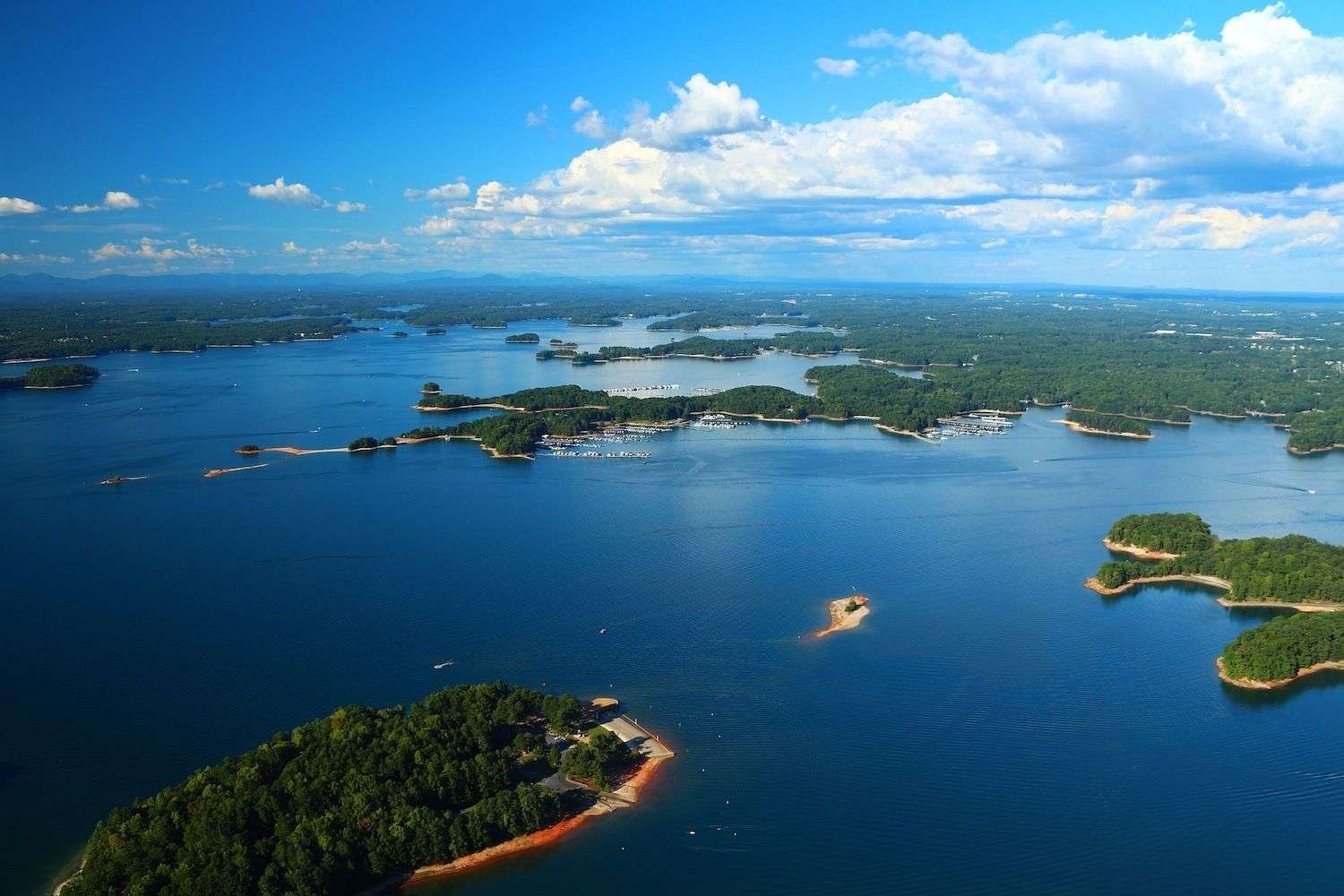
Lake Lanier and Blue Ridge are two of North Georgia's most-traded weekend-home markets, but they answer different buyer questions. Lake Lanier is a 38,000-acre U.S. Army Corps of Engineers reservoir on the Chattahoochee and Chestatee rivers, managed by the USACE Mobile District at Buford Dam, sitting roughly 45 to 90 minutes north of Atlanta across Forsyth, Hall, Dawson, Gwinnett, and Lumpkin counties. Blue Ridge is a North Georgia mountain town in Fannin County, roughly 90 miles and 1 hour 45 minutes to 2 hours 15 minutes north of Atlanta via I-75 and I-575/GA-515 (atlanta.com, current as of May 2026), anchoring a cabin and short-term-rental market in the Chattahoochee-Oconee National Forest.
Quick Answer: Lake Lanier or Blue Ridge?
Choose Lake Lanier when Atlanta accessibility, boating-centered weekends, and a deeper inventory across price points matter most. Choose Blue Ridge when a mountain cabin setting, hiking and river recreation, and short-term-rental income potential drive the underwriting. The two markets do not substitute for each other on a feature-by-feature basis; the decision is anchored on travel cadence, water versus mountain orientation, and whether the home will be used, rented, or both.
Choose Lake Lanier for boating, lake scale, and Atlanta accessibility
Lake Lanier sits at the southern edge of the North Georgia foothills with three primary access corridors to Atlanta: GA-400 through Forsyth County, I-985 through Hall and Gwinnett counties, and surface routes including the GA-400 / I-985 corridors anchored by Browns Bridge Road, Buford Dam Road, and Pilgrim Mill Road and Buford Highway through southern Gwinnett County. Drive time from a typical Lake Lanier shoreline address to the Perimeter (I-285) or Midtown Atlanta ranges roughly from 45 minutes to over 90 minutes depending on shoreline location, day of week, season, and destination. The shoreline crosses five counties (Forsyth, Hall, Dawson, Gwinnett, and Lumpkin), and the lake reaches full pool elevation of 1,071 feet above mean sea level (USACE Mobile District, current as of May 2026), with the Lake Lanier Project Management Office in Buford serving as the authoritative source for dock permit, Exhibit C electrical inspection, and shoreline classification records. Scale matters when matching buyer demand to listing supply. Lake Lanier's 38,000-acre surface and approximately more than 600 miles of shoreline support a deep inventory across price points, from lake-access condos and townhomes near Mall of Georgia through dock-permitted estates along the southern shoreline. Current market conditions require a dated MLS comparison that identifies the area, property type, reporting period, and sample before a buyer relies on it. Year-round usability separates Lake Lanier from a higher-elevation mountain market. The southern basin near Buford Dam, Aqualand Marina, Sunrise Cove Marina, and the Lake Lanier Islands marinas stays deep enough for routine boating across most of the USACE operating band, and waterfront dining at venues such as Pelican Pete's, Twisted Oar, Sunset Cove, and Fish Tales supports shoulder-season use. Buyers planning to use the home more than a handful of weekends a year typically weight this differently than buyers underwriting a true seasonal mountain retreat.
Choose Blue Ridge for mountain setting, cabin lifestyle, and vacation-rental appeal
Blue Ridge is a different product class. The city is the county seat of Fannin County, a Georgia mountain county whose population was estimated at 26,258 in 2026 (World Population Review, current as of May 2026), and approximately 90 percent of Fannin County residents live in unincorporated land. The surrounding terrain is dominated by the Chattahoochee-Oconee National Forest, which covers 749,689 acres in North Georgia, with the Blue Ridge Ranger District managing 66,097 acres inside Fannin County (U.S. Forest Service, current as of May 2026). The dominant residential product is a wood and stone mountain cabin, often on a sloped lot with seasonal mountain views, rather than a waterfront home with a private dock. The Blue Ridge market is structured around cabin ownership and short-term rentals. The two figures reflect different product mixes; buyers should compare like-for-like rather than averaging across the basin. Current market conditions require a dated MLS comparison that identifies the area, property type, reporting period, and sample before a buyer relies on it. Mountain lifestyle is what the market sells. Blue Ridge is anchored by 300 miles of hiking trails inside the surrounding national forest, the 93-mile Toccoa River corridor with the 270-foot Toccoa River Swinging Bridge (the longest swinging bridge east of the Mississippi), the Blue Ridge Scenic Railway, downtown East Main Street, and access to the southern terminus region of the Appalachian Trail. Buyers attracted to Blue Ridge typically value mountain quiet, fall foliage demand, and river-based recreation over the boating-centered weekend cadence on Lanier.
How water access, travel time, and use case shape the choice
Travel time is the first decision variable for buyers planning a regular cadence. Drive time from a typical Lake Lanier shoreline address to the Perimeter runs roughly 45 to 90 minutes via GA-400 or I-985; drive time from Blue Ridge to Atlanta runs roughly 1 hour 33 minutes under normal conditions, with typical real-world windows of 1 hour 45 minutes to 2 hours 15 minutes depending on traffic on I-75 and I-575 (atlanta.com, current as of May 2026). The 30- to 60-minute travel-time differential each way compounds across a weekend cadence and is the single largest variable separating the two markets for Atlanta-based buyers. Water access is the second variable, and it is a category-level distinction. Lake Lanier is a federal reservoir with a 600-plus-mile shoreline, a permitted private-dock framework, and active marina infrastructure. Blue Ridge is a mountain market with river access, lake access at the smaller 3,290-acre Lake Blue Ridge (a Tennessee Valley Authority reservoir), and trail access into the national forest. Buyers who define their weekend by being on the water in a private boat from a private dock generally end up on Lanier; buyers who define it by hiking, river recreation, fall color, and cabin time generally end up in Blue Ridge. Use case is the third variable. Lake Lanier homes are commonly used as primary residences, second homes, and weekend properties, with a smaller rental market constrained by USACE shoreline rules and county short-term-rental ordinances. Blue Ridge homes are commonly underwritten with rental income as a meaningful piece of the carrying-cost model, particularly in unincorporated Fannin County. The City of Blue Ridge voted to limit new short-term rentals inside city limits except in the Central Business District and commercially zoned parcels (WSB Radio, current as of recent reporting), while rentals in unincorporated Fannin County remain governed by the county's STVR ordinance. Buyers underwriting rental income should confirm jurisdiction parcel-by-parcel before relying on income projections.
Lifestyle and Property Comparison
The lifestyle-and-property comparison between Lake Lanier and Blue Ridge turns on three concrete axes: what the dominant product type looks like and how it is priced, what recreation patterns shape weekend and seasonal use, and how second-home, investment, and full-time-living strategies underwrite differently on each side. Each axis affects carrying cost, daily usability, and resale exposure across the hold period.
Lakefront homes vs. mountain cabins
Lake Lanier's dominant high-value product is the permitted-dock waterfront home. The USACE Mobile District's Lake Sidney Lanier Shoreline Management Plan administered by the U.S. Army Corps of Engineers and Engineer Pamphlet EP 1130-2-406 classify shoreline into zones (including Limited Development Area and Protected Shoreline) and set footprint, gangway, and Exhibit C electrical inspection requirements. A permitted private dock transfers with the property and is one of the dominant valuation drivers along the southern shoreline. Current market conditions require a dated MLS comparison that identifies the area, property type, reporting period, and sample before a buyer relies on it. Blue Ridge's dominant high-value product is the mountain cabin on a sloped, often wooded lot. Construction vocabulary is heavy in wood, stone, and stained timber, with covered porches, hot tubs, and seasonal mountain views as design anchors. Lot sizes are typically larger than a Lanier shoreline parcel because terrain limits buildable footprint, and many parcels border or back to Chattahoochee-Oconee National Forest land. Current market conditions require a dated MLS comparison that identifies the area, property type, reporting period, and sample before a buyer relies on it. The two product types are not substitutes. A buyer underwriting a permitted-dock home on Lanier rarely takes a Blue Ridge cabin at the same price, and vice versa. The lakefront home delivers a dock, deep water, marina access, and Atlanta-proximate weekend use; the mountain cabin delivers porch time, fall color, trail access, and short-term-rental income potential. Buyers should anchor the search on which experience they actually want the home to deliver before running comparable sales across the two markets.
Boating lifestyle vs. hiking and mountain recreation
Boating on Lake Lanier is structurally a high-volume activity. The lake's 38,000 surface acres and the southern basin's depth at full pool support recreational boating, sailing, water skiing, and watersport rentals, with marina capacity at Aqualand Marina, Holiday Marina, Sunrise Cove Marina, Habersham Marina, Port Royale Marina, and the Lake Lanier Islands marinas serving Atlanta-area weekend volume during the Memorial Day through Labor Day window. Day-boater traffic, ramp wait times, and waterfront events at Sunset Cove are part of the experience, and buyers seeking quieter water typically target the upper Chattahoochee and Chestatee arms in Hall County and Dawson County. Recreation in Blue Ridge is structured around the mountain and the river. The Blue Ridge Ranger District manages 66,097 acres of the Chattahoochee-Oconee National Forest inside Fannin County and supports 300 miles of hiking trails (U.S. Forest Service and Blue Ridge Mountains tourism, current as of May 2026), including segments of the Appalachian Trail in the broader region. The Toccoa River runs 93 miles and supports kayaking, fly fishing, and the Toccoa River Canoe Trail, with the Toccoa River Swinging Bridge as a recognized landmark. Lake Blue Ridge, the 3,290-acre TVA reservoir, supports smaller-scale boating, and Mercier Orchards, the Blue Ridge Scenic Railway, and downtown East Main Street anchor the year-round destination economy. Seasonal patterns also diverge. Lake Lanier weekends concentrate from Memorial Day through Labor Day, with shoulder-season use viable for owners on the southern basin. Blue Ridge weekends concentrate around fall foliage (October generates roughly $6,345 in monthly revenue per short-term rental on average) and the December holiday window ($6,443 per property), per StaySTRA's 2026 market analysis. Buyers underwriting use cadence or rental income should model the year against actual planned cadence and the specific cove or ridge rather than category averages.
Second-home, investment, and full-time living tradeoffs
Second-home buyers on Lake Lanier typically underwrite a use-driven model: weekends, holidays, and family-gathering windows on a property they intend to use themselves, with limited rental income built into the spreadsheet. USACE shoreline rules restrict commercial activity on permitted private docks, and county-level short-term-rental ordinances vary across Forsyth, Hall, Dawson, Gwinnett, and Lumpkin counties. The Lanier second-home thesis is anchored on personal use and long-term appreciation rather than nightly rental cash flow. Second-home buyers in Blue Ridge frequently underwrite a mixed-use model: personal use during selected weeks and short-term rental income across the balance of the year. Fannin County's STR market produced an average daily rate of $361 and 53 percent annualized occupancy as of May 2026 (StaySTRA, current as of May 2026), supporting roughly $62,500 in average annual rental revenue per property at market averages. Supply growth has compressed occupancy from approximately 68.6 percent to 53 percent since 2021, while ADR has held above $280 (StaySTRA, current as of May 2026), and the City of Blue Ridge has restricted new STR permits inside city limits except in commercial zones (WSB Radio, current as of recent reporting). Buyers underwriting rental income should confirm whether a parcel sits inside city limits or in unincorporated Fannin County before modeling revenue. Full-time living also splits between the two markets. Lake Lanier supports primary residence underwriting for buyers tied to Atlanta-area employers, with a deep service catchment across Northside Hospital Forsyth in Cumming, Northeast Georgia Medical Center in Gainesville, and Northside Hospital Gwinnett. Blue Ridge supports full-time living for buyers who work locally, remotely, or on a very limited in-office cadence, with services concentrated in downtown Blue Ridge and routing for specialized medical care toward Gainesville or Atlanta. Neither market is universally better; the answer depends on the buyer's actual week, not the marketing brochure.
Buyer Due Diligence Differences
Due diligence on a Lake Lanier home and due diligence on a Blue Ridge cabin involve different document trails and different categories of risk. Lanier's risks concentrate around USACE shoreline permits, dock classification, water depth, and Exhibit C electrical inspection status. Blue Ridge's risks concentrate around mountain access roads, steep driveway grades, well and septic systems, short-term-rental jurisdiction, and seasonal maintenance load. Buyers should match the due-diligence framework to the actual market before signing.
Dock permits, water levels, and shoreline rules on Lake Lanier
Lake Lanier dock permits are administered by the USACE Mobile District through the Lake Lanier Project Management Office in Buford, under the Lake Sidney Lanier Shoreline Management Plan administered by the U.S. Army Corps of Engineers and Engineer Pamphlet EP 1130-2-406. Permits are tied to the upland parcel and transfer with the property; an existing permitted dock is a material valuation driver and a closed permit moratorium for new private docks limits the supply of permittable shoreline. Buyers should verify the current permit on file, the dock classification (single-slip, double-slip, party dock, community dock), the Exhibit C electrical inspection status, and any open shoreline violation notices before closing. Water levels and shoreline geometry materially affect usable dock depth. Full pool sits at 1,071 feet above mean sea level (USACE Mobile District, current as of May 2026), but operational levels fluctuate seasonally and during drought windows. The 2007 to 2008 drought, when lake levels fell roughly 20 feet below full pool, remains a reference point for buyers underwriting deep-water access. Cove orientation, channel proximity, and seasonal silting affect whether a permitted dock holds usable water through the operating band; buyers should verify recent depth readings at the actual dock rather than relying on cove-level averages. Shoreline rules govern what owners can and cannot do between the property line and the water. Vegetation buffer requirements, tree-clearing limits, riprap and erosion-control standards, tram permits for sloped lots, and the Limited Development Area versus Protected Shoreline classification all shape what an owner can build, clear, or modify. The USACE shoreline classification on a given parcel is the document that defines the answer; buyers should pull the classification before assuming any improvement is permitted. A Lake Lanier home inspection checklist that includes dock, shoreline, and Exhibit C diligence catches issues that a standard residential inspection misses.
Mountain road access, steep drives, rental rules, and maintenance in Blue Ridge
Mountain road access is the first due-diligence axis in Blue Ridge. Many cabins sit on gravel or paved private roads with road-maintenance agreements that govern grading, snow and ice response, and shared cost. Buyers should request the road-maintenance agreement, verify whether the road is county-maintained or privately maintained, and assess winter access during ice events. Driveway grade also matters: steep mountain driveways can affect ambulance access, delivery service, and insurance underwriting, and some lenders require driveway grade documentation before closing. Short-term-rental jurisdiction is the second axis and the one most often missed by out-of-area buyers. Properties inside the City of Blue Ridge are governed by the city's STR ordinance, which limits new permits in many residential zones to commercial and Central Business District parcels, requires a rental certificate, a 24-hour local contact, visible onsite signage with the 911 address, and annual permit renewal (City of Blue Ridge STR forms, current as of May 2026). Properties in unincorporated Fannin County are governed by the county's STVR ordinance, which requires a $225 registration certificate with annual renewal and compliance with noise, occupancy, and emergency-management requirements (Fannin County, current as of 2024 ordinance and May 2026 reporting). Lodging taxes also differ: 8 percent inside city limits and 5 percent in unincorporated areas. A buyer underwriting rental income should confirm jurisdiction parcel-by-parcel before modeling revenue. Maintenance load on a mountain cabin runs structurally higher than on a Lanier waterfront home. Wood exteriors, decks, hot tubs, well systems, septic systems, and HVAC at altitude all carry recurring cost. Tree management around structures (storm damage, fall blowdown, ice load) is an annual line item. Buyers underwriting rental income should net out cleaning fees, management fees (typically 20 to 35 percent of gross rental revenue depending on operator), and platform fees before treating the headline ADR as the operating number.
Which market fits your family, lifestyle, and ownership plan?
The fit question reduces to four variables: travel cadence, water-versus-mountain orientation, use-versus-rental intent, and budget band. Buyers who plan a regular Friday-out, Sunday-back cadence and who define a weekend by being on the water generally find Lake Lanier the more practical fit; the 45- to 90-minute drive window keeps the round trip inside a workable weekend, and the GA-400 and I-985 corridors offer flexible departure timing. Buyers who plan a less frequent cadence and who define a weekend by hiking, river time, or fall color generally find Blue Ridge the more practical fit, accepting the longer drive in exchange for the mountain product. Use-versus-rental intent is the next filter. Buyers who plan to use the home themselves and who are not relying on rental income to support the carrying cost can underwrite either market on personal-use merits. Buyers who need rental income to clear the mortgage and operating cost typically lean Blue Ridge, accepting the regulatory complexity of city-versus-county jurisdiction in exchange for the established short-term-rental demand. Buyers blending the two should run a parcel-specific projection rather than relying on category averages. Budget band is the final filter, and it interacts with the other three. Buyers in the $400,000 to $800,000 range find broader inventory in Blue Ridge and on the Lanier lake-access tier; buyers in the $1 million-plus range find a deeper inventory of permitted-dock waterfront homes on Lanier and a tighter inventory of higher-tier mountain cabins in Blue Ridge. Buyers in the $2 million-plus range find ultra-luxury inventory in both markets but on very different product axes. Ashley Smith, real estate agent with The Dream Smith Team at Compass, builds cross-market shortlists that filter inventory by parcel-level dock permit class, water depth, road and driveway access, STR jurisdiction, and projected five-year carrying cost so the decision is anchored in documented data rather than category descriptions.
Frequently Asked Questions
- How far is Blue Ridge from Atlanta compared to Lake Lanier?
- Drive time from Atlanta to Blue Ridge runs roughly 1 hour 33 minutes under normal conditions and typically 1 hour 45 minutes to 2 hours 15 minutes in real-world traffic via I-75 and I-575/GA-515, across roughly 93 miles (atlanta.com, current as of May 2026). Drive time from a typical Lake Lanier shoreline address to the Perimeter (I-285) or Midtown Atlanta runs roughly 45 to over 90 minutes via GA-400, I-985, or surface routes depending on shoreline location, day, season, and destination. The 30- to 60-minute differential each way compounds across a weekend cadence and is the single largest variable separating the two markets for Atlanta-based buyers.
- What is the difference in home prices between Lake Lanier and Blue Ridge?
- The Blue Ridge figures reflect a mountain-cabin and in-town product mix; the Lanier figures reflect a permitted-dock waterfront mix. Buyers should compare like-for-like rather than averaging across the two markets. Current market conditions require a dated MLS comparison that identifies the area, property type, reporting period, and sample before a buyer relies on it.
- Can I rent my Blue Ridge cabin short-term like a Lake Lanier home?
- Short-term rental rules differ materially between the two markets. The City of Blue Ridge limited new short-term rentals inside city limits except in the Central Business District and commercially zoned parcels (WSB Radio, current as of recent reporting), and the city requires a rental certificate, a 24-hour local contact, visible 911-address signage, and annual renewal. Unincorporated Fannin County allows short-term rentals under its STVR ordinance with a $225 registration certificate and annual renewal (Fannin County, current as of 2024 ordinance and May 2026 reporting). Lake Lanier homes face county-level STR ordinances across Forsyth, Hall, Dawson, Gwinnett, and Lumpkin counties, plus USACE restrictions on commercial activity at permitted private docks. Buyers underwriting rental income should confirm jurisdiction parcel-by-parcel before modeling revenue.
- Who manages Lake Lanier versus the Blue Ridge area?
- Lake Lanier is a U.S. Army Corps of Engineers reservoir on the Chattahoochee and Chestatee rivers, managed by the USACE Mobile District through the Lake Lanier Project Management Office in Buford. Dock permits, shoreline classifications, and Exhibit C electrical inspections are administered under the Lake Sidney Lanier Shoreline Management Plan administered by the U.S. Army Corps of Engineers and Engineer Pamphlet EP 1130-2-406. The Blue Ridge area is governed at the municipal level by the City of Blue Ridge and at the county level by Fannin County, and the surrounding national forest land is administered by the U.S. Forest Service through the Blue Ridge Ranger District of the Chattahoochee-Oconee National Forest. Lake Blue Ridge itself is a Tennessee Valley Authority reservoir.
- Which market is better for a vacation rental investment?
- Blue Ridge has the more developed short-term-rental market by every measurable axis. Fannin County had 1,484 active short-term rental listings with an average daily rate of $361 and roughly 53 percent annualized occupancy as of May 2026 (StaySTRA, current as of May 2026), supporting roughly $62,500 in average annual rental revenue per property at market averages, with October and December as peak revenue months ($6,345 and $6,443 per property respectively). Supply has grown 77 percent since 2021 and occupancy has compressed from approximately 68.6 percent to 53 percent, so newer entrants are underwriting a more competitive market. Lake Lanier's STR market is materially smaller and constrained by USACE shoreline rules and varying county ordinances. Buyers should model parcel-specific revenue rather than rely on category averages.
- Is Blue Ridge or Lake Lanier better for full-time living?
- It depends on the buyer's commute, service-density preference, and budget band. Lake Lanier supports full-time living more practically for buyers tied to Atlanta-area employers, with a deep service catchment including Northside Hospital Forsyth in Cumming, Northeast Georgia Medical Center in Gainesville, and Northside Hospital Gwinnett, plus dense retail across Cumming, Buford, Gainesville, Flowery Branch, Suwanee, and Dawsonville. Blue Ridge supports full-time living for buyers who work locally, remotely, or on a very limited in-office cadence, with services concentrated in downtown Blue Ridge and specialized medical care routing toward Gainesville or Atlanta. Neither market is universally better; the answer depends on the buyer's actual week.
Related
- Lake Lanier Real Estate OverviewFull Lake Lanier shoreline market, dock permit, and lifestyle guide.
- Lake Lanier Lakefront HomesCurrent Lake Lanier waterfront listings across all five shoreline counties.
- Lake Lanier Commute to AtlantaGA-400, I-985, and surface routes from the lake to Atlanta employers.
- Lake Lanier Second HomesSecond-home buying framework for the Lake Lanier shoreline.
- Lake Lanier Vacation HomesVacation-home market and short-term-use planning on Lake Lanier.
- Lake Lanier Cost of OwnershipCarrying-cost framework for permitted-dock and lake-access homes.