
Buyer Guide
USACE permits and licenses are nontransferable. A new owner of an existing facility may apply through the Lake Lanier Operations Management Office, and approval is not automatic. Confirm the property-specific record and current requirements before closing.
Homes with Docks on Lake Lanier
Homes with docks on Lake Lanier fall into four distinct categories, each with different permit, pricing, and usage implications. Understanding the category a property belongs to is the first step in evaluating whether the dock is the asset a listing describes.
Private docks, single-slip docks, double-slip docks, and party docks
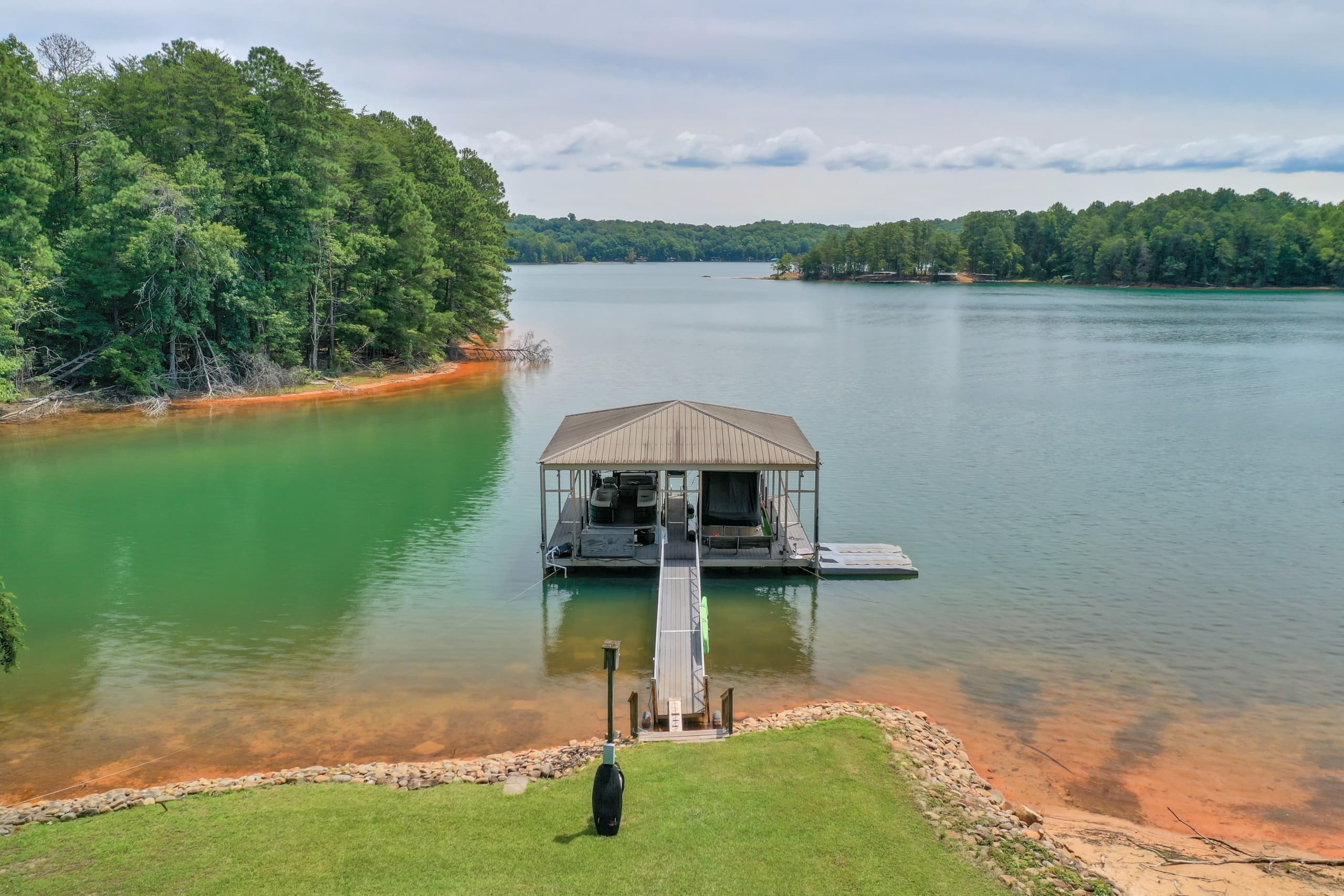
A private dock on Lake Lanier sits on shoreline associated with a single residential parcel and is permitted to that homeowner under a U.S. Army Corps of Engineers shoreline-use permit. The most common configurations are single-slip docks (one covered or uncovered boat slip, typical for cottage-scale and mid-tier waterfront homes), double-slip docks (two boat slips, often paired with a sundeck and a roof, the common build for new construction since the 2010s), and party docks (oversized platforms with seating decks, often grandfathered from older permits because USACE has tightened size allowances over time). Each category carries a different replacement cost, a different annual permit fee, and a different appeal to future buyers in the Cumming, Buford, and Gainesville submarkets.
Community docks, marina slips, and lake-access alternatives
Not every Lake Lanier home with water access has a dock attached to its own shoreline. Community docks serve subdivisions that share a permitted dock structure governed by an HOA — common in older developments around Flowery Branch and on parts of the south lake. Marina slips at Aqualand Marina, Holiday Marina, Sunrise Cove Marina, Habersham Marina, and Lanier Harbor offer leased slip rights without any shoreline attached, and homes that rely on a marina slip should be marketed as lake-access rather than waterfront. Lake-access homes inside lakeshore neighborhoods like those near Don Carter State Park and Lanier Islands Parkway typically convey with a community ramp or community dock rather than a deeded dock structure.
Why dock rights are central to Lake Lanier value
Dock rights drive the largest single price differential on Lake Lanier, and the math behind that differential is publicly visible in the multiple-listing data. Current market conditions require a dated MLS comparison that identifies the area, property type, reporting period, and sample before a buyer relies on it.
Dock Due Diligence for Buyers
Dock due diligence on Lake Lanier is a separate workstream from the home inspection and requires its own checklist. The dock can be the most expensive feature of the property and the easiest one to misread from the listing description alone, so buyers should plan to confirm the permit, the structure, and the cove conditions before contract deadlines lapse.
Verify permit status and dock compliance
USACE permits and licenses are nontransferable. A new owner of an existing facility may apply through the Lake Lanier Operations Management Office, and approval is not automatic. Confirm the property-specific record and current requirements before closing.
Understand change-of-owner procedures
USACE permits and licenses are nontransferable. A new owner of an existing facility may apply through the Lake Lanier Operations Management Office, and approval is not automatic. Confirm the property-specific record and current requirements before closing.
Confirm water depth, electrical condition, and shoreline access
Beyond the permit, the dock's physical usability deserves its own inspection pass. Water depth at the dock at full pool elevation 1,071 feet above sea level is the headline number, but the depth that matters for boating is the depth during USACE water-management operations and drought years, when Lake Lanier can drop several feet below full pool. Buyers should ask for current dock-side depth readings and ask whether the gangway length is sufficient to reach the dock at low pool. Dock electrical service should be inspected for code compliance, GFCI protection, and condition of the underwater connections. The shoreline access path — slope grade, steps, retaining walls, and distance from the home — should be walked at the time of showing.
Selling a Home with a Dock
Selling a Lake Lanier home with a dock is a different listing exercise than selling an off-water home in the same county. The dock itself is the asset most buyers will photograph, walk, and ask questions about, and the listing strategy should be built around verifiable dock facts rather than promotional language.
How dock access affects pricing and buyer demand
A single-slip dock on a shallow cove in north Hall County prices differently from a double-slip covered dock on a deep-water cove on the south lake near Buford, even with identical square footage. Current market conditions require a dated MLS comparison that identifies the area, property type, reporting period, and sample before a buyer relies on it.
Pre-listing dock and shoreline preparation
Pre-listing preparation for a Lake Lanier waterfront home should include a fresh review of the dock permit, the shoreline buffer, and the path from the home to the water. Sellers should confirm the permit is current, settle any open compliance items with USACE Mobile District before listing, and document the slip count, roof condition, gangway length, and electrical service in the listing notes. The shoreline buffer — the vegetated strip USACE requires between the home and the water — should be cleaned of debris without being cleared of permitted vegetation. Pressure-washing the dock deck, replacing any failing decking boards, and refreshing the gangway hardware are inexpensive steps that meaningfully improve showing presentation.
Marketing the dock without overpromising
Listing copy for a Lake Lanier home with a dock should describe the dock in falsifiable, specific terms: slip count, covered or uncovered, water depth at full pool, distance from the home, and permit transferability status. Vague phrases like 'deep-water dock' or 'party dock' invite buyer questions that erode trust if the answers do not match the description. Photographs taken at full pool from both the dock looking toward the home and the home looking toward the dock are the standard. The marketing copy should also disclose any Corps compliance items in progress, because the items will surface in due diligence regardless and earlier disclosure is the cleaner path.
Frequently Asked Questions
- Do all Lake Lanier dock permits transfer to a new owner?
- USACE permits and licenses are nontransferable. A new owner of an existing facility may apply through the Lake Lanier Operations Management Office, and approval is not automatic. Confirm the property-specific record and current requirements before closing.
- What is the annual dock permit fee on Lake Lanier?
- USACE Mobile District assesses a standard annual shoreline-use permit fee for each permitted private dock on Lake Lanier, billed to the permit holder of record. The fee covers the federal use authorization rather than any utilities, maintenance, or HOA charges. Buyers should request the most recent annual fee receipt during due diligence to confirm the permit is in good standing. The Corps adjusts the fee schedule periodically; current rates are published by USACE Mobile District for the Lake Sidney Lanier project.
- How deep does the water need to be at the dock?
- Water depth at the dock at full pool elevation 1,071 feet above sea level is the headline figure cited in listings, but the operational depth is the depth during summer drawdowns and drought years when Lake Lanier can drop several feet. Practical boating depth for a typical wakeboard or pontoon boat is generally considered 6 to 8 feet at the dock at the lowest expected pool. Coves deeper than 12 feet at full pool tend to retain enough depth through dry periods to keep boats in slip year-round.
- What does the USACE shoreline buffer rule require?
- U.S. Army Corps of Engineers shoreline-use rules require a vegetated buffer between the residential parcel and the water on Lake Lanier. Inside the buffer, homeowners may not clear native vegetation, install unpermitted structures, or modify the shoreline path without an approved permit amendment. The buffer is part of the Corps' lakewide shoreline management plan and is enforced at the parcel level. Buyers should walk the buffer at showing and confirm no compliance items are open with USACE Mobile District.
- What happens if the dock is not on the deed?
- Many Lake Lanier docks are not on the deed because the underlying shoreline is federal property managed by the U.S. Army Corps of Engineers, not private land. The dock conveys through the USACE shoreline-use permit, not through the deed. A community-permitted dock attached to an HOA-owned shoreline tract is a separate case and conveys with HOA membership, not with the home's private deed. Buyers should always confirm which structure governs the dock before contract.
- Are single-slip docks worth less than double-slip docks at Lake Lanier?
- Double-slip docks generally support a higher resale price than single-slip docks on Lake Lanier because they accommodate two boats, often include a covered roof and sundeck, and are the build standard for current waterfront new construction. However, the larger driver of dock value is cove depth and shoreline position, not slip count alone. A single-slip dock on a deep-water cove can outprice a double-slip dock on a shallow cove with the same home behind it.
Related
- Lake Lanier Dock Permits GuideHow USACE shoreline-use permits work, what buyers must verify, and what sellers should prepare before listing.
- Transferring a Lake Lanier Dock PermitChange-of-owner procedure, timing, and the contract contingency buyers should ask for.
- Lake Lanier Private Dock HomesWaterfront homes with private boat docks across Cumming, Buford, Gainesville, Flowery Branch, and Dawsonville.
- Deep-Water Dock Homes on Lake LanierWhy cove depth matters, how full pool affects usability, and how to verify depth before contract.
- Lake Lanier Water Levels & Full Pool 1,071How USACE water-management operations and drought years affect dock usability across the lake.
- Living at Lake LanierFull neighborhood guide: schools, market data, architecture, commute corridors, and adjacent communities.