
Buyer Guide
A Lake Lanier fishing home is a waterfront residence on the U.S. Army Corps of Engineers shoreline where parcel geometry, cove structure, and proximity to productive water support daily angling for striped bass, spotted bass, largemouth, crappie, and channel catfish across the 38,000-acre reservoir. Fishing-oriented buyers concentrate near the Chestatee River arm, the upper Chattahoochee arm above Browns Bridge, and the deep sub-coves off Forsyth County and Hall County where points, humps, brush piles, and creek-mouth structure hold seasonal fish. Distance from a public boat ramp and access to the main lake for striper tournaments out of Laurel Park, Van Pugh Park, and Tidwell Park drive the buyer-side filter.
Lake Lanier Homes for Outdoor Buyers
Lake Lanier waterfront homes oriented toward fishing serve outdoor buyers who treat the dock and the cove as daily angling infrastructure rather than as wake-sport launching points. The configuration favored by fishing households differs from a wake-sport waterfront because the diligence centers on fish-holding structure, productive cove geometry, and ramp access for tournament participation rather than on big-water frontage. Lake Lanier is managed by the U.S. Army Corps of Engineers Mobile District out of the Lake Lanier Project Management Office in Buford, Hall County, Georgia.
Fishing, kayaking, paddleboarding, boating, and lakeside living
Lake Lanier supports a year-round fishery that has shaped buyer demand for shoreline parcels with reliable angling access. Striped bass are the headline species; the Georgia Department of Natural Resources Wildlife Resources Division stocks Lanier annually, and the fishery produced a state-record striper of 47 pounds, 6 ounces caught in 2020 (Georgia DNR Wildlife Resources Division striper stocking and state-record records, as of Q1 2026). Spotted bass dominate the black-bass population on Lanier and draw tournament traffic out of Laurel Park, Van Pugh North, Van Pugh South, and Tidwell Park year-round. Crappie hold around brush piles and standing timber in the river arms, channel catfish work the deeper main-lake holes, and bream populations bed in spring shallows. Households that buy a fishing home use the dock for live-bait holding, rod storage, and pre-dawn launches.
Quiet coves, private docks, and homes near boat ramps
Fishing-oriented parcels on Lake Lanier are typically a hybrid: a quiet-enough cove to bank-fish and dock-fish without main-channel wake, paired with a short boat run to productive open-water humps, points, and brush piles. Long narrow sub-coves off the Chestatee River arm extending toward Dawson County and Lumpkin County are favored for crappie and largemouth, while sub-coves off the upper Chattahoochee arm near Gainesville and the Flat Creek and Mud Creek drainages produce mixed-species water close to the main channel. Proximity to a U.S. Army Corps of Engineers public boat ramp matters for tournament participation: Laurel Park ramp in Gainesville, Van Pugh North and Van Pugh South on the southern end, Tidwell Park on the upper Chestatee, and Bolding Mill near the Chattahoochee arm are the most frequently used launch points. A parcel within a 10-minute boat run to one of these ramps gives a tournament angler a workable home base.
Outdoor living spaces, decks, screened porches, and shoreline access
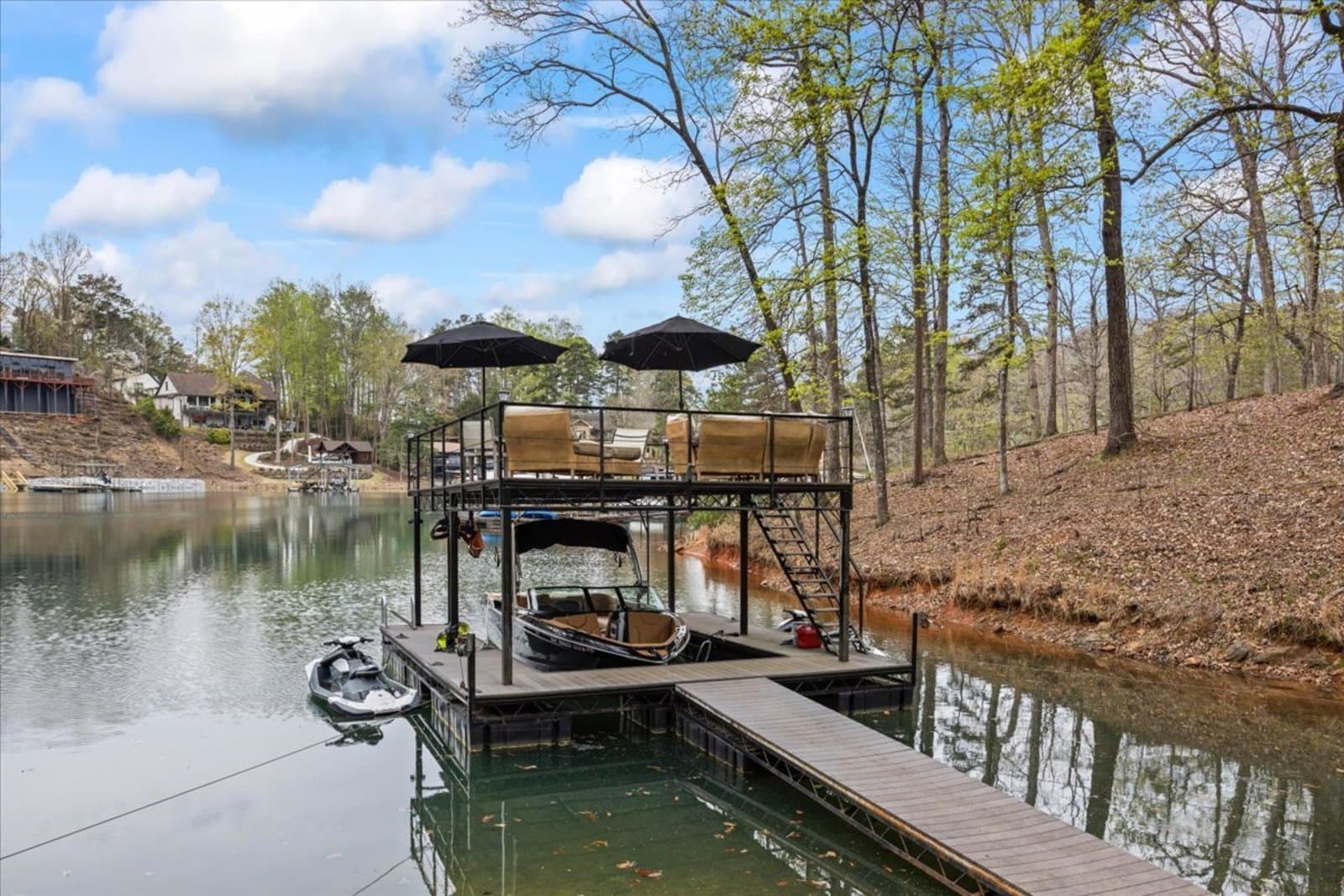
Fishing-home buyers usually evaluate the outdoor envelope as functional infrastructure rather than as a styling feature. Covered dock decks support rod-and-tackle storage, live-well rinse stations, and shaded summer fish-cleaning; screened porches above the slope handle bug pressure during spring shad spawns and summer striper runs; and gentle-to-moderate slope from the home to the dock allows easy gear transit at pre-dawn launch and post-tournament return. Shoreline access for bank fishing matters because Corps Line restrictions on Lake Lanier limit vegetation removal and grading inside the project boundary, which the USACE manages under the 2004 Lake Lanier Shoreline Management Plan. Buyers should confirm the existing shoreline-use permit, dock-class assignment, and any cleared-path easements with the USACE Lake Lanier Project Management Office in Buford as part of waterfront diligence.
What Fishing-Focused Buyers Should Compare
Fishing-focused buyers should compare Lake Lanier parcels on three dimensions that drive day-to-day angling utility: water depth and bottom structure off the slip, dock configuration relative to live-bait and gear handling, and the surrounding lake-use pattern that determines whether the cove fishes well in summer. The diligence is parcel-specific because cove geometry, USACE dock class, and proximity to productive structure all vary parcel to parcel across the more than 600 miles of shoreline managed by the Corps.
Water depth, cove location, and boat access
Water depth at the slip and the bottom structure inside the cove are the first filter for a fishing-oriented parcel. Deep sub-coves off the main body of Lake Lanier typically hold 20 to 40 feet of summer water at the cove mouth and shallow to single-digit feet at the back where feeder creeks deposit silt. Striped bass run deep on Lanier in summer, often holding at 40 to 60 feet near main-lake humps and points and pulling shallow at dawn and dusk for shad. Spotted bass hold tighter to structure year-round. USACE Mobile District lake-level records have shown Lake Lanier operating in the 1,070 to 1,071 foot full-pool elevation range during normal hydrology, with drawdown into the mid-1,060-foot range during dry late-fall periods, as of Q1 2026 (USACE Mobile District Lake Lanier lake-level public records, Q1 2026). Buyers should confirm slip depth at typical drawdown rather than only at full pool.
Dock setup, storage, and distance to open water
Dock configuration on Lake Lanier is governed by the existing USACE shoreline-use permit, which assigns dock class (single slip, double slip, party deck, covered, uncovered) and travels with the parcel under the 2004 Lake Lanier Shoreline Management Plan. Fishing-oriented households typically prioritize a covered single or double slip with usable deck space for rod storage, a hose hookup for live-well rinse, electrical service for trolling-motor and graph battery charging, and a permitted cleared path from the home to the dock that handles routine gear transit. Distance to open water matters for tournament participation because most Lake Lanier tournaments out of Laurel Park, Van Pugh, and Tidwell Park run on the main lake and the major creek arms. A 5 to 10 minute boat run from the slip to the main channel is a workable tournament base; a 25 minute run from a deep back-cove dock cuts effective fishing time on a 6-hour event.
Privacy, noise, traffic, and lake-use patterns
The lake-use pattern around a fishing-oriented parcel matters because the same water that fishes well in May can be unusable during a summer Saturday afternoon if the cove sits inside the wake field of the main channel. Quiet sub-coves off the Chestatee River arm and the upper Chattahoochee arm read as fishable water through the recreational peak because pass-through traffic is limited and posted no-wake segments near marina approaches and bridge corridors hold the wake down. Open-water shorelines along Browns Bridge, the Lanier Islands area, and the Buford Dam pool carry steady recreational wake during summer weekends and are typically fished early-morning, late-evening, or on weekdays. Fishing households should walk the dock at multiple times of day across a weekend before writing an offer, because the wake pattern reaching the slip is the most accurate read on whether the parcel supports daily angling.
Search Homes by Outdoor Lifestyle
Searching Lake Lanier fishing homes is most efficient when the filter is organized around how the household actually fishes rather than around the city or county boundary alone, because productive water, ramp access, and cove geometry cross county lines. Hall County, Forsyth County, Dawson County, Gwinnett County, and Lumpkin County each hold inventory that fits different angling profiles.
Quiet cove homes
Quiet-cove inventory on Lake Lanier overlaps heavily with fishing-oriented inventory because the same cove geometry that suppresses recreational wake also creates the brush-pile and creek-mouth structure that holds crappie, largemouth, and bream. Long narrow sub-coves off the Chestatee River arm near Dawsonville and the upper Chattahoochee arm near Gainesville are the geographies most frequently described in these terms by buyers and brokers familiar with Lanier. Buyers who plan to fish daily from the dock and the cove edge usually start the search in the North Lake area and the Chestatee arm and move south only when slope, dock class, or price drives the search into Forsyth County or Gwinnett County. The /lake-lanier-quiet-cove-homes inventory is the closest sibling filter and includes the contemplative-water parcels that double as workable fishing water.
Private dock homes
Private-dock inventory matters to fishing-oriented buyers because the dock is daily-use infrastructure rather than a weekend amenity. Dock class is set by the USACE Lake Lanier Project Management Office in Buford under the 2004 Lake Lanier Shoreline Management Plan and is non-trivial to change after closing. A covered slip with electrical service supports overnight live-bait holding for striper trips, a double-slip configuration supports a bass boat and a pontoon without a swap, and a permitted cleared path from the home reduces the gear-transit penalty at 4 a.m. departures. The /lake-lanier-private-dock-homes filter walks through dock-class permutations and the diligence specific to a permitted private dock on Corps shoreline.
Homes near ramps, marinas, parks, and recreation areas
Homes within easy boat range of USACE-managed public ramps and full-service marinas on Lake Lanier appeal to tournament anglers and visiting-guest households who launch trailered boats rather than relying solely on the slip. Laurel Park ramp in Gainesville, Van Pugh North and Van Pugh South on the southern end of the lake, Tidwell Park on the upper Chestatee, Bolding Mill on the Chattahoochee arm, and full-service marinas including Aqualand Marina, Holiday Marina, and Bald Ridge Marina serve the launch and refueling traffic. A parcel within a 5 to 10 minute boat run of one of these access points gives a fishing household a workable home base for both private dock-fishing and trailered tournament participation. Working with Ashley Smith of DreamSmith Realty on the buyer side allows a side-by-side comparison of fishing-oriented parcels across Hall County, Forsyth County, Dawson County, Gwinnett County, and Lumpkin County, with on-the-ground confirmation of slip depth, dock-class assignment, and the actual boat run to the nearest productive water. Ashley is licensed in Georgia (license #424319).
Frequently Asked Questions
- What fish species are most commonly targeted on Lake Lanier?
- Lake Lanier supports a year-round multi-species fishery with striped bass, spotted bass, largemouth bass, crappie, channel catfish, and bream as the headline targets. Striped bass are stocked annually by the Georgia Department of Natural Resources Wildlife Resources Division and drive most of the tournament traffic on the main lake. Spotted bass dominate the resident black-bass population and concentrate around main-lake humps, points, and brush piles. Crappie and bream hold around creek-mouth structure and standing timber in the river arms, and channel catfish work the deeper main-lake holes year-round.
- Where are the main public boat ramps on Lake Lanier for tournament fishing?
- The U.S. Army Corps of Engineers manages public boat ramps around Lake Lanier that serve most tournament and recreational launches. Laurel Park ramp in Gainesville, Van Pugh North and Van Pugh South on the southern end of the lake, Tidwell Park on the upper Chestatee River arm, and Bolding Mill on the Chattahoochee arm are the most frequently used launch points. Full-service marinas including Aqualand Marina, Holiday Marina, and Bald Ridge Marina also support trailered launches, refueling, and live-bait access. A waterfront home within a short boat run of one of these access points gives a tournament angler a workable home base.
- How does Lake Lanier striper season affect waterfront buyer demand?
- The striped bass fishery on Lake Lanier runs year-round with seasonal patterns that shape how anglers use a waterfront home. Spring and fall surface activity pulls striped bass into shallower water at dawn and dusk, summer fish hold deep on main-lake humps, and winter striper trips concentrate around shad schools in the creek arms. Households that buy specifically for striper fishing prioritize a covered slip for live-bait holding, electrical service for graph and trolling-motor batteries, and a short boat run to the main channel. The seasonal pattern is documented by the Georgia DNR Wildlife Resources Division and by long-running guide services on Lanier.
- What dock features matter most for a fishing-oriented waterfront home?
- Fishing-oriented households typically prioritize a covered single or double slip with usable deck space for rod and tackle storage, hose hookup for live-well rinse, electrical service for overnight battery charging and live-bait aerators, and a permitted cleared path from the home to the dock for routine pre-dawn gear transit. Dock class is set by the existing U.S. Army Corps of Engineers shoreline-use permit under the 2004 Lake Lanier Shoreline Management Plan and travels with the parcel. Buyers should review the permit, the dock-class assignment, and any compliance correspondence with the USACE Lake Lanier Project Management Office in Buford as part of standard waterfront diligence.
- Where do fishing-oriented parcels concentrate on Lake Lanier?
- Fishing-oriented inventory on Lake Lanier concentrates along the Chestatee River arm extending toward Dawson County and Lumpkin County, the upper Chattahoochee arm near Gainesville and Hall County, deep sub-coves off larger Forsyth County bodies, and parcels within short boat range of the Van Pugh ramps in Gwinnett County. The geographies overlap heavily with quiet-cove inventory because cove geometry that suppresses recreational wake also creates the brush-pile and creek-mouth structure that holds fish. The southern half of the lake near Buford Dam and Lake Lanier Islands carries higher main-channel traffic densities and fishes most reliably during early-morning, late-evening, or weekday windows.
- How does water level affect fishing access from a Lake Lanier waterfront home?
- U.S. Army Corps of Engineers Mobile District lake-level records have shown Lake Lanier operating in the 1,070 to 1,071 foot full-pool elevation range during normal hydrology, with drawdown into the mid-1,060-foot range during dry late-fall periods, as of Q1 2026 (USACE Mobile District Lake Lanier lake-level public records, Q1 2026). Shallow back-coves and slips near feeder-creek inflows can sit on muddy bottom during late-fall low pool and become non-functional for boat launches and live-bait operations. Buyers should confirm slip depth at typical drawdown rather than only at full pool, walk the dock during a drawdown window if timing allows, and review the historical water-level pattern with the seller.
Related
- Lake Lanier Quiet Cove HomesSheltered cove waterfront with lower boat traffic and contemplative-water character.
- Lake Lanier Private Dock HomesUSACE-permitted private-dock parcels and dock-class diligence context.
- Lake Lanier Waterfront HomesFull waterfront inventory across Hall, Forsyth, Gwinnett, Dawson, and Lumpkin counties.
- Lake Lanier Deep Water Dock HomesParcels with deep-water slip depth that hold usable depth through USACE water-management operations.
- Lake Lanier Community GuideFull neighborhood, market, school, and shoreline overview for Lake Lanier.
- Lake Lanier ListingsActive waterfront, lake-access, and land listings across the five lake counties.