
Community Guide
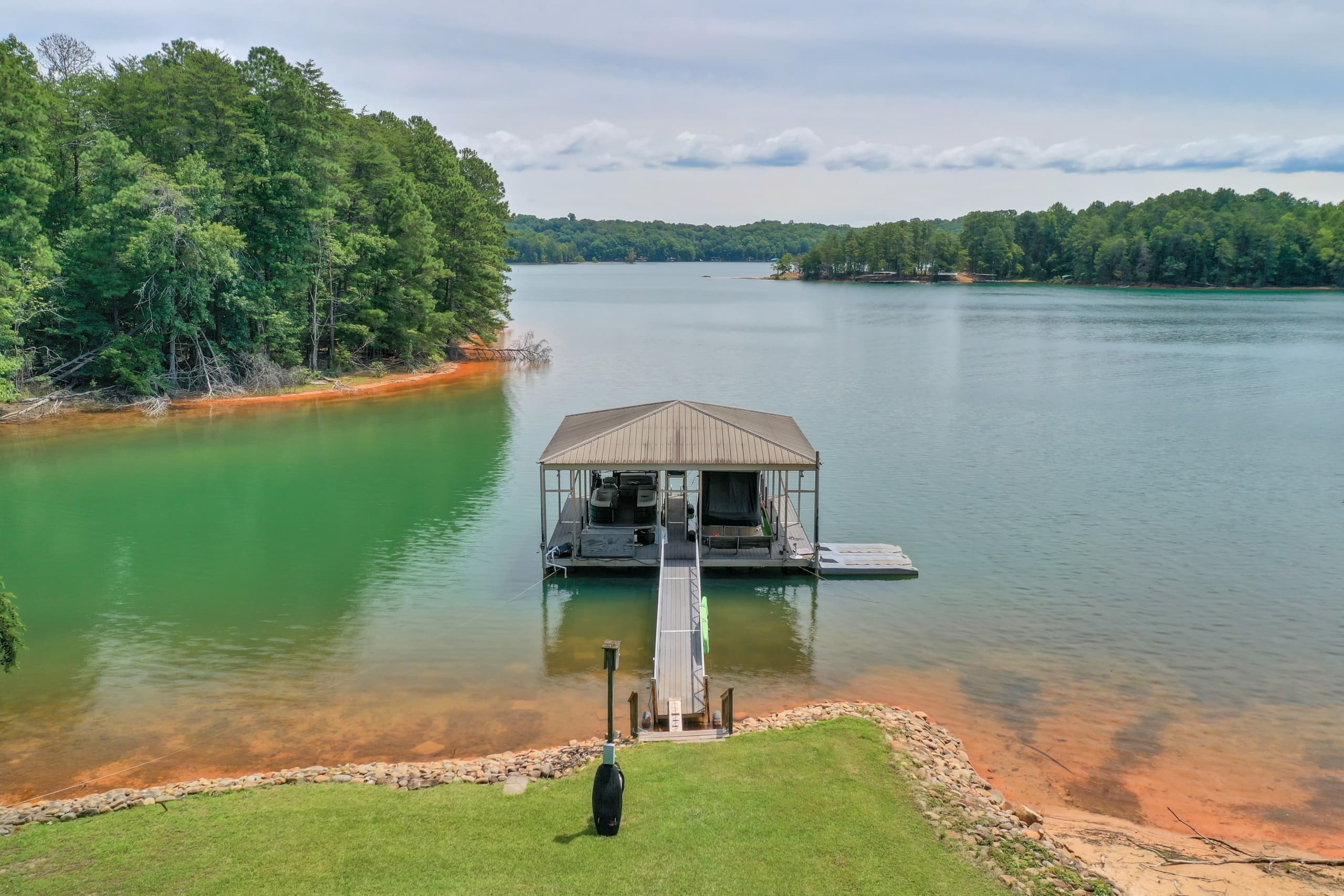
Lake Lanier community dock homes are properties that grant the owner access to a shared dock or slip facility managed by a homeowners association rather than a private USACE-permitted dock attached to the parcel. The community dock model is common across lake-access subdivisions in Forsyth County, Hall County, Dawson County, and Gwinnett County on the Lake Lanier shoreline, and slip rights typically flow through the HOA bylaws rather than through a parcel-specific U.S. Army Corps of Engineers Mobile District permit (USACE Mobile District, current as of May 2026). Buyers shortlisting community dock homes should confirm slip assignment, waitlist position, boat size limits, and transfer rules in writing before relying on the dock as guaranteed lake access.
How Community Dock Homes Work
Community dock homes deliver Lake Lanier access through a shared facility licensed by the U.S. Army Corps of Engineers Mobile District to the homeowners association rather than to an individual lot. The structure compresses cost and maintenance for the owner but introduces governance, waitlist, and assignment risk that does not exist on a private-dock parcel.
Community slips, shared docks, and HOA-controlled access
A Lake Lanier community dock is a multi-slip facility built and maintained under a community dock permit issued by the U.S. Army Corps of Engineers Mobile District to a homeowners association under the Lake Sidney Lanier Shoreline Management Plan administered by the U.S. Army Corps of Engineers (USACE Mobile District, current as of May 2026). The HOA holds the permit of record, the HOA's board administers slip assignments, and individual homeowners receive use rights through the community's covenants, conditions, and restrictions rather than through a permit attached to their deed. Slip access on Lake Lanier community docks typically takes one of three forms. Some communities assign a numbered slip to each lot at closing, which travels with the deed; others operate a rotating or waitlist-based assignment refreshed annually; and a few operate first-come, first-served daily use with no fixed assignment. The form matters because it determines whether the buyer is purchasing a guaranteed slip or only the right to enter a queue, and the HOA documents almost always control the answer rather than the listing description. Some communities also operate a shared day-use dock, swim platform, or boat ramp alongside the slip facility, and the access rules for each amenity are written into the HOA documents. The practical effect for a buyer is that the dock is real but the buyer's specific access is governed by the HOA rather than the Corps. Buyers should request the current HOA bylaws, the slip assignment policy, the most recent annual meeting minutes, and the slip waitlist (where one exists) during the due diligence period rather than relying on the listing agent's description of community dock rights.
How community docks differ from private dock ownership
Private dock ownership on Lake Lanier, the 38,000-acre U.S. Army Corps of Engineers reservoir on the Chattahoochee River formed by Buford Dam in 1956, means the U.S. Army Corps of Engineers Mobile District has issued a single-slip or double-slip permit to a specific shoreline parcel, and the permit is assignable to the new owner at closing under standard transfer procedures (USACE Mobile District, current as of May 2026). The dock sits on Corps-managed shoreline immediately adjacent to the home, the owner controls scheduling and maintenance, and the price of the home reflects the embedded dock value. A community dock, by contrast, sits on a parcel held by the HOA, is shared across multiple homes, and produces a different cost, maintenance, and access profile. Cost moves in opposite directions on the two models. Current market conditions require a dated MLS comparison that identifies the area, property type, reporting period, and sample before a buyer relies on it. Maintenance, scheduling, and privacy also differ. Private-dock owners absorb the dock repair, repainting, electrical, and water-side maintenance lines directly but control the dock's availability and condition. Community dock owners pay into the HOA's dock reserve through dues and special assessments and accept shared scheduling, shared maintenance timing, and a common appearance standard set by the board. Buyers should evaluate which trade-off fits the planned use rather than treating one model as universally better.
Why buyers should confirm slip assignment, waitlists, and rules
A community dock listing description that says the home includes lake access is not a contract. The contract is the HOA's covenants, the slip assignment policy, and any amendment the board has passed since the most recent governing document was recorded. Buyers should request these documents during the due diligence period and read them, because slip access on Lake Lanier community docks varies far more than buyers typically expect. Waitlist position is the variable most often missed. Some Lake Lanier community docks have full slip assignment with every lot covered; others operate with a meaningful waitlist where a new owner may wait months or years before a slip becomes available. Communities with strong long-term retention in the assigned slips can produce a multi-year wait, and buyers who assume same-summer slip access may discover a different reality after closing. The HOA's seller disclosure or estoppel letter should confirm the buyer's actual slip status at the closing table. Rules around boat size, boat type, overnight use, guest access, and trailer storage also vary community by community. Some Lake Lanier HOAs limit slips to runabouts and bowriders under a stated length; others accommodate larger wakeboats, pontoons, and cruisers. Some prohibit personal watercraft entirely; others designate specific slips for them. Buyers should confirm their planned boat fits both the slip dimensions and the community's written rules before assuming the slip works for their use, and should re-confirm the rules with the HOA management company rather than the listing agent.
Buyer Considerations for Community Dock Properties
Community dock properties on Lake Lanier resolve into three buyer-side questions: what does the HOA actually cost and control, what is the real slip availability for this lot, and what is gained or given up versus a private-dock alternative. The honest answer to each requires document review rather than agent description.
HOA fees, marina rules, and community restrictions
HOA fees on Lake Lanier community dock developments cover a different cost stack than a typical interior subdivision's dues, because the dock reserve, the shoreline maintenance, the community boat ramp, and any swim platform or day-use amenity all sit inside the HOA budget. Annual dues at Lake Lanier dock communities range widely, with smaller communities operating modest annual budgets and larger amenity-rich communities running multi-thousand-dollar annual dues plus periodic special assessments tied to dock replacement cycles. Buyers should pull the current budget, the reserve study, and the past three years of special assessments before relying on the headline dues figure. Marina-style rules apply at most community docks because the U.S. Army Corps of Engineers Mobile District treats community dock facilities as a regulated shoreline use. Rules typically cover slip insurance requirements, registration of boats with the HOA, restrictions on fueling at the dock, mandatory pump-out at off-site marinas, and limits on shoreline modification near the dock (USACE Mobile District, current as of May 2026). Some HOAs administer a key-card or gate access system, parking limits, and trailer-storage rules in addition to the dock itself. Community restrictions extend beyond the dock into the home and the lot. Architectural review committees control exterior changes, paint colors, fences, and landscaping in most planned Lake Lanier communities, and short-term rental rules vary widely across Forsyth County, Hall County, Dawson County, and Gwinnett County HOAs as well as at the county level. Buyers planning to short-term rent the home should confirm both the HOA position and the county short-term rental ordinance before purchase, because either layer can prohibit the use even when the other layer permits it.
Slip availability, boat size limits, and transferability questions
Slip availability is the buyer's most important due diligence question on a community dock property. The seller's disclosure, the HOA's current slip roster, and the management company's written confirmation of the buyer's slip status at closing should all align. Buyers should not close on a community dock home with a verbal assurance about slip access; the documentation should be on paper, dated, and in the buyer's closing file. Boat size limits are written into most Lake Lanier community dock rules and reflect both the slip's physical dimensions and the dock's permitted use class under the U.S. Army Corps of Engineers Mobile District shoreline framework. A community dock built for runabouts in the 18 to 22 foot range does not accommodate a 26 foot wake-surf boat regardless of slip availability, and the HOA's rule book typically codifies the limit. Buyers planning to upgrade to a larger boat after purchase should confirm the slip and the community rules support the upgrade before assuming the dock works long term. Transferability deserves a separate check at every transaction. In communities with deed-assigned slips, the slip travels with the deed automatically; in communities with rotating or waitlist assignment, the buyer effectively starts a new relationship with the HOA at closing and may inherit the seller's waitlist position only if the bylaws explicitly preserve it. Buyers and their agents should obtain the HOA's written transferability rules before assuming any specific slip access transfers to the new owner. The estoppel letter at closing should confirm the buyer's slip status in writing.
Convenience vs. privacy tradeoffs
Community dock living trades private control for shared access and amenity scale. The convenience side is meaningful. The community absorbs dock repair, repainting, electrical, water-line, and shoreline maintenance through the HOA reserve, the homeowner does not carry the dock-insurance line individually, and the dock can deliver amenities such as covered slips, a swim platform, or a shared boat ramp that a private single-slip dock typically does not. Owners with light boating use, second-home cadence, or limited interest in dock maintenance often find the community model strictly easier than private ownership. The privacy side runs the other direction. Shared docks mean shared neighbors at the water's edge, shared scheduling for slip access on summer weekends, shared appearance standards on the boat and slip, and shared rule enforcement when the HOA board changes a policy. Owners who value walking from the back door to a private slip with no shared traffic, who plan to entertain on the dock regularly, or who want to customize the slip with personal lifts, lighting, or storage typically find the private-dock model better suited to the use. The right call depends on planned use, not on a feature-by-feature comparison. Buyers who plan 30 to 50 boating days per year, store a single mid-size boat, and value low maintenance often choose community dock homes. Buyers who plan 80 plus boating days per year, want flexibility to upgrade boats, and prefer direct shoreline access often choose private-dock waterfront. The price difference between the two models typically funds the maintenance and insurance line on the private-dock side rather than disappearing.
Best Fit for Community Dock Living
Community dock homes on Lake Lanier fit a specific buyer profile better than private-dock waterfront does. The fit usually resolves on three variables: cadence of use, willingness to absorb dock maintenance, and the size of the lake-access budget relative to private-dock pricing in the same shoreline corridor.
Low-maintenance second-home buyers
Second-home buyers who plan to use the Lake Lanier property 30 to 80 nights per year, who live in the Atlanta metro or a nearby market, and who do not want to manage dock maintenance from a primary residence elsewhere typically anchor on community dock homes early in the search. The HOA absorbs the dock reserve, the shoreline maintenance, the boat ramp, and any common-area landscaping, and the homeowner pays a predictable annual dues line rather than absorbing surprise repair costs across a 200-night-per-year usage profile. The second-home use case also benefits from the community amenity scale that a single-lot private dock cannot match. Many Lake Lanier community dock developments operate a shared swim platform, a clubhouse, a pool, a boat ramp, and an organized social calendar that delivers value on weekend visits without requiring the owner to coordinate or maintain them. Owners who arrive on Friday and depart on Sunday across a typical season find the turnkey amenity package easier than running an equivalent program from a single waterfront parcel. The carrying-cost math typically works out in the second-home buyer's favor as well. Property tax, dues, and the operating cost of a community dock home in Forsyth County, Hall County, Dawson County, or Gwinnett County across a 200-night occupancy year typically scale to a lower total than the equivalent private-dock waterfront's tax, dock insurance, dock maintenance, and operating cost, freeing budget for boat ownership or other lake-side spending.
Buyers who want lake access without private dock maintenance
Some buyers want Lake Lanier as part of life without wanting Lake Lanier as a part-time maintenance role. Private docks on Lake Lanier require annual inspections, periodic electrical and lighting upgrades, repainting and roof maintenance on covered slips, replacement of flotation, dock-line and bumper upkeep, and a coordinated relationship with the U.S. Army Corps of Engineers Mobile District for any shoreline modification (USACE Mobile District, current as of May 2026). The work is real and the cost band is real, even on a well-built dock. Community dock living shifts the maintenance role from the homeowner to the HOA. The board contracts dock repair, the reserve study sets the replacement timeline, and the dues fund the work on a smoothed annual basis rather than a surprise repair year. Owners who value predictability over control typically prefer this structure, and buyers transitioning from a primary residence with no waterfront experience often find the community model a softer on-ramp to lake ownership than a private dock would be. The other group inside this segment is the buyer who plans to keep a boat at a marina rather than at home. Lake Lanier marinas, including Aqualand Marina, Sunrise Cove Marina, Holiday Marina, Lake Lanier Islands Resort marina, and Habersham Marina, offer slip rental and full-service marina access on the southern and central shoreline. Buyers using a marina slip do not need a private dock at the home and often pair marina slip rental with a community dock home for hybrid access and lower carrying cost.
Compare community dock homes with Ashley Smith
Comparing community dock homes against private-dock waterfront on Lake Lanier requires both the home-level analysis and the HOA-level analysis side by side. Buyers should run total annual carrying cost (dues, taxes, insurance, dock maintenance or HOA reserve contribution), the realistic slip access (assigned, waitlist, or rotating), and the documented community rules (boat size, short-term rental, architectural review) against the planned use rather than evaluating the homes on listing photos alone. The shortlist also benefits from a corridor-specific reality check. Community dock developments on the southern shoreline near Buford, Cumming, Flowery Branch, Sugar Hill, and Gainesville sit closer to the Atlanta metro and trade at a different price band than community dock developments on the upper arms in Hall County and Dawson County. Buyers should match the corridor to the planned commute, weekend pull from Atlanta via GA-400 or I-985, and healthcare access at Northside Hospital Forsyth and Northeast Georgia Medical Center in Gainesville (Georgia Department of Transportation, current as of January 2026). Ashley Smith, real estate agent with The Dream Smith Team at Compass, can build a comparison shortlist that prices the community dock and private-dock paths on the same basis and runs both against the live Lake Lanier inventory, anchored in documented USACE Mobile District, Georgia MLS, county HOA records, and county short-term rental ordinances rather than category averages. Buyers benefit most from running the comparison before falling in love with a single listing, because the trade-offs are easier to evaluate on paper than after a private showing.
Frequently Asked Questions
- What is a Lake Lanier community dock home?
- A Lake Lanier community dock home is a property whose lake access is provided through a shared dock facility owned and managed by the homeowners association rather than through a private dock permitted to the individual parcel. The community dock typically operates under a community dock permit issued by the U.S. Army Corps of Engineers Mobile District to the HOA under the Lake Sidney Lanier Shoreline Management Plan administered by the U.S. Army Corps of Engineers (USACE Mobile District, current as of May 2026). Slip access flows through the HOA's covenants, bylaws, and assignment policy rather than through a permit tied to the deed.
- How much do Lake Lanier community dock homes cost compared to private dock waterfront?
- Community dock home pricing varies widely by community and amenity package, and buyers should run a corridor-specific comparison rather than relying on a single lake-wide figure. Current market conditions require a dated MLS comparison that identifies the area, property type, reporting period, and sample before a buyer relies on it.
- Is the slip at a Lake Lanier community dock guaranteed when I buy the home?
- Not automatically. Slip access at Lake Lanier community docks is governed by the HOA's covenants, bylaws, and slip assignment policy, and the structure varies from deed-assigned slips that travel with the property to rotating or waitlist-based assignments. Buyers should request the current HOA documents, the slip roster, and an estoppel letter or written confirmation from the management company before closing. The verbal description in a listing is not a contract; the HOA documents and the estoppel are.
- Are there boat size limits at Lake Lanier community docks?
- Most Lake Lanier community docks set boat size limits in their HOA rules, reflecting both the physical slip dimensions and the dock's permitted use class under the U.S. Army Corps of Engineers Mobile District shoreline framework (USACE Mobile District, current as of May 2026). Limits vary by community and can cover length, beam, weight, and personal watercraft. Buyers planning to bring a specific boat or upgrade after purchase should confirm the slip and rule book accommodate the boat before closing rather than after.
- What HOA fees should I expect at a Lake Lanier community dock development?
- Annual HOA dues at Lake Lanier community dock developments cover the dock reserve, shoreline maintenance, any boat ramp or swim platform, and common amenities, and they range from modest annual budgets at smaller communities to multi-thousand-dollar annual dues plus periodic special assessments at larger amenity-rich communities. Buyers should pull the current budget, the most recent reserve study, and the past three years of special assessments to understand the real carrying cost rather than relying on the headline dues number. Lender requirements often include a reserve study review during the due diligence period.
- Can I short-term rent a Lake Lanier community dock home?
- Sometimes, but two layers govern the answer. The HOA's covenants and amendments control rental restrictions inside the community, and the county short-term rental ordinance controls rentals at the municipal level in Forsyth County, Hall County, Dawson County, or Gwinnett County. Either layer can prohibit short-term rentals even when the other layer permits them. Buyers planning to rent the home should confirm both layers in writing before closing rather than assuming a community dock home supports rental income.
Related
- Lake Lanier Lake Access HomesLake-access communities, shared docks, marina access, and lakefront alternatives across the Lanier shoreline.
- Lake Lanier Waterfront HomesPermitted-dock private waterfront listings across the Lake Lanier shoreline.
- Lake Lanier Dock Builder Resource GuideUSACE-permitted dock construction, repair, and shoreline rules on Lake Lanier.
- Lake Lanier Dock Sizes and TypesSingle-slip, double-slip, and community dock permit classes across the Lanier shoreline.
- Buford Communities on Lake LanierBuford-area community guide for buyers shortlisting lake-access and waterfront homes.
- Lake Lanier Cost of OwnershipAnnual carrying-cost model including HOA dues, dock maintenance, property tax, and insurance.