
Community Guide
Four Seasons is a named Lake Lanier residential community positioned for buyers who want lake-area lifestyle access without the full price band of front-line deep-water waterfront. Located in the Lake Lanier corridor across Hall County and Forsyth County, Georgia, the community typically combines a defined HOA, an amenity package, and either direct shoreline access or short-drive proximity to a U.S. Army Corps of Engineers Mobile District public ramp. Buyers shortlisting Four Seasons usually weigh HOA structure, dock or slip arrangement, school attendance under the Hall County School District or Forsyth County Schools, and resale trajectory relative to neighboring Lake Lanier communities before committing.
Living in Four Seasons Near Lake Lanier
Four Seasons fits buyers who value a defined HOA, predictable amenity access, and proximity to Lake Lanier without necessarily underwriting a private deep-water dock. The community's lake-area positioning means daily life is organized around boating season, Corps-managed public access points, and the broader Lake Lanier recreation calendar that runs from spring drawdown through fall pool elevations.
Neighborhood setting and lake-area lifestyle
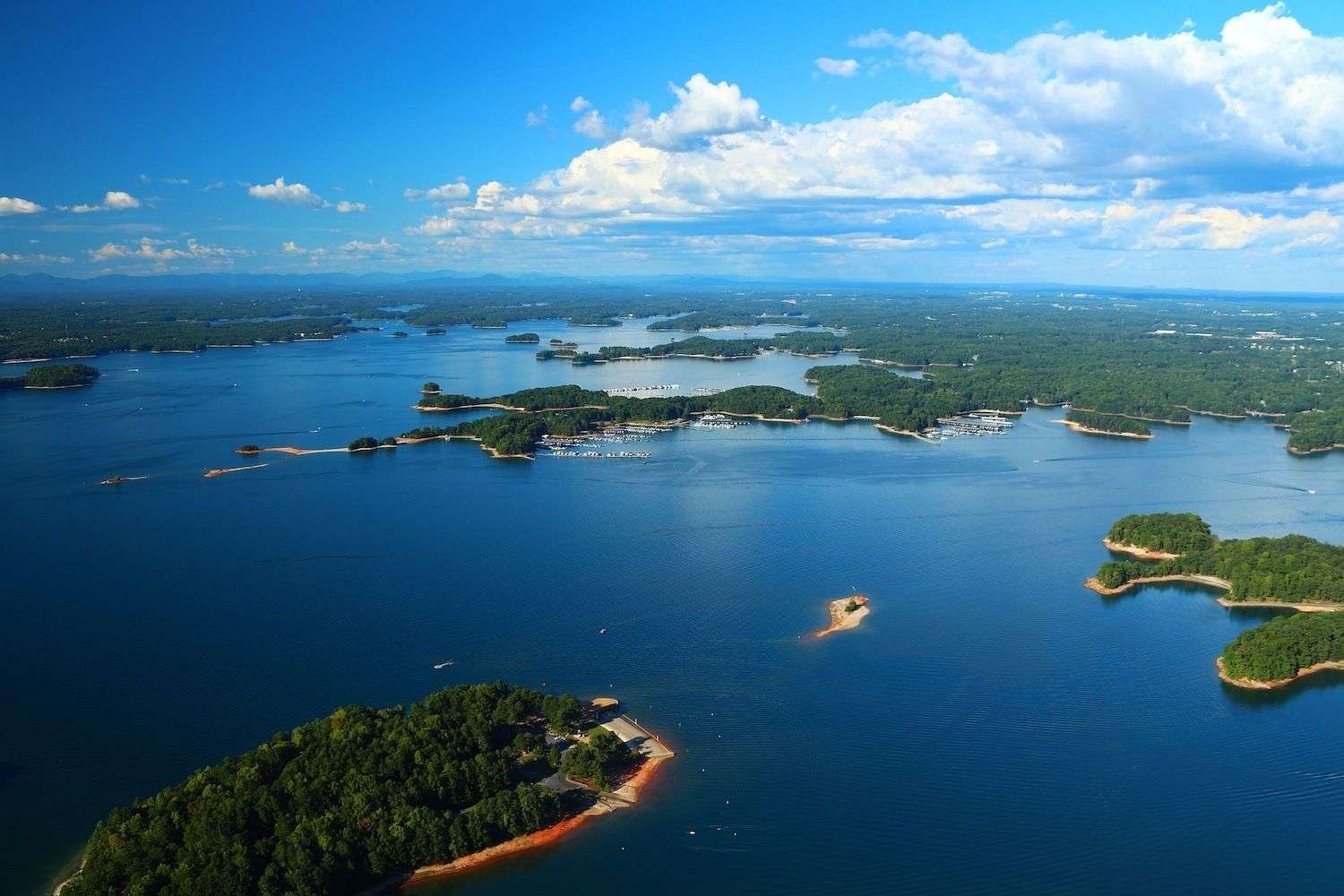
The Four Seasons setting reads as a planned residential subdivision inside the Lake Lanier corridor, with street layout, lot sizing, and architectural character that reflect a single development era rather than the patchwork of one-off lake homes that dominate older shoreline pockets. Buyers walking the community typically see a defined entry, internal connector roads, and a consistent set of architectural elevations, which tends to keep curb-appeal turnover within a tighter band than scattered shoreline parcels in the same ZIP code. Lake-area lifestyle in Four Seasons resolves around access patterns more than direct shoreline ownership. Residents typically reach the water through community amenity arrangements, nearby U.S. Army Corps of Engineers Mobile District public ramps and day-use parks, or partner marinas, rather than through a private dock attached to every lot. The U.S. Army Corps of Engineers Mobile District manages Lake Lanier at a full-pool elevation of 1,071 feet above mean sea level under its Lake Sidney Lanier Shoreline Management Plan administered by the U.S. Army Corps of Engineers, and that pool-level rhythm sets the daily lake-use cadence across all Lanier communities (USACE Mobile District, current as of May 2026). Pool elevation fluctuates seasonally and during drought years, which changes ramp depths, dock heights, and shoreline access points across the lake. Residents who organize boating around the Corps-published lake level chart tend to plan ramp days, dock visits, and shoreline activities with fewer surprises than residents who treat the lake as a fixed elevation across the calendar year. Daily rhythms in Four Seasons typically follow the lake calendar. Spring brings rising pool levels and the return of weekend boating; summer carries the heaviest dock and ramp usage; fall offers cooler boating days with thinner ramp traffic; winter drops the pool level for shoreline maintenance and brings quieter weekends. Buyers who prioritize the lake calendar over urban amenity density tend to settle into Four Seasons more comfortably than buyers who want a downtown-walkable lifestyle.
Homes, amenities, and nearby recreation access
Home stock in Four Seasons typically reflects a single-developer build period, which means floor plans, lot sizing, and exterior elevations cluster within a narrower band than the broader Lake Lanier resale market. Buyers should expect a defined set of plan types rather than the wide stylistic range found on the open Lanier shoreline. Square footage, garage configuration, and lot-to-house ratios tend to be more consistent across the community, which simplifies the comparative market analysis when pricing a resale. Community amenities in a lake-area HOA-defined subdivision typically include some combination of a pool, a clubhouse, walking trails, and in many cases a community boat ramp, day-use dock, or partner marina arrangement that gives residents lake access without each lot carrying an individual U.S. Army Corps of Engineers Mobile District permit. Buyers should confirm the specific amenity list, the HOA fee schedule, and whether boat or trailer storage is permitted on lot before assuming any amenity is guaranteed. The amenity package is one of the most important pricing variables in any Lake Lanier HOA community. Nearby recreation access extends well beyond the community boundary. Lake Lanier's USACE-managed shoreline includes more than 70 day-use parks, public boat ramps, and recreation areas distributed across Hall County, Forsyth County, Dawson County, and Gwinnett County (USACE Mobile District, current as of May 2026). Residents within a short drive of multiple Corps ramps can effectively use the lake at a frequency comparable to private-dock owners, with the trade-off of ramp-day logistics rather than walk-out water access.
How Four Seasons fits Lake Lanier buyers
Four Seasons typically fits buyers who want a defined HOA structure, predictable maintenance and amenity costs, and a lake-area address without the price premium of a permitted deep-water private dock. This buyer profile is common on Lake Lanier because the spread between a community amenity arrangement and a private double-slip dock parcel can run six figures or more in the same ZIP code, which makes the HOA-amenity path attractive for buyers whose lake use is weekend-focused rather than daily. Buyers shortlisting Four Seasons against open-shoreline resale inventory should price the HOA fee schedule, the lake-access mechanism, and any boat-storage rules into the decision rather than comparing list prices alone. A Four Seasons home with predictable HOA-managed amenities can carry a different total cost of ownership than a same-price open-shoreline home that requires individual dock maintenance, individual shoreline-management coordination with the Corps, and full responsibility for landscape and erosion control along a private waterfront. Finally, Four Seasons typically fits buyers who value community identity. Single-developer Lake Lanier subdivisions deliver a defined social fabric around the clubhouse, pool, and HOA-organized events that scattered shoreline parcels do not. Buyers who want that identity tend to surface Four Seasons early in the search; buyers who want maximum lot privacy and zero HOA oversight typically gravitate toward the open shoreline instead.
Buyer Questions to Ask
Most Four Seasons buyer questions resolve into three buckets: HOA mechanics, lake-access mechanics, and resale-context mechanics. Buyers who pull HOA documents, confirm the lake-access path in writing, and benchmark recent comparable sales tend to underwrite the community with far less surprise than buyers who anchor on list price alone.
HOA rules, community features, and fees
Buyers should request the full HOA governing documents before writing an offer. That package typically includes the covenants, conditions, and restrictions (CC&Rs), the bylaws, the most recent annual budget, the reserve study, and the current dues and assessment schedule. The reserve study in particular tells the buyer whether the HOA is funded to handle pool, clubhouse, road, and amenity maintenance over the next decade, or whether a special assessment is plausible. Key HOA rules to read carefully include short-term rental restrictions, boat and trailer storage rules, exterior modification approvals, fencing and shoreline-vegetation rules where applicable, and any community-dock or ramp-access rules. Lake Lanier communities vary widely on short-term rental policy, and the policy directly affects both lifestyle fit and resale buyer pool. Buyers planning to rent the home for weekends should not assume short-term rental is permitted without written confirmation. Dues structure matters as much as dues amount. A community with lower dues and a thin reserve can carry a higher long-run cost than a community with higher dues and a fully funded reserve. Buyers should compare the dues line against the amenity package, the reserve health, and any historical special-assessment pattern from prior board minutes before assuming the dues number reflects the true cost of community membership.
Lake access, commute, and nearby services
Lake access in Four Seasons should be confirmed in writing, not inferred from marketing language. Buyers should ask whether the community holds a U.S. Army Corps of Engineers Mobile District community-dock permit, whether residents share a private ramp, whether boat slips are assigned or first-come, and whether nearby Corps ramps or partner marinas are the primary access path (USACE Mobile District, current as of May 2026). Each of these answers materially changes the daily lake-use experience and the resale value of the community membership. Commute patterns from Lake Lanier communities typically run south on Interstate 985 to Interstate 85 toward Buford, Sugar Hill, Suwanee, Duluth, and ultimately the Atlanta core, or west via Georgia 400 from the Forsyth County side toward Cumming, Alpharetta, and Sandy Springs. Buyers should drive the actual commute at the actual time of day they will travel before assuming the corridor is workable. Lake Lanier commute times vary significantly between off-peak and peak windows. Nearby services are a daily-life variable that gets under-weighted in lake-community shopping. Grocery, urgent care, pharmacy, hardware, marine fuel, boat service, and weekend dining options should be inventoried within a defined radius before committing. Hall County hubs around Gainesville and Forsyth County hubs around Cumming each carry full service stacks, and the relative drive time from Four Seasons to each hub typically defines weekly logistics more than the lake address itself.
Property condition, resale context, and comparable communities
Property condition in any Lake Lanier subdivision skews toward the build era. Buyers should pull a full home inspection, a separate HVAC review on older systems, a roof age check, and where applicable a structural review on basements that sit on slope-graded shoreline lots. Resale homes in single-developer communities sometimes share systemic issues from the original build, and a Lake Lanier specialist inspector who has worked the community before will spot patterns a general inspector may miss. Lake-access HOA communities without individual private docks typically trade below that band, with pricing tied to amenity quality, HOA financial health, and proximity to lake access points. Current market conditions require a dated MLS comparison that identifies the area, property type, reporting period, and sample before a buyer relies on it. Comparable communities to benchmark against include other lake-area HOA subdivisions in Hall County and Forsyth County, particularly those built in similar eras with similar amenity packages. Buyers should ask their agent to pull three to six like-for-like recent sales, compare HOA dues, amenity scopes, and lake-access arrangements, and use that comparison to anchor offer price rather than relying on the single Four Seasons listing in isolation.
Buying or Selling in Four Seasons
Buying or selling in Four Seasons rewards a disciplined process anchored in current Lake Lanier inventory, HOA documentation, and lake-access verification. The community sits within a broader Lake Lanier market where buyer behavior shifts seasonally with the lake calendar, and sellers who price and position around that calendar tend to clear at fairer numbers.
Current listings and recent market activity
Current listings inside Four Seasons turn over on a different cadence than the broader Lake Lanier shoreline. Single-developer subdivisions typically run thinner active inventory at any one time, which means buyers may need to be patient or expand the shortlist to adjacent lake-area HOA communities while waiting for a fit to surface. Sellers benefit from this same dynamic on the listing side, because direct competition within the community at any one moment is often limited. Buyers should track the most recent 90 days of closed sales rather than the trailing 12-month average, because rate environment changes have shortened the relevance window of older comps. Current market conditions require a dated MLS comparison that identifies the area, property type, reporting period, and sample before a buyer relies on it. Days on market in any Lake Lanier community vary with the lake calendar. Listings hitting the market in March and April typically clear faster than listings hitting in November or December, because buyer demand peaks alongside boating season. Sellers who can time the listing to align with the spring buyer cycle generally see tighter days-on-market and stronger negotiating posture than sellers who list against the winter trough.
Seller strategy for community and lifestyle positioning
Seller strategy in Four Seasons should lead with community and lifestyle positioning rather than with raw square footage and finish list. The buyer pool drawn to a single-developer Lake Lanier subdivision is buying into the HOA, the amenity package, and the lake-area lifestyle as much as the four walls of the specific home. Listing photography, copy, and showing flow should foreground the community amenities, the lake-access mechanism, and the daily rhythm of living in the neighborhood. Pre-list preparation in a Lake Lanier community should include a HOA-documents package ready for buyer review at first showing. Buyers shopping HOA subdivisions on Lanier ask the same questions repeatedly: dues, reserve health, short-term rental policy, lake-access mechanism, boat storage rules, and any pending assessments. Sellers who have those answers documented and available at the first showing meaningfully shorten the offer cycle and reduce the chance of an inspection-period renegotiation rooted in HOA surprise. Pricing strategy should anchor in three to six like-for-like comps inside Four Seasons and adjacent Lake Lanier HOA communities, adjusted for amenity package, lake-access quality, and HOA dues differential. Sellers who anchor on a generic Lake Lanier median without adjusting for the lake-access mechanism typically misprice in either direction. The right comp set is amenity-and-access-aligned, not just ZIP-code-aligned.
Schedule a Four Seasons consultation
Buyers and sellers evaluating Four Seasons benefit from a community-specific consultation that resolves the lake-access mechanism, HOA financial health, and recent comparable-sale picture before committing to an offer or a list price. The Lake Lanier market is wide enough that generic Atlanta-metro guidance regularly misses the dock-permit, shoreline-management, and HOA-amenity variables that drive Lanier-specific value. A Four Seasons consultation typically walks through the active inventory, the most recent 90 days of closed sales inside the community and adjacent HOA subdivisions, the HOA fee schedule and reserve health, the lake-access mechanism, and the resale-trajectory picture relative to surrounding Lake Lanier communities. Buyers leave the consultation with a defensible offer band; sellers leave with a documented pricing strategy and a positioning brief. Ashley Smith, real estate agent with The Dream Smith Team at Compass, can run a Four Seasons consultation anchored in U.S. Army Corps of Engineers Mobile District shoreline data, Hall County and Forsyth County property records, and Georgia MLS comparable-sale data rather than category averages. The consultation is built around documented sources, current inventory, and the specific community's HOA and lake-access mechanics.
Frequently Asked Questions
- What kind of community is Four Seasons at Lake Lanier?
- Four Seasons is a named lake-area residential community in the Lake Lanier corridor across Hall County and Forsyth County, Georgia, typically organized around a defined HOA and a consistent set of architectural elevations from a single development era. The community fits buyers who want predictable HOA-managed amenities and lake-area access without necessarily underwriting a permitted private deep-water dock. Specific amenity, dock, and HOA details should be confirmed against the current governing documents before writing an offer.
- Does every home in Four Seasons come with a private Lake Lanier dock?
- Not necessarily. Many Lake Lanier HOA subdivisions provide lake access through a community dock, an assigned-slip arrangement, a private ramp, or partner marina access rather than through an individual U.S. Army Corps of Engineers Mobile District permit on every lot (USACE Mobile District, current as of May 2026). Buyers should confirm the specific lake-access mechanism in writing before assuming a private slip is included. The lake-access mechanism is one of the most important pricing variables in the community.
- What schools serve Four Seasons at Lake Lanier?
- School attendance depends on whether the specific parcel sits in the Hall County School District or Forsyth County Schools, which both serve portions of the Lake Lanier shoreline. Buyers should confirm the exact attendance zone with the relevant district office or the county GIS parcel lookup before assuming any specific elementary, middle, or high school assignment. Attendance boundaries can be re-drawn between school years, so the current zoning of record is the right reference rather than older listings or third-party summaries.
- How do HOA dues work in a Lake Lanier community like Four Seasons?
- HOA dues in Lake Lanier subdivisions typically fund pool, clubhouse, road, common-area maintenance, and in many cases shared lake-access infrastructure such as a community dock or ramp. Buyers should pull the most recent annual budget, the reserve study, and the dues and assessment schedule to confirm what the dues cover and whether the reserve is funded for the next decade of maintenance. A community with lower dues and a thin reserve can carry a higher long-run cost than a community with higher dues and a fully funded reserve.
- How does Four Seasons compare to other Lake Lanier communities for resale value?
- Resale value inside a community like Four Seasons depends on amenity quality, HOA financial health, lake-access mechanism, and the absorption rate of comparable communities in Hall County and Forsyth County. Current market conditions require a dated MLS comparison that identifies the area, property type, reporting period, and sample before a buyer relies on it.
- What is the commute from Four Seasons to Atlanta?
- Lake Lanier communities typically commute south on Interstate 985 to Interstate 85 toward Buford, Sugar Hill, Suwanee, and the Atlanta core, or west via Georgia 400 from the Forsyth County side toward Cumming, Alpharetta, and Sandy Springs. Actual commute times vary significantly between off-peak and peak windows, and buyers should drive the corridor at their planned commute time before assuming a workable schedule. Hybrid and lake-day commute patterns are common for Lake Lanier residents who do not need to be in the office daily.
Related
- Gainesville Lake Lanier CommunitiesNorth-shore Lake Lanier communities in Hall County around Gainesville, including waterfront and lake-access subdivisions.
- Buford Lake Lanier CommunitiesSouth-shore Lake Lanier communities in Gwinnett and Hall County around Buford and the dam corridor.
- Cumming Lake Lanier CommunitiesWest-side Lake Lanier communities in Forsyth County around Cumming with lake-access and waterfront inventory.
- Lake Lanier Homes for SaleActive Lake Lanier listings filtered by dock class, water depth, and HOA arrangement.
- Lake Lanier FAQCommon buyer and seller questions about Lake Lanier dock permits, shoreline rules, HOA structures, and market dynamics.
- Lake Lanier Dock Sizes and TypesUSACE Mobile District dock classes, single-slip vs. double-slip arrangements, and community-dock permit structure.