
Relocation Guide
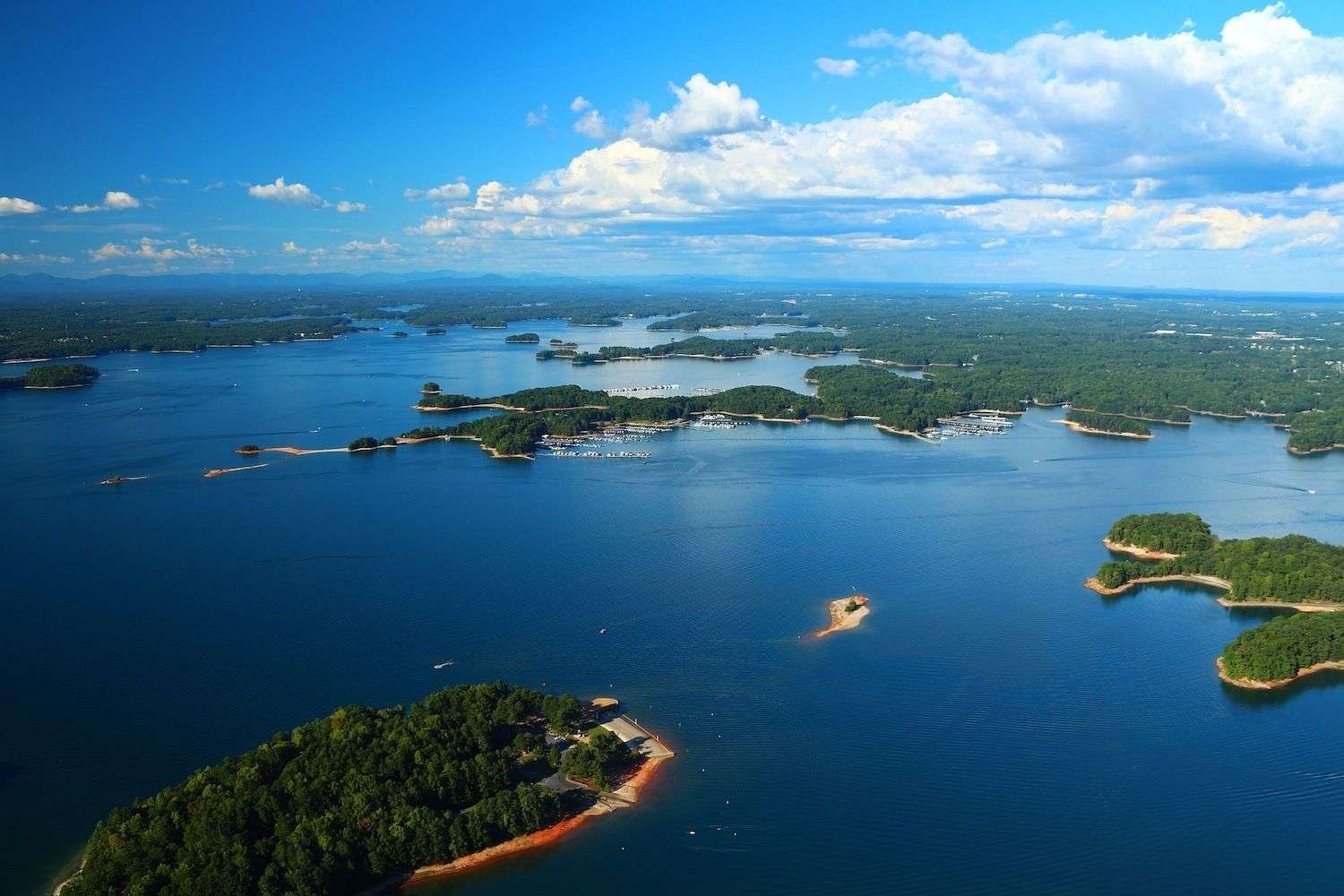
Moving to Lake Lanier from the Northeast typically resolves on five variables: total housing cost per square foot, Georgia state and property tax exposure, year-round outdoor cadence, healthcare access, and the dock-permit model. Lake Lanier is a 38,000-acre U.S. Army Corps of Engineers reservoir on the Chattahoochee River, formed by Buford Dam in 1956, sitting 45 to 90 minutes north of Atlanta in Forsyth, Hall, Gwinnett, and Dawson counties (USACE Mobile District, current as of May 2026). For Northeast buyers relocating from Connecticut, Massachusetts, New York, New Jersey, Pennsylvania, or the New England states, Lanier delivers a longer outdoor season, a lower combined tax band, USACE-permitted private dock waterfront, and a single-corridor primary-residence path that few Northeast lake markets can match.
Why Northeast Buyers Consider Lake Lanier
Northeast buyers most often arrive at Lake Lanier after running the cost, climate, and lifestyle numbers against Lake Winnipesaukee, Lake George, Candlewood Lake, the Finger Lakes, or the Pocono lake markets. Three motivations recur across the relocation conversations: a year-round outdoor calendar, lower-friction lake ownership for primary or hybrid use, and a tax and cost-of-living delta meaningful enough to change the household's annual carrying cost. Each motivation deserves an honest underwriting against the Northeast lake the buyer already knows.
Year-round outdoor lifestyle, boating, and North Georgia access
Lake Lanier delivers a longer usable lake season than any Northeast comparable, which is the single most cited motivation in Northeast-to-Lanier relocations. North Georgia's climate supports boating, fishing, paddleboarding, and dock use from roughly mid-March through mid-November in a typical year, with shoulder-season warm weeks extending the window further on both ends (National Weather Service Atlanta forecast office climate normals, current as of January 2026). Lake Winnipesaukee, Lake George, and Candlewood Lake by contrast typically run a five-to-six-month usable boating window before lake closures and dock removal. The delta is roughly two to three additional months of dock-side use per year, which materially changes the value-per-dollar of a lakefront home. North Georgia access widens the lifestyle envelope beyond the lake itself. The Blue Ridge Mountains, the Chattahoochee National Forest, Amicalola Falls State Park, Vogel State Park, Tallulah Gorge State Park, and the North Georgia wine country in Dahlonega all sit within a one-to-two-hour drive of most Lake Lanier addresses (Georgia Department of Natural Resources, current as of May 2026). The Appalachian Trail's southern terminus at Springer Mountain is roughly an hour north. Buyers who currently weight the Catskills, the Berkshires, or the White Mountains into their seasonal rhythm typically find the North Georgia equivalent within reach from a Lanier base. Atlanta urban access closes the lifestyle loop. Hartsfield-Jackson Atlanta International Airport, the largest hub in the country, sits 60 to 90 minutes south of most Lake Lanier addresses depending on the shoreline and the corridor, with GA-400 serving the western Forsyth County shoreline and I-985 serving the eastern Hall County and Gwinnett County shoreline (Georgia Department of Transportation, current as of January 2026). For Northeast buyers who currently fly through LaGuardia, JFK, Newark, Boston Logan, or Philadelphia, the Atlanta hub structure changes the calculus on visiting family in the Northeast and on national and international travel.
Lower-friction lake ownership compared with fly-to second-home markets
Northeast lake markets often function as fly-to or long-drive second-home markets relative to primary residences in the New York, Boston, Philadelphia, or Hartford metros. Lake Winnipesaukee from Boston runs roughly two hours by car; Lake George from Manhattan runs roughly four hours; Candlewood Lake from Manhattan runs roughly two hours; the Poconos from Philadelphia run roughly two hours. Lake Lanier from Atlanta runs 45 to 90 minutes from the Perimeter (I-285) depending on the shoreline location and the corridor, which puts Lanier inside the primary-residence commute envelope for many hybrid-work households (Georgia Department of Transportation, current as of January 2026). The practical effect is that Lake Lanier supports primary-residence use rather than second-home cadence. The home does not sit empty five days a week, the dock is in the water and used routinely, the property maintenance happens incrementally rather than in concentrated weekend bursts, and the household pays one set of property taxes rather than two. Buyers relocating from a primary-Northeast-metro plus second-home-on-a-Northeast-lake structure typically collapse the two homes into a single Lanier primary residence, which simplifies the carrying-cost stack meaningfully. USACE-permitted private dock ownership also runs at a different scale than most Northeast lake associations. Lanier's southern basin marinas Aqualand Marina, Sunrise Cove Marina, Lake Lanier Islands, Holiday Marina, and Habersham Marina anchor the boating infrastructure, and a permitted single-slip or double-slip private dock at the home eliminates the slip-rental and seasonal-haul logistics that characterize many Northeast lake markets (USACE Mobile District, current as of May 2026). For buyers who keep a boat in the water seven months a year, the operational simplification is meaningful.
Primary residence, retirement, and remote-work relocation motivations
Three relocation profiles recur in Northeast-to-Lanier moves. Primary-residence relocators are typically hybrid-work or fully remote knowledge workers who can keep a Northeast employer relationship while basing in North Georgia, or who are changing employers concurrent with the move. The 45-to-90-minute drive from the Perimeter to most Lake Lanier addresses supports a two-or-three-day in-office cadence in the Atlanta metro for buyers taking a new role locally, and the airport access supports continued in-person work in Northeast cities for buyers retaining a Northeast employer. Retirement relocators are typically buyers in their late fifties through early seventies who have a Northeast primary residence and have evaluated lower-tax retirement markets in Florida, the Carolinas, Tennessee, and Georgia. Lake Lanier sits within this comparison set with a meaningfully shorter drive to the Northeast than Florida, a four-season climate that retains real winters without Northeast snow loads, and access to Northeast Georgia Medical Center in Gainesville, Northside Hospital Forsyth, and the Emory and Piedmont health systems in the Atlanta metro. Retirement buyers should run the actual healthcare network match against their current Northeast providers before relocating. Remote-work relocators are typically buyers whose employer has formalized fully remote status post-2020 and who are now optimizing for cost, climate, and lifestyle rather than office proximity. This profile often runs the widest comparison set, including Lake Lanier, Lake Norman, Lake Keowee, Lake Hartwell, the Tennessee River markets, and the Florida lake markets. Lanier typically wins on the combination of airport access, primary-care and tertiary healthcare access in the Atlanta metro, and the longer usable lake season than the more northerly comparables.
What Northeast Buyers Should Compare
Northeast buyers should compare four practical categories before committing to a Lake Lanier shortlist: the lake's surrounding cities and counties, the waterfront and lake-access inventory bands, the dock model and shoreline rules, and the daily-life logistics covering commute, healthcare, weather, and schools. Each category produces a different short list, and the relocation rarely succeeds when one of the four is left unexamined.
Lake Lanier cities, counties, taxes, services, and amenities
Lake Lanier touches four counties, each with its own tax structure, service profile, school district, and amenity calendar, and Northeast buyers should map the four against household priorities before narrowing the shoreline shortlist. Forsyth County (Cumming) sits on the western shoreline with GA-400 access, the Forsyth County Schools district, Northside Hospital Forsyth, and the Cumming City Center commercial core. Hall County (Gainesville, Flowery Branch, Buford-adjacent unincorporated) sits on the eastern and upper-arm shoreline with I-985 access, the Hall County Schools and Gainesville City Schools districts, Northeast Georgia Medical Center, and the Gainesville Civic Center. Gwinnett County (Buford, Sugar Hill, Suwanee) sits on the southern shoreline with I-985 access and the Gwinnett County Public Schools district. Dawson County (north shoreline) sits on the northwestern upper arms with GA-400 access and the Dawson County Schools district (county school district websites, current as of May 2026). Georgia's combined state and local tax profile typically reads as a meaningful step down for Northeast relocators. Georgia's top marginal individual income tax rate runs at 5.39 percent as of the 2024 tax year, with continued reductions scheduled through 2027 under HB 1437 (Georgia Department of Revenue, current as of May 2026). The exact household-level delta against Connecticut, Massachusetts, New York, New Jersey, or Pennsylvania depends on income mix and bracket positioning, but the directional move is consistently downward. Property tax millage rates vary by county and city across Forsyth, Hall, Gwinnett, and Dawson counties, and Georgia's homestead exemption framework, combined with senior homestead exemptions in several counties, can produce a meaningfully lower effective property tax bill than Northeast equivalents on a comparably priced home. Services and amenities map across the four counties in a recognizable Atlanta-suburban pattern. Mall of Georgia in Buford, North Georgia Premium Outlets in Dawsonville, the Cumming City Center, the Avalon mixed-use development in Alpharetta nearby, and the Halcyon mixed-use development in south Forsyth concentrate retail and dining. Northeast Georgia Medical Center, Northside Hospital Forsyth, Emory Johns Creek Hospital, and the Piedmont system across the metro cover the healthcare network. Buyers should run the actual provider, network, and specialty match against the household's current Northeast providers before assuming a clean transition.
Waterfront homes, dock access, lake-access communities, and townhomes
Lake Lanier inventory splits into four practical bands. Permitted-dock waterfront homes sit at the top of the price stack and concentrate in the southern shoreline ZIP codes 30518, 30519, 30506, 30542, and 30040 across Buford, Cumming, Flowery Branch, Gainesville, and Sugar Hill. Current market conditions require a dated MLS comparison that identifies the area, property type, reporting period, and sample before a buyer relies on it. Lake-access communities form the second band. These are subdivisions and communities with deeded or community-association access to the lake through a community dock, a community boat ramp, or a shared shoreline park, without a private dock on the home parcel itself. The price band sits structurally below permitted-dock waterfront and gives Northeast buyers a lower-friction entry point to lake life while preserving access to boating, swimming, and dock use through the community framework. Buyers should read the community covenants and the dock-allocation rules carefully because the access framework varies meaningfully across communities. Townhomes, condominiums, and lake-area single-family homes without direct lake access form the third and fourth bands. These inventory types extend the Lake Lanier address envelope into the lower-price brackets and give buyers a way to base in the Lanier-area school districts and commute corridors without absorbing waterfront pricing. Buyers relocating from the Northeast with a primary-residence budget below the permitted-dock waterfront band typically start the shortlist in lake-access communities and townhome inventory, then evaluate the upgrade path to waterfront on a planned multi-year timeline.
Commute, healthcare, weather, and lifestyle expectations
Commute structure is the first variable Northeast relocators should drive in person before committing. GA-400 serves the western Forsyth County shoreline from Cumming, Coal Mountain, and Lake Lanier West, connecting to the Perimeter at I-285 in roughly 45 to 75 minutes depending on the time of day and the segment of the shoreline. I-985 serves the eastern Hall County and southern Gwinnett County shoreline from Buford, Sugar Hill, Flowery Branch, and Gainesville, connecting to I-85 and then to the Perimeter in roughly 45 to 90 minutes (Georgia Department of Transportation, current as of January 2026). Buyers should drive both corridors during the actual planned commute window before deciding the shoreline. Healthcare access is the second variable. Northeast Georgia Medical Center in Gainesville is the primary tertiary care center for the upper-arm and eastern shoreline and is a Level II Trauma Center. Northside Hospital Forsyth in Cumming covers the western shoreline. Emory Johns Creek Hospital, Northside Hospital Atlanta, Piedmont Atlanta Hospital, and the broader Emory and Piedmont systems sit within the broader Atlanta metro reach (hospital system websites, current as of May 2026). Buyers should confirm specific network participation, specialty availability, and continuity-of-care transition with their current Northeast providers, particularly for ongoing chronic conditions or specialty oncology, cardiology, or orthopedic care. Weather is the third variable, and the delta from the Northeast is the most cited surprise. North Georgia summers run hot and humid from June through September with regular afternoon thunderstorms; winters run mild with occasional freezes and rare snow events; spring and fall are extended and pleasant (National Weather Service Atlanta climate normals, current as of January 2026). Northeast buyers accustomed to harder winters and shorter, cooler summers should expect to adjust outdoor scheduling around heat and humidity rather than around cold and snow. Lifestyle expectations should account for this seasonal inversion before the move rather than after.
Relocation Due Diligence
Northeast buyers running Lake Lanier due diligence should treat the dock-permit, county service, and shoreline-rule layer as the most important checks before contract, because the regulatory framework is meaningfully different from any Northeast lake market. Insurance, property tax, and local service provider checks follow, and a virtual or in-person buying plan with a local agent ties the threads together.
Dock permits, water levels, shoreline rules, and septic
USACE permits and licenses are nontransferable. A new owner of an existing facility may apply through the Lake Lanier Operations Management Office, and approval is not automatic. Confirm the property-specific record and current requirements before closing. Water levels on Lake Lanier track the U.S. Army Corps of Engineers' management of Buford Dam, with full pool elevation at 1,071 feet above mean sea level and operational drawdowns that follow the Apalachicola-Chattahoochee-Flint river basin water control manual. Lake levels can vary by several feet during drought years and during planned drawdowns, which materially affects dock function, navigability around the dock, and shoreline appearance. Northeast buyers accustomed to natural-lake-level systems should price seasonal and drought-cycle level variation into the dock and shoreline expectations rather than assuming a constant elevation. Shoreline rules govern vegetation buffers, mowing, walkways, paths, and stairs down to the dock. The shoreline management plan limits buffer-zone modification and requires Corps approval for many shoreline improvements that buyers casually picture in a lake-home program. Septic is a separate layer because most Lake Lanier shoreline parcels are not on municipal sewer, and county-approved septic systems govern the home's wastewater. Forsyth County Environmental Health, Hall County Environmental Health, Dawson County Environmental Health, and Gwinnett County Environmental Health each run the septic permit and inspection process for shoreline parcels in their jurisdictions (county environmental health departments, current as of May 2026).
Insurance, property taxes, maintenance, and local service providers
Insurance on a Lake Lanier waterfront home typically combines a primary homeowner policy, a separate dock and watercraft policy, and, for some lenders, a stand-alone wind or storm endorsement. Northeast buyers accustomed to coastal-flood-zone insurance pricing should find inland-lake insurance economics meaningfully different, because Lake Lanier sits well inland of the Atlantic coastal flood-zone framework. Buyers should obtain insurance quotes during due diligence rather than after contract, and confirm dock coverage, boat coverage, and any builder-risk coverage on planned shoreline improvements. Property taxes vary by county and city across Forsyth, Hall, Gwinnett, and Dawson counties, and the effective rate on a Lake Lanier home depends on the combined county, school district, and city millage. Georgia's homestead exemption framework reduces the taxable assessed value on a primary residence, and several counties operate senior homestead exemptions that further reduce the effective bill for buyers above specified age thresholds (county tax commissioner websites, current as of May 2026). Northeast buyers should not assume a flat percentage relationship to Northeast property taxes; the household-level delta should be modeled against the specific parcel's assessment and millage. Local service providers cover dock maintenance, boat maintenance, septic pumping and inspection, lawn and shoreline-buffer maintenance, HVAC, and home maintenance generally. The dock and septic categories are the two most unfamiliar to Northeast relocators because the regulatory and engineering frameworks differ from Northeast lake markets. Buyers should build a service-provider roster during the first year rather than assume one will materialize, and should treat the dock contractor and septic contractor as priority hires before the first heavy-use summer.
Ask Ashley Smith for a virtual Lake Lanier buying plan
Northeast buyers running a long-distance relocation should anchor the search in a structured virtual buying plan rather than rely on episodic in-market trips. A virtual buying plan typically opens with a goal-aware discovery conversation covering primary-residence versus second-home cadence, hybrid-work versus fully remote schedule, school district priorities if applicable, healthcare network priorities, club or community preferences, and the realistic carrying-cost band including dock, boat, property tax, insurance, and maintenance. The plan then narrows the shoreline shortlist to one or two corridors before any in-market trip. The in-market trip is then structured around the shortlist rather than around general shoreline exploration. A typical productive first trip covers two to three days, drives the GA-400 and I-985 commute corridors during the planned weekday commute window, walks five to eight properties in the targeted price and shoreline band, drives the school assignment and grocery, healthcare, and routine-errand routes, and ends with a written shortlist refinement against the original goals. The trip is a filter, not a tour. Ashley Smith, real estate agent with The Dream Smith Team at Compass, can build a Northeast-to-Lake-Lanier virtual buying plan and the structured in-market trip that follows. The plan anchors in documented USACE shoreline management data, Georgia MLS market data, Georgia Department of Revenue tax data, county-level service and school district data, and the buyer's specific cadence and healthcare profile rather than category averages. Northeast buyers running this process typically arrive at a contract-ready shortlist within one to three structured trips rather than open-ended shopping across a year.
Frequently Asked Questions
- How does Lake Lanier compare to Lake Winnipesaukee or Lake George for a primary residence?
- Lake Lanier supports primary-residence cadence in a way most Northeast lake markets do not, primarily because it sits 45 to 90 minutes from the Atlanta metropolitan commute envelope rather than two-to-four-plus hours from the nearest major metro (Georgia Department of Transportation, current as of January 2026). Lake Lanier also delivers roughly two to three additional months of usable boating and dock season per year compared with Lake Winnipesaukee and Lake George (National Weather Service Atlanta climate normals, current as of January 2026). Northeast buyers consolidating a primary residence and a Northeast lake second home into a single Lanier primary often find the carrying-cost math improves meaningfully.
- What is the tax delta between the Northeast and Lake Lanier?
- Georgia's top marginal individual income tax rate runs at 5.39 percent as of the 2024 tax year, with scheduled reductions through 2027 under HB 1437 (Georgia Department of Revenue, current as of May 2026), which sits below the top marginal rates in Connecticut, New York, New Jersey, Massachusetts, and Pennsylvania. Property tax effective rates vary by county across Forsyth, Hall, Gwinnett, and Dawson, with Georgia's homestead and senior homestead exemption framework reducing the effective bill on a primary residence. The household-level delta should be modeled against actual income mix, residency status, and the specific parcel rather than assumed.
- What is the climate like at Lake Lanier compared with the Northeast?
- North Georgia summers run hot and humid from June through September with regular afternoon thunderstorms, winters run mild with occasional freezes and rare snow events, and spring and fall are extended and pleasant (National Weather Service Atlanta climate normals, current as of January 2026). The usable outdoor and lake-use season runs roughly mid-March through mid-November in a typical year. Northeast relocators typically find the seasonal calendar inverted from their current expectations, with outdoor scheduling adjusting around heat and humidity rather than around cold and snow.
- What healthcare access does Lake Lanier offer for Northeast retirees?
- Lake Lanier addresses access Northeast Georgia Medical Center in Gainesville, a Level II Trauma Center serving the upper-arm and eastern shoreline, Northside Hospital Forsyth on the western shoreline, and the broader Emory and Piedmont health systems across the Atlanta metro within a 45-to-90-minute drive (hospital system websites, current as of May 2026). Retirement buyers running an honest healthcare match against current Northeast providers should confirm specific network participation, specialty availability, and continuity-of-care transition for any ongoing chronic, oncology, cardiology, or orthopedic care.
- How do USACE dock permits work for a Northeast buyer relocating to Lake Lanier?
- USACE permits and licenses are nontransferable. A new owner of an existing facility may apply through the Lake Lanier Operations Management Office, and approval is not automatic. Confirm the property-specific record and current requirements before closing.
- Can I work remotely from Lake Lanier for a Northeast employer?
- Yes, this is one of the most common relocation profiles. Lake Lanier supports fully remote work for a Northeast employer through residential broadband across the Forsyth, Hall, Gwinnett, and Dawson county footprint, and Hartsfield-Jackson Atlanta International Airport sits 60 to 90 minutes south of most Lanier addresses for in-person Northeast travel (Georgia Department of Transportation, current as of January 2026). Buyers should confirm broadband options and speeds at the specific parcel during due diligence rather than after closing, and confirm employer policy on state of residence and any payroll or tax implications of the move.
Related
- Lake Lanier Real Estate OverviewFull Lake Lanier shoreline market, USACE dock permit, and lifestyle guide.
- Lake Lanier Waterfront HomesPermitted-dock and lake-access waterfront listings across the Lanier shoreline.
- Lake Lanier Commute to AtlantaDrive-time profiles via GA-400 and I-985 from each Lake Lanier sub-area.
- Lake Lanier Cost of OwnershipAnnual carrying-cost model including property tax, dock, insurance, and HOA.
- Cumming, GA Homes for SaleForsyth County market on the western Lake Lanier shoreline with GA-400 access.
- Buford, GA Homes for SaleGwinnett County market on the southern Lake Lanier shoreline near Buford Dam.