
Relocation Guide
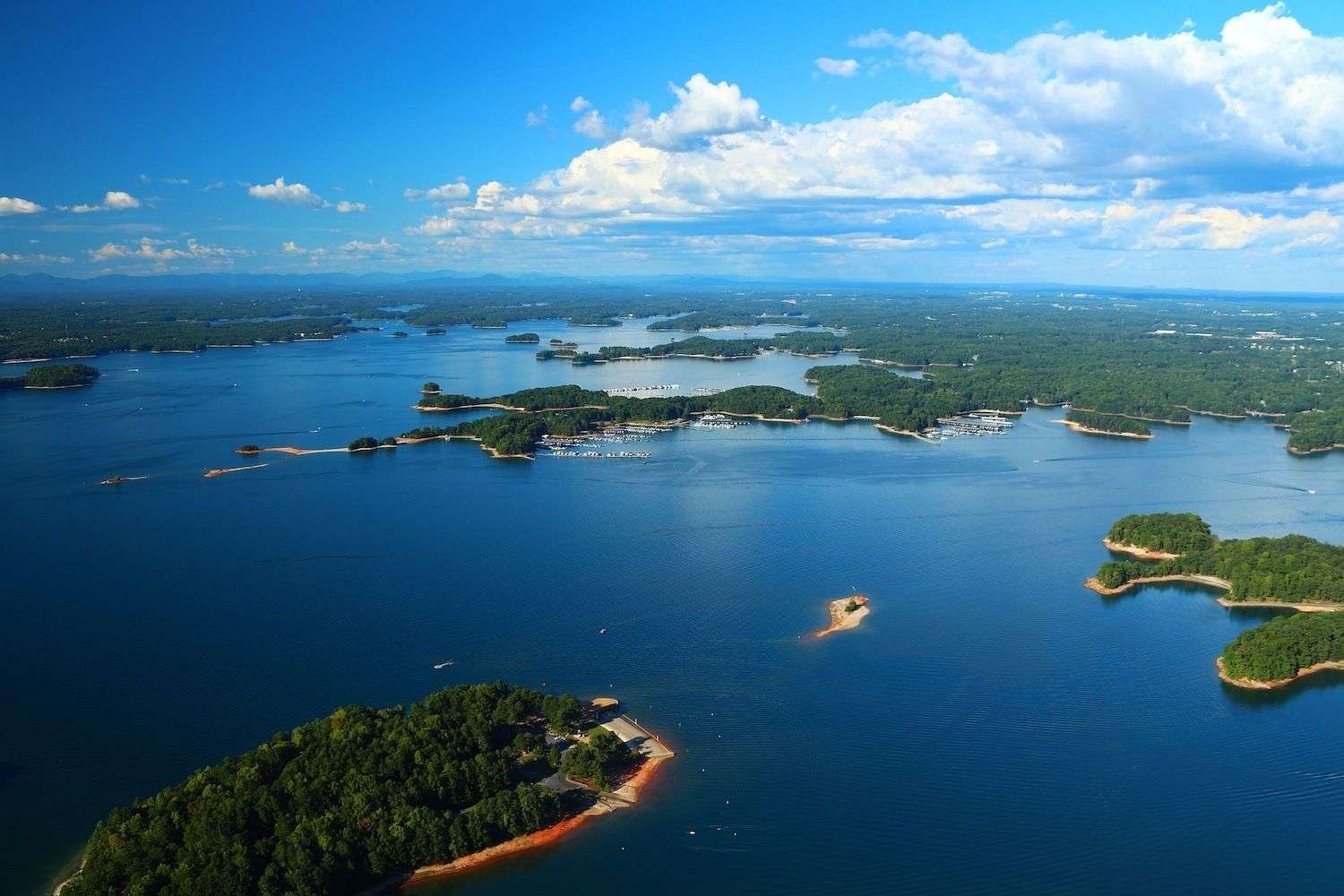
Moving to Lake Lanier from California typically resolves on four practical variables: total cost-of-ownership delta, state income tax exposure, climate and seasonal lifestyle change, and travel-back-to-California access. Lake Lanier sits 45 to 90 minutes north of Atlanta in Forsyth, Hall, Gwinnett, and Dawson counties on a 38,000-acre U.S. Army Corps of Engineers reservoir on the Chattahoochee River (USACE Mobile District, current as of May 2026). California buyers relocating to Cumming, Gainesville, Buford, Flowery Branch, or Dawsonville typically see meaningfully lower delivered cost per square foot, a top marginal Georgia state income tax of 5.39 percent for tax year 2026 versus California's 13.3 percent top bracket (Georgia Department of Revenue and California Franchise Tax Board, current as of January 2026), and a four-season climate that differs from coastal California.
Why California Buyers Consider Lake Lanier
California buyers moving to Lake Lanier are typically optimizing for three things at once: land and square footage that no longer fit their California budget, a state tax framework with a meaningfully lower top bracket, and a lake-direct lifestyle that supports boating, year-round outdoor use, and family gatherings on a scale that is hard to assemble inside coastal California. The decision rarely turns on a single number and usually resolves only once cost-of-ownership, work cadence, and travel access are modeled together.
Luxury lake lifestyle, space, outdoor living, and North Georgia access
Lake Lanier delivers a luxury lake lifestyle anchored in 38,000 acres of navigable water, more than 600 miles of shoreline at full pool elevation of 1,071 feet above mean sea level, and a USACE-permitted private-dock framework that lets shoreline owners hold a single-slip or double-slip dock on their own parcel (USACE Mobile District, current as of May 2026). California buyers accustomed to Lake Tahoe, Lake Arrowhead, or Big Bear typically find the freshwater scale comparable, the navigable-water depth comparable on the southern basin, and the private-dock model structurally different from California's predominantly public-shoreline lakes. The lake supports wakeboarding, sailing, fishing, paddleboarding, and pontoon boating across a typical April-through-October season, with shoulder use into March and November depending on the year. Land and square footage are the second draw. Current market conditions require a dated MLS comparison that identifies the area, property type, reporting period, and sample before a buyer relies on it. North Georgia access broadens the lifestyle envelope beyond the lake itself. Lake Lanier sits within a 60-to-90-minute drive of the North Georgia mountains, Helen, Dahlonega wine country, the Blue Ridge corridor, and the Chattahoochee National Forest, and within 45 to 90 minutes of downtown Atlanta and Hartsfield-Jackson Atlanta International Airport via GA-400 or I-985 (Georgia Department of Transportation, current as of January 2026). The geography supports a primary-residence lake life with weekend mountain access and meaningful international and domestic flight access, which is structurally different from the trade-offs at California lake markets.
Primary residence, remote-work, retirement, and second-home options
Primary-residence buyers relocating from California to Lake Lanier are typically moving a household full-time, often anchored by a remote or hybrid work pattern that allows them to keep a California-based employer or rebuild their professional footprint in the Atlanta metro. The 45-to-90-minute drive envelope from a typical Lake Lanier address to the Perimeter (I-285) via GA-400 or I-985 supports a hybrid in-office cadence, and a remote-only role supports a full-time lake address with no commute exposure. Buyers should test-drive the actual planned commute window before assuming the corridor map estimates match the lived experience. Remote-work buyers form a meaningful share of the California-to-Lanier inbound mix. The combination of fiber broadband across most of Forsyth, Hall, and southern Gwinnett counties, the Georgia tax framework, and a household budget that no longer needs to absorb California-coastal carrying costs makes a lake-direct home office a workable substitute for a California-based one. Buyers should confirm fiber-class internet availability at the specific parcel before assuming connectivity, because the upper-arm Hall and Dawson county shoreline is less uniformly served than the southern basin. Retirement and second-home patterns sit alongside the primary-residence and remote-work flows. Retirement buyers from California typically prioritize healthcare access at Northside Hospital Forsyth and Northeast Georgia Medical Center in Gainesville, single-level or limited-stair floor plans, lower-maintenance lake-access communities, and a household carrying-cost band that fits a fixed retirement income. Second-home buyers from California typically prioritize a lock-and-leave format with a managed community or a small-footprint waterfront cottage on a permitted dock, often coordinated with adult children or grandchildren who live in the Atlanta metro.
Comparing Georgia lake property with West Coast lifestyle tradeoffs
The honest California-versus-Georgia comparison is rarely a single-axis trade. California buyers typically give up immediate Pacific Ocean access, year-round 65-to-75-degree coastal weather in the Bay Area and coastal Los Angeles County, and an immediate proximity to specific California professional, family, or cultural networks. Buyers should not minimize what they are giving up; the relocation works better when both columns are written down honestly. What California buyers typically gain is delivered cost-of-housing room, a Georgia state income tax top marginal rate of 5.39 percent for tax year 2026 versus California's 13.3 percent top bracket (Georgia Department of Revenue and California Franchise Tax Board, current as of January 2026), property tax rates that vary by county but generally run in the 0.75 to 1.10 percent effective range on assessed value across Forsyth, Hall, Dawson, and Gwinnett counties (county tax assessor offices, current as of January 2026), and a freshwater-lake-direct lifestyle that is not feasible inside most California metros at a comparable household budget. The tax delta alone, on a high-income household, can fund a meaningful share of the Lanier carrying-cost line. Climate is the second axis. Coastal California buyers typically experience colder winters than they are used to, hotter summers with higher humidity, and a true four-season pattern with deciduous fall color across North Georgia. Buyers from inland California (Sacramento, Central Valley, Inland Empire) typically find the summer pattern more familiar but the humidity less so. The lake itself moderates temperature on the immediate shoreline by a few degrees relative to inland Forsyth or Hall County, which can matter on July and August afternoons.
What California Buyers Should Compare
California buyers shortlisting Lake Lanier should run the comparison across three layers: the specific Lake Lanier city and county, the inventory type and dock model, and the practical logistics of taxes, insurance, healthcare, climate, and travel. The shortlist that survives this comparison is typically tighter than the initial set of map pins.
Cumming, Gainesville, Buford, Flowery Branch, and Dawsonville
Cumming sits in Forsyth County on the western shoreline of Lake Lanier, anchored by GA-400, Northside Hospital Forsyth, The Collection at Forsyth, and the Cumming City Center. Forsyth County typically carries the highest median household income in the lake's surrounding counties and the strongest school-district reputation through Forsyth County Schools, which materially affects pricing on permitted-dock and lake-access inventory inside Forsyth County boundaries (Forsyth County Tax Assessor and Forsyth County Schools district reports, current as of January 2026). California buyers from the Bay Area, Orange County, and San Diego County tend to gravitate toward Cumming first because the household-budget and school-axis profile maps closely to their prior California neighborhoods. Gainesville sits in Hall County on the eastern and northern shoreline, anchored by Northeast Georgia Medical Center, Brenau University, Lake Lanier Olympic Park, and the historic downtown square. Hall County typically carries a more diverse waterfront price band than Forsyth County, with both entry-band lake-access and high-end deep-water permitted-dock inventory across the eastern basin and the upper arms toward Lula and Clermont. Buford and Flowery Branch sit on the southern shoreline at the I-985 corridor, with Buford running through both Gwinnett County and Hall County jurisdictions and Flowery Branch sitting fully in Hall County. The southern shoreline anchors the shortest Atlanta commute and the deepest year-round water depths in many coves. Dawsonville sits in Dawson County on the upper western shoreline above Cumming via GA-400, anchored by North Georgia Premium Outlets, the Atlanta Motorsports Park, and access to the North Georgia mountains and Amicalola Falls State Park. Dawson County inventory typically runs at a lower median price band than Forsyth and southern Hall, with longer drive times to Atlanta but stronger proximity to the mountains and a more rural feel. California buyers comparing across these five city anchors should match the city to the buyer's daily-life cadence and Atlanta-access requirement, not only to the listing price.
Waterfront homes, private docks, luxury estates, and gated communities
Waterfront home inventory on Lake Lanier breaks into three structural tiers: deep-water permitted-dock waterfront, lake-access community waterfront, and luxury estate waterfront. Deep-water permitted-dock homes on the southern basin in Forsyth, Hall, and Gwinnett counties typically carry the strongest year-round usability because the cove depth at full pool elevation 1,071 supports boat access without seasonal dry-dock concerns. Current market conditions require a dated MLS comparison that identifies the area, property type, reporting period, and sample before a buyer relies on it. Lake-access community inventory sits below the permitted-dock band on price but provides community-managed shoreline, marina slips, or a shared dock instead of a private slip on the buyer's parcel. Communities such as Stoney Point, Marina Bay, Twin Lakes, and several Cumming and Flowery Branch subdivisions deliver lake-access amenities at a meaningfully lower price band than permitted-dock waterfront. California buyers who do not require a private dock on their own parcel often find lake-access inventory delivers most of the lake lifestyle at a significantly lower carrying cost. Luxury estate inventory concentrates in large-lot, deep-water, double-slip-dock parcels on the southern basin in Forsyth, Hall, and Gwinnett counties, often outside a master-planned community. Gated and managed communities exist around the lake but in smaller numbers than buyers may expect from the California planned-community model; the Lanier inventory leans toward open-shoreline single-family and toward community-amenity neighborhoods rather than fully gated club communities. Buyers prioritizing a gated, club-style format should evaluate whether a permitted-dock single-family parcel paired with a separate country-club membership delivers the program more efficiently than a gated-community-only model.
Taxes, insurance, healthcare, climate, travel access, and local services
Georgia's state income tax structure is the largest practical tax delta for California buyers relocating to a Lake Lanier address. The Georgia top marginal income tax rate is 5.39 percent for tax year 2026, with the state moving toward a flat-rate structure under the 2024 tax legislation, versus a California top marginal rate of 13.3 percent in the highest brackets (Georgia Department of Revenue and California Franchise Tax Board, current as of January 2026). Property tax effective rates on Lake Lanier shoreline parcels generally run in the 0.75 to 1.10 percent range of assessed value across Forsyth County, Hall County, Dawson County, and Gwinnett County, with the assessment ratio applied to the appraised value (county tax assessor offices, current as of January 2026). Buyers should pull the specific millage and homestead exemption schedule for the target parcel rather than relying on category averages. Insurance and healthcare logistics differ from coastal California. Homeowners insurance on Lake Lanier shoreline properties typically prices wind, water, and dock exposure into the premium and does not carry the wildfire-zone underwriting overlay that drives premium and availability volatility in California fire-risk zones. Healthcare anchors include Northside Hospital Forsyth in Cumming, Northeast Georgia Medical Center in Gainesville, Northside Hospital Gwinnett, and the Atlanta tertiary systems including Emory University Hospital, Piedmont Atlanta Hospital, and Northside Hospital Atlanta within a typical 45-to-75-minute drive. Buyers with chronic-care or specialty-care requirements should map the specific provider network to Lake Lanier addresses before committing. Climate, travel access, and local services round out the comparison. The lake region runs a typical July-August daily high in the upper 80s to low 90s Fahrenheit with high humidity, January overnight lows in the upper 20s to low 30s, and roughly 50 inches of annual rainfall (National Weather Service Peachtree City forecast office, current as of January 2026). Travel access through Hartsfield-Jackson Atlanta International Airport delivers nonstop service to San Francisco International, Los Angeles International, San Diego International, Sacramento International, San Jose International, and Oakland International on multiple daily frequencies (Hartsfield-Jackson Atlanta International Airport carrier schedules, current as of January 2026), which supports return travel for buyers maintaining California family, professional, or property ties.
Relocation Due Diligence
California buyers running an out-of-state relocation to Lake Lanier should structure due diligence around the items that do not show up on a listing photo: dock permits, water depth, septic, slope, virtual tour quality, and the practical sequencing of a long-distance closing. Skipping any of these creates avoidable risk on a high-dollar transaction.
Dock permits, USACE rules, water depth, septic, and slope
USACE permits and licenses are nontransferable. A new owner of an existing facility may apply through the Lake Lanier Operations Management Office, and approval is not automatic. Confirm the property-specific record and current requirements before closing. Water depth at the dock site matters as much as the permit itself. Lake Lanier operates on a managed lake-level cycle around the full pool elevation of 1,071 feet above mean sea level, with USACE water-management operations and drought-cycle variations that can shift cove-side water depth by several feet (USACE Mobile District, current as of May 2026). Deep-water coves on the southern basin in Forsyth, Hall, and Gwinnett counties typically maintain usable depth at the dock through normal cycles, while shallower upper-arm coves in northern Hall and Dawson counties can lose usable boat access during drawdowns. Buyers should obtain a recent bathymetric reading at the dock and ask sellers for documented historical drawdown depth. Septic and slope are the third due-diligence layer. Most Lake Lanier shoreline parcels are not on municipal sewer, so the home is served by a county-approved septic system whose capacity and condition should be inspected by a licensed septic contractor before closing. Slope and retaining-wall conditions on cove-side parcels in Forsyth, Hall, Dawson, and Gwinnett counties vary widely, and California buyers used to flatter California coastal lots should price a geotechnical or civil-engineering review into the offer on any parcel with significant grade. The county environmental health departments (Forsyth County Environmental Health, Hall County Environmental Health, Dawson County Environmental Health, and Gwinnett County Environmental Health, current as of May 2026) maintain records of septic permits and can confirm system class at the parcel level.
Virtual tours, private showings, and remote due diligence steps
Virtual tour quality is the first practical bottleneck on an out-of-state relocation. California buyers should request a live narrated video walkthrough rather than a static 3D tour, with the agent moving through the home, the lot, the shoreline, the dock, and the cove view in a single continuous take. The narrated walkthrough captures sound, lighting, traffic, and shoreline conditions that pre-rendered tours filter out, and it lets the buyer ask questions in real time about specific elevations, views, or finishes. In-person showings on a relocation timeline should be sequenced rather than scattered. California buyers who fly into Hartsfield-Jackson Atlanta International Airport for a focused two-or-three-day shortlist tour typically see a tighter, agent-curated set of permitted-dock waterfront, lake-access community, and luxury estate inventory across Cumming, Gainesville, Buford, Flowery Branch, and Dawsonville. The tour should anchor on the buyer's top three to five candidates rather than a generic open-ended schedule, because relocation buyers typically suffer more from too many options than from too few. Remote due diligence steps include a full home inspection by a licensed Georgia inspector, a separate dock inspection if a permitted dock is on the parcel, a septic inspection by a licensed septic contractor, a structural or geotechnical review on any cove-side parcel with significant slope, a survey to confirm parcel boundaries and the Corps Line, and a title review through a Georgia closing attorney. Georgia is an attorney-state for residential real estate closings, which differs structurally from California's escrow-based model. California buyers should ask the closing attorney to explain the Georgia closing sequence early so that the timeline expectations match the actual process.
Schedule a California-to-Lake-Lanier buyer consultation
A structured California-to-Lake-Lanier relocation consultation typically starts with the buyer's actual cadence: how many days a week the household needs to be in an Atlanta-direction office, whether the work pattern is remote or hybrid, whether a private dock is required or whether lake-access is acceptable, what the school assignment requirement is if school-aged children are part of the household, and what the round-trip-to-California cadence is for family, professional, or property ties. The consultation should also map the buyer's California current-home equity and timing into the Lake Lanier purchase timeline, because the sequencing of a California sale and a Georgia purchase materially affects financing and cash position. A second layer of the consultation evaluates the inventory and dock-model fit. California buyers used to high-density coastal markets sometimes underestimate the meaningful differences between deep-water permitted-dock waterfront, lake-access community waterfront, and non-waterfront lake-region inventory in Cumming, Gainesville, Buford, Flowery Branch, and Dawsonville. A side-by-side comparison of three to five candidates across two or three city anchors usually surfaces the right shortlist faster than an open-ended search. Ashley Smith, real estate agent with The Dream Smith Team at Compass, can build a California-to-Lake-Lanier relocation worksheet that prices the carrying-cost delta, the Georgia tax framework, the dock-model fit, and the travel-back-to-California access on the same basis, anchored in documented USACE Mobile District, Georgia MLS, county tax assessor, Georgia Department of Revenue, and Hartsfield-Jackson schedule data rather than category averages. California buyers should request the worksheet before the shortlist tour rather than after, because the right candidate set depends on what the worksheet surfaces.
Frequently Asked Questions
- How does the Georgia state income tax compare with California for buyers moving to Lake Lanier?
- Georgia's top marginal state income tax rate is 5.39 percent for tax year 2026 under the state's flat-rate transition legislation, compared with California's top marginal rate of 13.3 percent in the highest brackets (Georgia Department of Revenue and California Franchise Tax Board, current as of January 2026). The delta is most material for high-income households, where the annual state-tax savings can fund a meaningful share of a Lake Lanier carrying-cost line. Buyers should run the specific income and filing scenario with a CPA who is licensed in both states before relying on the headline rate.
- What is the price difference between California waterfront and Lake Lanier waterfront?
- California buyers used to coastal California pricing typically find the Lanier band substantially lower than oceanfront or Lake Tahoe lakefront. The honest comparison should be done on like-for-like square footage, lot size, and dock or shoreline access. Current market conditions require a dated MLS comparison that identifies the area, property type, reporting period, and sample before a buyer relies on it.
- How close is Lake Lanier to Hartsfield-Jackson Atlanta International Airport?
- Most Lake Lanier shoreline addresses sit 60 to 90 minutes from Hartsfield-Jackson Atlanta International Airport, depending on the specific city, corridor, and time of day (Georgia Department of Transportation, current as of January 2026). Southern shoreline addresses in Buford, Flowery Branch, and southern Cumming typically reach the airport faster via I-85 and I-285 than northern Hall County or Dawson County addresses. The airport offers daily nonstop service to San Francisco International, Los Angeles International, San Diego International, San Jose International, Sacramento International, and Oakland International, which supports regular round-trip travel back to California (Hartsfield-Jackson Atlanta International Airport carrier schedules, current as of January 2026).
- Can I work remotely from a Lake Lanier home while keeping my California employer?
- Many California buyers relocating to Lake Lanier maintain a remote or hybrid arrangement with a California-based employer, supported by fiber-class broadband across most of Forsyth County, southern Hall County, and southern Gwinnett County. Buyers should confirm fiber-class internet availability at the specific parcel before assuming connectivity, because upper-arm Hall and Dawson county shoreline coverage is less uniform. Buyers should also work with a tax professional to confirm any state income tax exposure to California after the Georgia move is complete, because California residency and source-income rules can be complex for cross-state workers.
- How does the Lake Lanier climate compare with coastal California?
- Lake Lanier runs a true four-season climate, with July and August daily highs typically in the upper 80s to low 90s Fahrenheit with high humidity, January overnight lows in the upper 20s to low 30s, and roughly 50 inches of annual rainfall (National Weather Service Peachtree City forecast office, current as of January 2026). Coastal California buyers from the Bay Area, Los Angeles, and San Diego typically experience colder winters and hotter, more humid summers than they are used to. Inland California buyers from the Central Valley or Inland Empire typically find the summer pattern more familiar but the humidity less so.
- What due diligence should I run on a Lake Lanier dock before closing?
- California buyers should pull the current U.S. Army Corps of Engineers Mobile District dock permit copy and confirm the transfer process under the Lake Sidney Lanier Shoreline Management Plan administered by the U.S. Army Corps of Engineers before closing (USACE Mobile District, current as of May 2026). A licensed dock inspector should evaluate the physical condition of the dock, walkway, and hardware, and the buyer should obtain a recent water-depth reading at the dock site and ask the seller for documented historical drawdown depth. Buyers should also confirm that the dock's permit class matches the buyer's intended use (single-slip, double-slip, or community).
Related
- Lake Lanier Real Estate OverviewFull Lake Lanier shoreline market, USACE dock permit, and lifestyle guide.
- Lake Lanier Waterfront HomesPermitted-dock and lake-access waterfront listings across the Lanier shoreline.
- Cumming, GA Homes for SaleForsyth County market on the western Lake Lanier shoreline with GA-400 access.
- Lake Lanier Cost of OwnershipAnnual carrying-cost model including property tax, dock, insurance, and utilities.
- Lake Lanier Commute to AtlantaDrive-time profiles via GA-400 and I-985 from each Lake Lanier sub-area.
- South Lake Lanier HomesSouthern shoreline inventory closest to Buford Dam and the Hartsfield-Jackson airport corridor.