
Relocation Guide
Moving from Midtown Atlanta to Lake Lanier usually resolves on four variables: commute cadence to the Midtown core, primary-residence versus second-home use, dock permit certainty, and the lifestyle delta between a high-rise condo and a U.S. Army Corps of Engineers shoreline parcel. A typical Midtown address sits 55 to 95 minutes from a Lake Lanier shoreline home via GA-400 or I-985 (Georgia Department of Transportation, current as of January 2026). Midtown buyers usually anchor on South Lake Lanier first because the drive is shortest, but Gainesville, Flowery Branch, and Dawsonville each fit different cadences.
Why Midtown Buyers Consider Lake Lanier
Midtown Atlanta buyers consider Lake Lanier because the lake delivers what the urban core structurally cannot: a private USACE-permitted dock, deep navigable water at full pool, and a primary or second-home cadence inside a 60-to-90-minute drive of the Midtown commute envelope. The decision usually clarifies once the buyer is honest about how the home will actually be used five days a week.
More outdoor space, boating, quiet, and weekend recreation
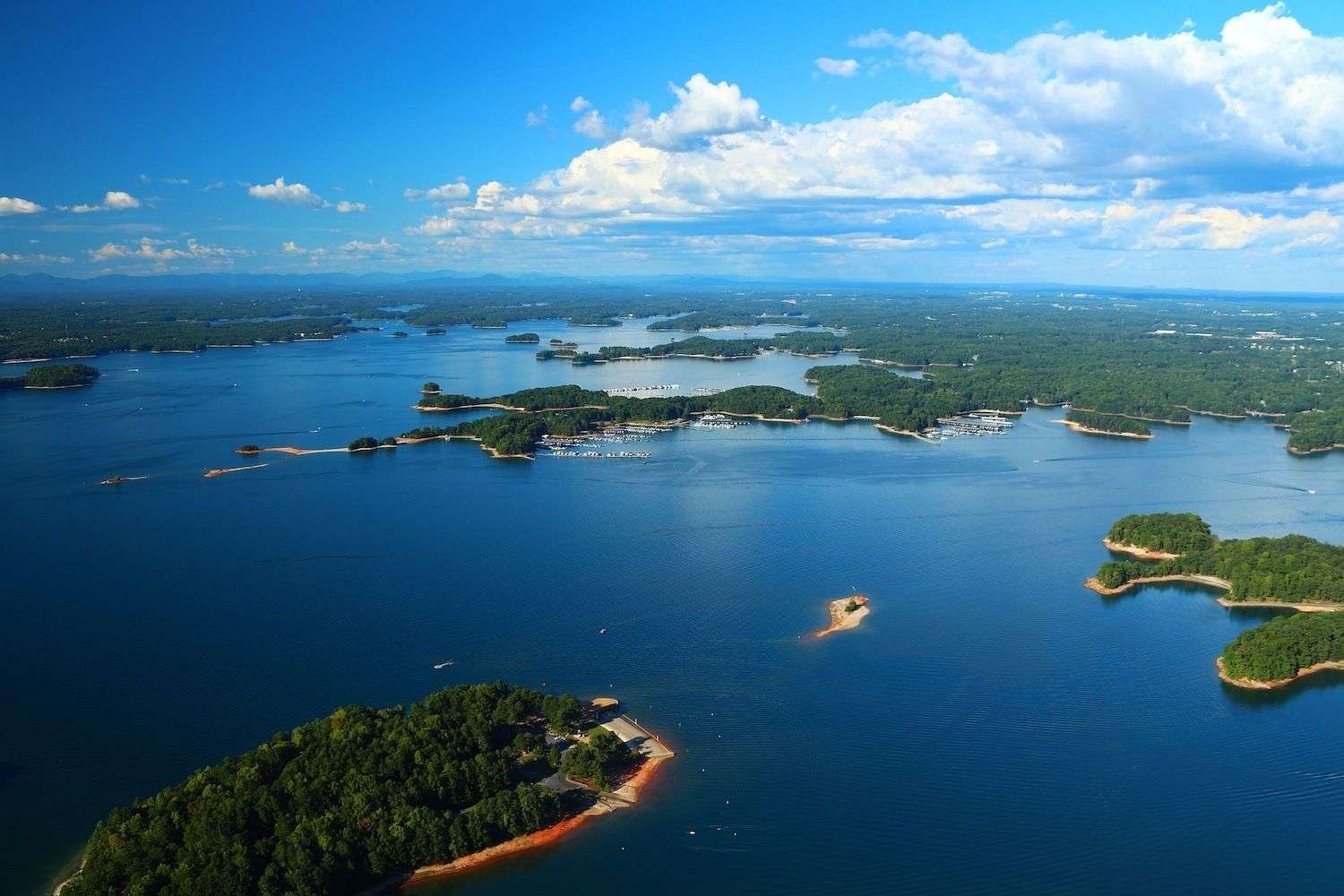
Midtown Atlanta delivers walkable density, restaurant culture, MARTA access, and proximity to Piedmont Park, the High Museum, and the Atlanta BeltLine, but it does not deliver a private boat slip, a deep-water cove, or a 600-plus-mile shoreline within walking distance of the kitchen. Lake Lanier delivers all three. The lake covers 38,000 acres with more than 600 miles of shoreline at full pool elevation of 1,071 feet above mean sea level, managed by the U.S. Army Corps of Engineers Mobile District at Buford Dam on the Chattahoochee River (USACE Mobile District, current as of May 2026). Buyers leaving a Midtown condo for a Lake Lanier shoreline home are usually trading walkable amenity density for water-direct daily use. Outdoor space is the most-cited driver. A typical Midtown high-rise unit delivers 900 to 1,600 square feet without private outdoor space beyond a balcony, while a typical Lake Lanier waterfront home delivers a multi-acre lot with a permitted dock, a rear yard sloping to the shoreline, and direct access to boating, fishing, paddleboarding, and wakeboarding. The lifestyle delta is structural rather than incremental, and buyers should walk a candidate parcel before assuming the photographs capture the difference. Weekend recreation also shifts meaningfully. Midtown's weekend cadence centers on restaurants, the BeltLine, Piedmont Park events, and Atlanta cultural institutions. Lake Lanier's weekend cadence centers on the boat, marina restaurants, fishing tournaments, lakefront state parks including Don Carter State Park in Hall County, and the Lake Lanier Islands resort complex. Buyers should evaluate which set of weekend rhythms actually fits their lives across an entire calendar year, not just the summer.
Primary residence vs. second-home lifestyle
The primary-residence versus second-home decision drives the rest of the Midtown-to-Lanier relocation math. A buyer making Lake Lanier the primary residence absorbs the full commute to the Midtown office on every in-office day, the full daily-life logistics of Cumming, Buford, Flowery Branch, or Gainesville, and the full property-tax, dock-maintenance, and lake-house operating cost base across 360 nights a year. A buyer making Lake Lanier a second home retains the Midtown primary residence, uses the lake home on weekends and selected weeks, and runs a different carrying-cost model. Primary-residence buyers typically anchor on the southern shoreline in Forsyth, Hall, and Gwinnett counties because the commute envelope to Midtown is shortest. South Lake Lanier ZIP codes including 30518 (Buford), 30519 (Buford), 30506 (Gainesville), 30542 (Flowery Branch), and 30040 (Cumming) sit 55 to 85 minutes from Midtown via GA-400 or I-985 depending on the corridor and the day (Georgia Department of Transportation, current as of January 2026). Buyers planning a hybrid two-to-three-day in-office cadence usually find these ZIP codes workable; buyers planning a full five-day cadence should drive the route in actual rush-hour conditions before committing. Second-home buyers have a wider parcel shortlist because the daily commute disappears from the underwriting. Upper-arm Hall County and Dawson County parcels near Dawsonville, Murrayville, and the upper Chestatee River arm become viable on a weekend cadence even though they sit 90 to 120 minutes from Midtown. Second-home carrying costs concentrate in property tax, dock maintenance, USACE permit renewals, insurance, and the cost of holding a second residence in a Midtown high-rise simultaneously.
Comparing city convenience with lake living
City convenience and lake living optimize for different rhythms, and the honest comparison runs across daily logistics, social pattern, and operating cost. Midtown Atlanta concentrates dining, healthcare, cultural events, MARTA, Hartsfield-Jackson Atlanta International Airport access, and walkable density inside a roughly two-mile radius from Piedmont Park. Lake Lanier disperses dining, healthcare, retail, and infrastructure across Cumming, Buford, Flowery Branch, Gainesville, and Dawsonville, with errand-radius drives running 10 to 25 minutes from a typical lakefront address rather than a five-minute walk. Healthcare access shifts but does not disappear. Midtown buyers access Emory University Hospital Midtown, Piedmont Atlanta Hospital, and the Grady Health System within a few miles of most addresses. Lake Lanier buyers access Northside Hospital Forsyth in Cumming, Northeast Georgia Medical Center in Gainesville, and the Atlanta tertiary systems within a 60-to-90-minute drive on GA-400 or I-985 (Georgia Department of Transportation, current as of January 2026). Buyers with ongoing specialist care in Midtown should price the round-trip drive into the relocation underwriting before assuming the move is neutral on healthcare. Operating cost moves in opposite directions on the two sides. A Midtown high-rise unit carries condo HOA, parking, and a higher property-tax rate per square foot but lower exterior maintenance and no dock. A Lake Lanier waterfront home carries lower HOA in most subdivisions but higher exterior maintenance, dock maintenance, USACE permit administration, lake-house insurance, and the cost of a longer commute on in-office days. Buyers should run a side-by-side annual carrying-cost worksheet for both formats rather than relying on the mortgage payment alone.
Lake Lanier Areas for Midtown Buyers
Midtown buyers typically shortlist three Lake Lanier sub-areas because each fits a different cadence: South Lake for the shortest commute, Gainesville and Flowery Branch for the deepest lake inventory with amenity access, and Dawsonville with the North Lake arm for privacy and retreat-style second-home use. The right sub-area depends on whether the lake home is a primary residence, a hybrid-work base, or a weekend retreat.
South Lake for shorter weekend access
South Lake Lanier is the default starting point for Midtown buyers because the GA-400 and I-985 corridors deliver the shortest weekend drive and support a hybrid in-office cadence. The southern shoreline runs across Forsyth County (Cumming), southern Hall County (Flowery Branch, Oakwood), and Gwinnett County (Buford, Sugar Hill), with marinas including Aqualand Marina, Lake Lanier Islands, Sunrise Cove Marina, and Holiday Marina concentrated on the southern basin. Drive time from a typical South Lake address to Midtown's Tech Square or 10th Street corridor runs 55 to 85 minutes depending on the day and the corridor (Georgia Department of Transportation, current as of January 2026). Current market conditions require a dated MLS comparison that identifies the area, property type, reporting period, and sample before a buyer relies on it. South Lake buyers should drive the actual commute route during the planned travel window before committing. GA-400 and I-985 each carry their own corridor-specific traffic profile, and the difference between a 55-minute drive on a Tuesday at 10 a.m. and a 95-minute drive on a Friday at 5 p.m. is the kind of difference that determines whether a primary-residence decision actually works in practice.
Gainesville and Flowery Branch for amenities and lake inventory
Gainesville and Flowery Branch sit on the eastern shoreline in Hall County and deliver the deepest combined lake inventory, amenity base, and healthcare access on Lake Lanier. Gainesville hosts Northeast Georgia Medical Center, a Class I trauma center system, Brenau University, the historic downtown square, and Lake Lanier Olympic Park, the 1996 Atlanta Summer Olympics rowing venue (Northeast Georgia Health System / City of Gainesville, current as of May 2026). Flowery Branch sits between Gainesville and Buford on I-985 and delivers a smaller downtown, the Atlanta Falcons training facility, and a meaningful inventory of lake-access subdivisions. Lake inventory across Gainesville and Flowery Branch covers the full price band, from lake-access starter homes to permitted-deep-water-dock luxury estates. Communities including Cresswind at Lake Lanier in Gainesville and Sterling on the Lake in Flowery Branch deliver master-planned amenity packages with community pools, walking trails, fitness centers, and event calendars, alongside the standalone permitted-dock parcels concentrated on coves throughout Hall County. Buyers should evaluate whether they want a master-planned community amenity layer or a standalone parcel with a private dock and a wooded lot. Drive time from Gainesville and Flowery Branch to Midtown runs 65 to 95 minutes via I-985 depending on the address and the day (Georgia Department of Transportation, current as of January 2026). The eastern shoreline supports a hybrid Atlanta cadence for buyers who can flex their in-office days but typically does not support a daily five-day cadence as well as the southern Forsyth County shoreline does. Buyers should treat Gainesville and Flowery Branch as the amenity-and-healthcare sweet spot rather than the absolute commute sweet spot.
Dawsonville and North Lake for privacy and retreat living
Dawsonville and the North Lake arm in Dawson County and northern Hall County deliver the most private and retreat-oriented Lake Lanier experience but at the longest commute distance from Midtown Atlanta. Dawsonville sits on GA-400 north of Cumming and hosts the North Georgia Premium Outlets, Amicalola Falls State Park nearby, and the upper Chattahoochee River arm of Lake Lanier. The upper arms generally run shallower at lower lake levels than the southern basin, which affects dock placement and water depth during drawdown periods (USACE Mobile District, current as of May 2026). North Lake inventory typically trades at a lower per-square-foot band than South Lake permitted-dock inventory because of the longer commute, shallower coves on the upper arms, and lower density of marina and amenity infrastructure. Buyers seeking a retreat-style second home, a true privacy parcel, or a wooded waterfront lot for a custom build often find the North Lake math more attractive than South Lake. The trade-off is the drive: a typical Dawsonville or northern Hall County lake address sits 85 to 115 minutes from Midtown via GA-400 or I-985 depending on the day (Georgia Department of Transportation, current as of January 2026). North Lake fits buyers who plan a true weekend or seasonal cadence, who run a fully remote work pattern with no in-office requirement, or who plan a future retirement transition from Midtown to the lake. Buyers shortlisting Dawsonville or the upper arms should drive the corridor on a Friday evening and a Sunday evening before committing, because the GA-400 weekend pulse north and south of Cumming runs differently than the daily commute pattern.
What Changes When You Buy on Lake Lanier
Buying on Lake Lanier introduces a specific set of regulatory, infrastructure, and operating-cost variables that a Midtown condo or in-town single-family home does not have. The biggest categories are USACE dock permits and shoreline rules, septic and lake-house insurance, and the ongoing maintenance and property-management cadence of a waterfront parcel.
Dock permits, shoreline rules, and water depth
The single largest structural change when moving from Midtown to Lake Lanier is the U.S. Army Corps of Engineers shoreline regime, and it is the variable Midtown buyers most often underestimate during the first round of underwriting. Every private dock on Lake Lanier sits under a USACE Mobile District permit issued under the Lake Sidney Lanier Shoreline Management Plan administered by the U.S. Army Corps of Engineers, which assigns each shoreline parcel a permit class and determines whether the parcel can hold a single-slip, double-slip, or community dock (USACE Mobile District, current as of May 2026). Buyers purchasing a resale home with an existing permitted dock generally inherit an assignable permit at closing under standard transfer procedures, while buyers purchasing a raw lot or a non-permitted parcel must apply for a new permit and the outcome is not guaranteed. The permit class, Corps Line position, and water depth together drive a meaningful share of a shoreline home's value, and buyers should request the permit documentation during due diligence rather than after closing. Shoreline rules also govern what owners can and cannot do beyond the dock itself. The shoreline management plan limits buffer-zone vegetation removal, requires Corps approval for many shoreline improvements including walkways, paths, retaining walls, and stairs to the dock, and constrains mowing inside the regulated shoreline buffer. Midtown buyers used to working only with HOA architectural-review boards should expect a structurally different regulatory layer at Lake Lanier and should confirm any planned shoreline work directly with the USACE Mobile District before construction. Water depth at the dock site varies meaningfully across the lake and across the calendar. Full pool elevation is 1,071 feet above mean sea level, and the lake operates with USACE water-management operations that can drop dock-site depth on shallower coves by several feet during drought years (USACE Mobile District, current as of May 2026). Buyers should pull the parcel's bathymetry and historical lake-level data before assuming a cove holds usable depth year-round, particularly on the upper Chestatee and Chattahoochee arms.
Septic, insurance, maintenance, and property management
Most Lake Lanier shoreline parcels in Forsyth County, Hall County, Dawson County, and Gwinnett County are not on municipal sewer and operate on a county-approved septic system designed for the parcel's soil and slope. Septic systems require pumping on a multi-year cadence, ongoing inspection, and replacement of drain-field components on a longer cycle, with the system class determined by the soil percolation test result and the county environmental health department's review (Forsyth County Environmental Health, Hall County Environmental Health, Dawson County Environmental Health, and Gwinnett County Environmental Health, current as of May 2026). Midtown buyers moving from a condo or in-town home on municipal sewer should not assume septic is invisible. Insurance also restructures. A Lake Lanier waterfront home typically carries a standard homeowners policy plus separate dock and watercraft coverage, and certain shoreline parcels sit inside or near FEMA flood zones that require flood insurance through the National Flood Insurance Program or a private flood market (Federal Emergency Management Agency, current as of May 2026). Buyers should pull the parcel's FEMA flood map and request a homeowners-plus-dock quote during the due-diligence window rather than after closing. Lake-house insurance premiums often exceed comparable in-town premiums even before flood coverage is layered in. Maintenance and property management run on a different cadence than a Midtown condo. A waterfront home with a private dock, multi-acre lot, wooded shoreline, and exterior decks requires landscape maintenance, dock maintenance, gutter and roof attention, and periodic deck sealing. Owners who plan to use the home only on weekends often retain a property manager to handle vendor scheduling, post-storm inspection, and seasonal preparation. Buyers should price the annual maintenance and property management line before assuming the carrying cost matches a comparable in-town home.
Work with Ashley Smith to compare lifestyle fit
Midtown-to-Lanier relocations resolve more cleanly when the buyer runs a side-by-side worksheet covering commute, carrying cost, regulatory exposure, and lifestyle delta against the actual Lake Lanier inventory rather than category averages. Ashley Smith, real estate agent with The Dream Smith Team at Compass, can build that worksheet against the live southern, eastern, and northern shoreline inventory, anchored in documented USACE, county environmental health, Georgia MLS, FEMA, and Georgia Department of Transportation data. The practical first step is usually a single-day driving tour that covers a South Lake parcel in Forsyth or Gwinnett County, a Gainesville or Flowery Branch parcel in Hall County, and a Dawsonville or upper-arm parcel in Dawson County, on the actual commute corridor the buyer plans to use. Driving the three sub-areas in one day surfaces the cadence question more reliably than any spreadsheet, because the lifestyle delta between South Lake and the upper arms is felt in the drive itself. Buyers should also confirm three regulatory items before writing an offer on any parcel: the USACE dock permit status and class, the county environmental health septic status, and the FEMA flood-zone designation. These three confirmations, run in parallel during the due-diligence window, surface the structural variables that determine whether a parcel actually fits a Midtown-to-Lanier relocation budget.
Frequently Asked Questions
- How long is the drive from Midtown Atlanta to Lake Lanier?
- A typical Midtown Atlanta address sits 55 to 95 minutes from a Lake Lanier shoreline home via GA-400 or I-985 depending on the corridor, the shoreline location, and the day (Georgia Department of Transportation, current as of January 2026). South Lake addresses in Buford, Cumming, Flowery Branch, and Sugar Hill sit at the shorter end of that range, while Gainesville, Dawsonville, and upper-arm addresses sit at the longer end. Buyers planning a regular Midtown commute should drive the route during the actual planned travel window before committing.
- Can I commute to Midtown Atlanta from Lake Lanier?
- Yes for a hybrid cadence; with more strain for a daily five-day cadence. South Lake Lanier ZIP codes 30518, 30519, 30506, 30542, and 30040 sit 55 to 85 minutes from Midtown via GA-400 or I-985 (Georgia Department of Transportation, current as of January 2026), which supports a two-to-three-day in-office pattern. A daily five-day commute is technically possible from the southern shoreline but should be tested in actual rush-hour conditions before the home purchase rather than after.
- Should I keep my Midtown condo and buy a Lake Lanier second home?
- It depends on use cadence, total carrying cost, and lifestyle fit. Buyers who plan to use the lake home 60 or more nights a year, who want a private USACE-permitted dock, and who can carry both properties through a multi-year hold typically find a second-home model workable. Carrying-cost models should reflect Lake Lanier-specific lines including USACE dock permit administration, county septic, dock and lake-house insurance, FEMA flood coverage where applicable, and ongoing property management.
- What's the price difference between Midtown Atlanta condos and Lake Lanier waterfront homes?
- Buyers should compare total delivered cost including dock, lot, septic, and operating expense rather than headline price alone. Current market conditions require a dated MLS comparison that identifies the area, property type, reporting period, and sample before a buyer relies on it.
- Which Lake Lanier area is closest to Midtown Atlanta?
- South Lake Lanier in Forsyth County and Gwinnett County is closest to Midtown Atlanta. ZIP codes 30518 and 30519 in Buford, 30542 in Flowery Branch, and 30040 in Cumming sit 55 to 85 minutes from Midtown via GA-400 or I-985 depending on the day (Georgia Department of Transportation, current as of January 2026). Gainesville and Flowery Branch sit slightly farther east on I-985, and Dawsonville and the upper Chestatee arm sit farthest north via GA-400.
- What changes regulatorily when I move from Midtown to Lake Lanier?
- The biggest regulatory change is the U.S. Army Corps of Engineers shoreline regime. Every private dock on Lake Lanier sits under a USACE Mobile District permit issued under the Lake Sidney Lanier Shoreline Management Plan administered by the U.S. Army Corps of Engineers, which determines dock class and shoreline modification rules (USACE Mobile District, current as of May 2026). Buyers also move from municipal sewer to county-approved septic in most cases, layer in dock and lake-house insurance plus potential FEMA flood coverage, and absorb a different property-tax structure across Forsyth, Hall, Dawson, or Gwinnett counties depending on the parcel.
Related
- Lake Lanier Real Estate OverviewFull Lake Lanier shoreline market, USACE dock permit, and lifestyle guide.
- Lake Lanier Commute to AtlantaDrive-time profiles via GA-400 and I-985 from each Lake Lanier sub-area to the Atlanta metro.
- South Lake Lanier HomesSouthern shoreline inventory closest to Buford Dam and the Midtown commute corridor.
- Gainesville, GA Homes for SaleHall County market on the eastern Lake Lanier shoreline with I-985 access.
- Lake Lanier Cost of OwnershipAnnual carrying-cost model including property tax, dock, insurance, and lake-house operating expense.
- Lake Lanier Waterfront HomesPermitted-dock and lake-access waterfront listings across the Lanier shoreline.