
Neighborhood Guide
Lake Lanier homes near boat ramps give buyers a structurally different ownership model than permitted-dock waterfront: instead of carrying a private slip and the U.S. Army Corps of Engineers shoreline-permit chain, the household trailers the boat to a nearby public ramp or leases a marina slip a short drive away. The U.S. Army Corps of Engineers operates more than a dozen public boat ramps around Lake Lanier's more than 600 miles of shoreline, with concentrations near Buford Dam, the Browns Bridge Road corridor, the Pilgrim Mill Road corridor in Cumming, and the Flowery Branch and Gainesville shoreline in Hall County (USACE Mobile District, current as of May 2026). This page compares the trailered-boating and marina-alternative path against direct waterfront ownership, and breaks down which neighborhoods, HOAs, and ZIP codes around Cumming, Buford, Gainesville, and Flowery Branch most often surface on the ramp-proximate shortlist.
Why Some Lake Lanier Buyers Prioritize Boat Ramp Access Over Private Docks
Not every Lake Lanier household needs a private dock attached to the home. A meaningful share of buyers, especially first-time lake buyers and weekend users, end up better served by an inland or near-lake home a short drive from a public boat ramp. The trade is structural: the home gives up the at-home dock convenience and absorbs the boat-launch and load-out workflow, but in exchange the household typically gains a lower acquisition price, lower carrying cost, and fewer USACE shoreline obligations.
Trailered boating, public ramp access, and the cost-of-ownership delta
Trailered boating from a near-lake home runs structurally cheaper than ownership of a permitted-dock waterfront. For a household that uses the boat 8 to 20 days a year, the per-use cost of trailered boating from an interior home is almost always lower than the per-use cost of carrying a private dock. Current market conditions require a dated MLS comparison that identifies the area, property type, reporting period, and sample before a buyer relies on it. The operating-cost delta extends past the mortgage. Dock insurance, annual dock inspection, boat-lift maintenance, shoreline erosion control, and USACE permit-renewal cycles all attach to a permitted-dock waterfront home; none of those line items attach to an interior near-ramp home. A trailered-boating household typically pays a one-time trailer cost, a daily boat-ramp parking fee at USACE day-use ramps (USACE Mobile District, current as of May 2026), and a seasonal storage cost at home or in a covered-storage facility. The aggregate annual operating cost on a trailered-boating program is frequently a fraction of the operating cost on a permitted-dock program. The trade is real, though. Trailering a boat takes time on each end of the outing, the public ramps run busy on Saturday mornings between Memorial Day and Labor Day, and weekend congestion at the most popular ramps near Buford Dam, Bald Ridge, and Mary Alice Park is genuine. Buyers should walk the actual ramp they plan to use on a peak Saturday before committing to a near-ramp home, because the launch-and-load workflow is the variable that most often determines whether the trailered model holds up across a full ownership cycle.
Marina alternatives, dry stack storage, and wet slip leasing
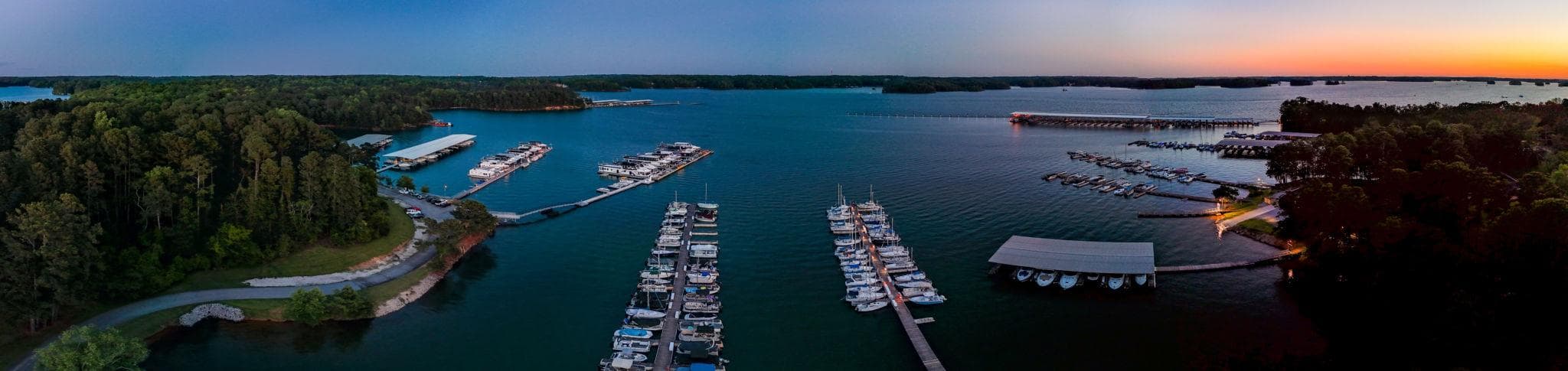
Marina-based boat storage is the second alternative to private-dock ownership and pairs well with a near-lake home that does not sit directly on a USACE-permitted shoreline parcel. Lake Lanier's marina network, including Aqualand Marina on the Flowery Branch shore in Hall County, Sunrise Cove Marina, Holiday Marina, Lanier Islands (Buford mailing address; Hall County jurisdiction), Habersham Marina, and Bald Ridge Marina near Cumming, offers a mix of wet slip leasing, dry stack storage, and covered slip options across the southern and southeastern basin (Lake Sidney Lanier Project Management Office, current as of May 2026). Aqualand Marina is widely cited as one of one of the largest inland marinas in the United States. Dry stack storage stores the boat in a rack inside a covered marina building and uses a marina forklift to launch and retrieve the boat for the owner on request. The model eliminates trailering, eliminates dock maintenance, and concentrates the seasonal workflow into a single call ahead of the outing. Wet slip leasing, by contrast, keeps the boat in the water at the marina under a covered or open slip, which preserves the spontaneous-outing convenience but adds the seasonal slip-lease cost and the marina drive to the workflow. Marina pricing varies by marina, by slip class, and by season, and the slip waiting lists at the most popular southern-basin marinas can run long. Buyers planning a marina-based program should call the candidate marina directly during the search phase to confirm the current wait list, the current slip class availability, and the current pricing rather than assuming category-level estimates. The marina model holds up especially well for buyers who want a Lake Lanier home but prefer to outsource the boat-maintenance and dock-maintenance line items entirely.
Lifestyle fit, weekend boating, and household cadence
Lifestyle fit is the variable that most often determines whether a near-ramp or marina-based program holds up. Households that use the boat every weekend, host friends and family on the water 20 or more days a year, and value the at-home dock as a backyard amenity rarely settle for a trailered or marina-based model and ultimately resolve to permitted-dock waterfront. Households that use the boat 8 to 20 days a year, prioritize the home's interior program, and want lake access without the shoreline-maintenance overhead frequently land on a near-ramp or marina-based program and report higher satisfaction than buyers who stretched into a permitted-dock waterfront they did not fully use. The weekend-cadence test is the most honest one. Buyers walking the lake shortlist should ask, plainly, how many Saturdays a year will the boat actually leave the slip, and how often will a weekday evening cruise happen. The honest answer almost always points to one model over the other. Buyers who anchor on the at-home dock for the once-or-twice-a-month outing typically end up paying for shoreline carrying cost they do not use; buyers who anchor on the trailered or marina-based model and discover they want the boat in the water every weekend can upgrade later in a market where permitted-dock waterfront remains available. The near-ramp lifestyle also pairs well with households that boat as a secondary activity rather than a primary one. A family that golfs at Chestnut Mountain or Royal Lakes Golf and Country Club, hikes the Don Carter State Park trails, and dines on the Lanier Islands waterfront on a Saturday evening typically uses the lake as one amenity in a multi-amenity weekend rather than as the central use case. For that household, a near-ramp home in Cumming, Buford, or Gainesville with the boat trailered to a public ramp on the days the household actually boats almost always delivers a better lifestyle fit than a deep-water permitted-dock waterfront.
Best Lake Lanier Areas with Strong Public Boat Ramp Access
Public boat ramp access on Lake Lanier concentrates around four shoreline corridors: the southern basin near Buford Dam, the western shoreline around Cumming and the Pilgrim Mill Road corridor, the Browns Bridge Road corridor between Cumming and Gainesville, and the eastern and northeastern shoreline near Flowery Branch and Gainesville. Each corridor surfaces a different shortlist of near-ramp neighborhoods, ZIP codes, and price bands. The pattern that surfaces over and over is that the right neighborhood depends more on which ramp the household will actually use than on the headline community marketing.
Cumming and Forsyth County near Bald Ridge Creek and Mary Alice Park
Cumming and the Forsyth County shoreline hold one of the densest concentrations of USACE public boat ramps on Lake Lanier, anchored by Bald Ridge Creek Day Use Park, Mary Alice Park, Two Mile Park, and Sawnee Campground (USACE Mobile District, current as of May 2026). For a buyer prioritizing ramp access on the western and southwestern shoreline, the Pilgrim Mill Road corridor and the Browns Bridge Road corridor are the two natural anchors. Pilgrim Mill Road runs from downtown Cumming north toward the Mary Alice Park and Two Mile Park ramps, while Browns Bridge Road runs east across the lake into the central shoreline. Forsyth County Schools assignment, the GA-400 corridor commute envelope into Alpharetta and Atlanta, and the Forsyth County permit cycle govern the move. Buyers should pair the candidate neighborhood with a specific public ramp at the parcel level and drive the actual launch route from the home to the ramp before committing. Current market conditions require a dated MLS comparison that identifies the area, property type, reporting period, and sample before a buyer relies on it. The near-lake subdivisions along the Pilgrim Mill and Browns Bridge corridors deliver a range of programs from established 1980s and 1990s neighborhoods to newer 2010s and 2020s build-outs. Buyers should verify any community-level lake-access amenity, common-area marina slip, or HOA-controlled boat-storage facility against the current HOA documentation before assuming the amenity conveys with the home, because community-level lake-access programs vary considerably across Forsyth County subdivisions and the documentation is the only reliable source.
Buford and South Lake near Buford Dam and Lower Pool ramps
Buford and the South Lake shoreline anchor the southern foot of Lake Lanier near Buford Dam, with the USACE-managed Lower Pool East and Lower Pool West day-use areas, Big Creek Day Use Park, and the West Bank Day Use Park concentrating public ramp access on the southern basin (USACE Mobile District, current as of May 2026). For an east-Alpharetta, Johns Creek, Suwanee, or Sugar Hill buyer who runs the I-985 corridor, Buford's near-ramp shortlist is the natural first stop. Near-ramp inventory in Buford ZIP codes 30518 and 30519 spans the broad Buford and South Lake near-lake market, including subdivisions along Buford Dam Road, Friendship Road, and the I-985 commercial corridor. Buford's split jurisdiction between Hall County and Gwinnett County, with the Buford City Schools system also active in the Buford city limits, means the school assignment varies by address and buyers should verify the assignment at the parcel level before assuming. Current market conditions require a dated MLS comparison that identifies the area, property type, reporting period, and sample before a buyer relies on it. The Buford near-ramp program also pairs well with the South Lake marina footprint. A Buford homeowner who uses Lanier Islands, Holiday Marina, or one of the smaller marina operators on the southern basin for slip or dry-stack storage can pair the home with marina-based boating without ever needing to operate a private dock or trailer the boat. Buyers should call the candidate marina directly to confirm slip availability and the current wait list, especially during the spring transition months when slip turnover concentrates.
Gainesville and Flowery Branch near the eastern shoreline ramps
Gainesville and Flowery Branch anchor the eastern and northeastern shoreline along I-985 in Hall County, with USACE-managed public ramps at Long Hollow Day Use Park, Belton Bridge, Little Hall Day Use Park, River Forks Park, and the Don Carter State Park ramp on the upper Chattahoochee arm (USACE Mobile District, current as of May 2026). For a buyer prioritizing eastern-shoreline access without the deep-water southern-basin price band, the Gainesville and Flowery Branch near-ramp shortlist almost always surfaces. Near-ramp inventory in Hall County ZIP codes 30506 and 30542 spans the broad Gainesville and Flowery Branch near-lake market, with established neighborhoods on the Browns Bridge Road corridor, the Thompson Bridge Road corridor, and the Atlanta Highway corridor anchoring the shortlist. Hall County Schools assignment, the Northeast Georgia Medical Center healthcare access, and the I-985 commute envelope govern the move. Current market conditions require a dated MLS comparison that identifies the area, property type, reporting period, and sample before a buyer relies on it. The Flowery Branch near-ramp program pairs well with Aqualand Marina on the Flowery Branch shore and with the I-985 corridor commute. Buyers planning a hybrid Atlanta-office cadence should test-drive the actual I-985 morning commute before committing, because the corridor congestion behaves very differently at 7:15 a.m. on a Tuesday than at 11:00 a.m. on a Sunday (Georgia Department of Transportation, current as of January 2026). The eastern-shoreline near-ramp model holds up especially well for buyers who want lake lifestyle without the cost band of southern-basin permitted-dock waterfront, and Ashley Smith, real estate agent with DreamSmith Realty, can build a near-ramp shortlist that matches the household's actual cadence to the right shoreline corridor.
Buyer Due Diligence on Near-Ramp Lake Lanier Homes
Near-ramp and lake-access homes carry a different due-diligence checklist than permitted-dock waterfront. The four streams that matter most are the actual ramp the household will use and its peak-season congestion, the HOA or community-level lake-access rules, the cost-of-ownership math without a private dock, and the boat storage and trailering logistics at the home itself.
Public boat ramp logistics, peak season congestion, and parking
Public boat ramp logistics on Lake Lanier vary widely by ramp. The U.S. Army Corps of Engineers operates the day-use parks that house most of the public ramps around the lake, with a daily vehicle entry fee and separate trailered-launch parking at most ramps (USACE Mobile District, current as of May 2026). Ramp lane counts, courtesy dock counts, parking-spot counts, and restroom facilities all vary by ramp, and the practical capacity of a ramp on a peak Saturday morning between Memorial Day and Labor Day often runs well below the marketing capacity. Buyers planning a near-ramp ownership model should walk the candidate ramp on a peak Saturday morning before committing. The most popular southern-basin ramps near Buford Dam, including Lower Pool East and Lower Pool West and Big Creek Day Use Park, can run wait lines for the launch lane and full parking lots by mid-morning on summer weekends. The western and northern shoreline ramps at Mary Alice Park, Two Mile Park, Bald Ridge Creek, Long Hollow, and River Forks typically run less congested but require a longer drive from the southern-basin commute corridors. Parking is the variable most often overlooked. A trailered-boat household needs to park both the tow vehicle and the trailer, which requires a longer parking footprint than a passenger-car parking space. Buyers should verify the trailer-parking capacity at the candidate ramp and plan an alternate ramp for peak weekends rather than relying on a single ramp during high season. The Don Carter State Park ramp on the upper Chattahoochee arm offers an alternative for buyers on the northeastern shoreline who want a less-congested launch on summer weekends (Lake Sidney Lanier Project Management Office, current as of May 2026).
HOA rules, community boat storage, and trailer parking at home
HOA rules govern the day-to-day workflow of trailered boating from a near-ramp home, and the rules vary widely across Lake Lanier neighborhoods. Some near-lake subdivisions allow trailer parking in the driveway or in a side-yard pad with no restriction; others restrict trailer parking to a screened or enclosed location, and still others prohibit overnight trailer parking on the lot entirely. Buyers should pull the current HOA covenants and the current HOA rules and regulations from the candidate neighborhood and confirm that the proposed boat-trailer storage plan complies before writing an offer. Community-level lake-access amenities, including community docks, community boat ramps, and community slip-assignment programs, also vary widely. A handful of HOA-controlled lake-access communities around the lake offer community-dock or community-slip access as a deeded or HOA amenity, but the slip-assignment rules, the rotation policies, and the upgrade policies all vary by community. Buyers should verify current HOA documentation for any community-level lake-access amenity before assuming the amenity is available, transferable, or guaranteed at the property level. The trailer-parking question pairs with the boat-storage question. Some near-ramp owners store the boat at home year-round; some use a covered storage facility for the boat's off-season; some lease a marina dry-stack slip and trailer the boat only seasonally. The home's lot size, garage configuration, driveway slope, and side-yard access all affect which boat-storage program holds up on the parcel. Buyers should plan the boat-storage workflow at the parcel level before assuming a near-ramp home will accommodate a particular boat class.
Cost of ownership for near-lake homes without a private dock
Cost of ownership on a near-ramp home runs structurally lighter than on a permitted-dock waterfront. The dock insurance rider, the boat-lift maintenance line, the annual dock-inspection line, the USACE permit-renewal cycle, and the shoreline-erosion-control line all drop off the operating budget for a home that does not hold a private USACE-permitted dock. In exchange, the household absorbs the daily boat-ramp parking fee at USACE day-use ramps, the seasonal boat storage cost, the trailer maintenance cost, and the tow-vehicle wear-and-tear cost. Property tax on a near-lake home depends on the county tax commissioner's office at the parcel address. Forsyth County, Hall County, Gwinnett County, and Dawson County each run separate millage rates, homestead exemption rules, and assessment cycles (county tax commissioner offices, current as of May 2026). Buyers should pull the actual prior-year tax bill on the candidate parcel rather than estimating from a category average, because near-lake property tax can shift meaningfully depending on the parcel's valuation history and the household's homestead exemption eligibility. Insurance on a near-lake home without a private dock also runs structurally lower than insurance on permitted-dock waterfront, because the dock structure does not need to be underwritten and the lake-side exposure profile is different. The boat itself typically requires a separate marine policy, and buyers should price the marine coverage before assuming a category estimate. The near-ramp model often delivers a 12-month carrying cost meaningfully below an equivalent permitted-dock waterfront, and the savings frequently fund either a larger interior program at the home or a higher boat-class on the lake. Ashley Smith, real estate agent with DreamSmith Realty, can build a side-by-side near-ramp versus permitted-dock cost-of-ownership comparison for a specific buyer cadence using documented USACE, Georgia MLS, and county tax commissioner data.
Frequently Asked Questions
- How many public boat ramps does Lake Lanier have?
- The U.S. Army Corps of Engineers operates more than a dozen public boat ramps around Lake Lanier's more than 600 miles of shoreline, concentrated in the southern basin near Buford Dam, the western shoreline near Cumming, the Browns Bridge Road corridor, and the eastern and northeastern shoreline near Flowery Branch and Gainesville (USACE Mobile District, current as of May 2026). Ramps include Mary Alice Park, Two Mile Park, Bald Ridge Creek Day Use Park, Lower Pool East and West near Buford Dam, Big Creek Day Use Park, Long Hollow, River Forks, and the Don Carter State Park ramp on the upper Chattahoochee arm.
- Do I need a private dock to enjoy Lake Lanier?
- Not at all. A significant share of Lake Lanier homeowners boat the lake without a private USACE-permitted dock. The two most common alternatives are trailered boating from a near-lake home to a public USACE boat ramp, and marina-based slip leasing or dry-stack storage at one of the lake's marinas, including Aqualand Marina, Lanier Islands, Holiday Marina, Bald Ridge Marina, and Habersham Marina. The right model depends on weekend cadence, boat class, and how often the household plans to actually leave the slip during the boating season.
- Are near-ramp Lake Lanier homes cheaper than waterfront homes?
- Generally, yes. Near-lake homes within a 10-minute drive of a public boat ramp in Lake Lanier ZIP codes 30518, 30519, 30040, 30041, 30506, and 30542 typically trade at a structurally lower band than permitted-dock waterfront homes in the same ZIP codes (Georgia MLS, March 2026). The permitted-dock waterfront premium reflects the dock structure, the USACE shoreline-permit chain, and the lake-side exposure. Buyers prioritizing a larger interior home program for the dollar frequently find near-ramp homes deliver more home, more lot, and a comparable lake lifestyle for households that boat 8 to 20 days a year.
- Can I park a boat trailer at my Lake Lanier home?
- It depends on the HOA. Some near-lake Lake Lanier subdivisions allow trailer parking in the driveway or a side-yard pad with no restriction; others restrict trailer parking to a screened or enclosed location; and still others prohibit overnight trailer parking on the lot entirely. Buyers should pull the current HOA covenants and the current HOA rules and regulations from the candidate neighborhood before writing an offer to confirm that the boat-trailer storage plan complies. Lots outside HOA jurisdictions, including many rural and unincorporated parcels, typically carry no such restriction.
- What are the busiest Lake Lanier boat ramps in summer?
- The southern-basin ramps closest to Buford Dam, including Lower Pool East and Lower Pool West and Big Creek Day Use Park, run busiest on summer Saturday mornings between Memorial Day and Labor Day, with full parking lots and launch-lane wait lines common by mid-morning (USACE Mobile District, current as of May 2026). The western and northern shoreline ramps at Mary Alice Park, Two Mile Park, Bald Ridge Creek, Long Hollow, and River Forks typically run less congested but require a longer drive from the southern-basin commute corridors. Buyers planning a near-ramp ownership model should plan an alternate ramp for peak weekends.
- Is dry stack storage a good alternative to a private dock on Lake Lanier?
- Yes, for many households. Dry stack storage at Lake Lanier marinas, including Aqualand Marina and several southern-basin marina operators, stores the boat in a covered rack and uses a marina forklift to launch and retrieve the boat on request. The model eliminates trailering, eliminates dock maintenance, and concentrates the seasonal workflow into a single call ahead of the outing. Buyers planning a marina-based program should call the candidate marina directly to confirm current slip availability, the current waiting list, and the current pricing, because slip waiting lists at the most popular marinas can run long.
Related
- Lake Lanier Waterfront HomesPermitted-dock and lake-access waterfront listings across the Lanier shoreline for buyers comparing direct-dock ownership.
- Lake Lanier Dock PermitsCheck USACE permit requirements and the application process for a new owner.
- Lake Lanier Cost of OwnershipAnnual carrying-cost model including property tax, dock, insurance, and storage for Lake Lanier shoreline and near-lake homes.
- South Lake Lanier HomesSouthern shoreline inventory in Forsyth, Hall, and Gwinnett counties closest to Buford Dam and the highest-volume ramps.
- Cumming, GA Homes for SaleForsyth County market on the western Lake Lanier shoreline with strong public boat ramp access along Pilgrim Mill Road.
- Lake Lanier Real Estate OverviewFull Lake Lanier shoreline market, USACE framework, marina network, and lifestyle guide for new lake buyers.