
Investment Guide
Evaluating a Lake Lanier home as an Airbnb or short-term rental investment requires a county-by-county read of short-term rental ordinances, HOA covenants, U.S. Army Corps of Engineers shoreline rules, dock-permit transfer logistics, and realistic guest-capacity math before underwriting revenue. The Lake Lanier shoreline spans four jurisdictions with separate STR rules: Forsyth County, Hall County, Dawson County, and Gwinnett County, plus the cities of Cumming, Buford, Gainesville, and Flowery Branch (county code-enforcement offices, current as of May 2026). Property fit, dock access, HOA approval, occupancy taxes, and parking capacity drive revenue more than the headline nightly rate. Buyers approaching the lake with an STR thesis should resolve regulatory clearance before falling for a specific property.
Lake Lanier Short-Term Rental Rules by County and City
Lake Lanier's STR regulatory landscape is fragmented. Each county and incorporated city around the lake maintains its own short-term rental ordinance, business license requirement, occupancy tax structure, and enforcement posture, and the rules change frequently. Buyers underwriting a property based on a nearby Airbnb listing's revenue cannot assume the same regulatory permission applies at the candidate parcel. The first due-diligence step is verifying current STR status at the specific address.
Forsyth County and Cumming STR ordinance overview
Forsyth County and the City of Cumming maintain separate short-term rental frameworks that apply across the western Lake Lanier shoreline in ZIP codes 30040, 30041, and 30028. Forsyth County's STR ordinance requires operators to register with the county, maintain a local responsible party who can respond within a defined window, and pay applicable occupancy and hotel-motel taxes on rentals of less than 30 consecutive days (Forsyth County code-enforcement office, current as of May 2026). The City of Cumming runs a separate registration process for properties inside the city limits, and buyers should confirm at the parcel level whether the candidate property sits inside the city or in unincorporated Forsyth County. Forsyth County's STR enforcement posture has tightened across the most recent code-update cycles, with limits on guest occupancy keyed to bedroom count and septic-system capacity, restrictions on outdoor amplified noise after defined evening hours, and requirements for off-street parking that exclude street parking and shoreline-buffer parking. Buyers underwriting an STR thesis on a Forsyth County shoreline parcel should pull the current ordinance directly from the Forsyth County website and confirm the candidate parcel's septic system supports the planned guest count, because septic capacity is the most common operational ceiling on Forsyth shoreline STR revenue. Forsyth County HOA covenants frequently impose STR restrictions independent of the county ordinance, and many lake-adjacent subdivisions explicitly prohibit rentals shorter than 30 days regardless of county permission. Buyers should pull the HOA's full covenant package and any subsequent amendments before assuming an Airbnb thesis is viable at the parcel. The HOA layer is the regulatory ceiling that most often kills a Forsyth County STR underwriting after the county ordinance clears.
Hall County, Buford, and Gainesville STR rules
Hall County governs the largest single share of the Lake Lanier shoreline by jurisdiction and applies its own STR framework across the eastern, northern, and northeastern shoreline in ZIP codes 30506, 30518, 30519, 30542, and 30501. Hall County requires STR operators to register the property, maintain a designated local contact, and collect and remit applicable lodging taxes on rentals of less than 30 days (Hall County code-enforcement office, current as of May 2026). The City of Gainesville and the City of Buford each run separate registration and tax-collection processes for properties inside their respective city limits, and Buford's split jurisdiction between Hall County and Gwinnett County means the operative ordinance depends on which side of the county line the parcel sits. Hall County's STR enforcement focuses heavily on lake-adjacent properties because the lake basin generates the highest STR demand on the eastern shoreline. Code-enforcement complaints commonly cite over-occupancy, parking spillover into neighboring lots, dockside noise, and improper fireworks usage. Buyers underwriting a Hall County STR on the eastern or southeastern shoreline should expect active enforcement during the Memorial Day through Labor Day window and plan operations accordingly. Hall County also coordinates with the U.S. Army Corps of Engineers on shoreline complaints, and persistent shoreline-buffer violations can escalate into the USACE permit-class review. Flowery Branch sits inside Hall County between Buford and Gainesville and applies the Hall County STR framework, with additional municipal rules for properties inside Flowery Branch city limits. The Flowery Branch shoreline neighborhoods generate strong STR demand because of southern-basin proximity, but several Flowery Branch HOAs maintain blanket short-term rental prohibitions inside their covenants. As with Forsyth, the HOA covenant package is the regulatory ceiling that frequently overrides what the county ordinance permits.
Dawson County, Gwinnett County, and city-specific rules
Dawson County covers the northwestern Lake Lanier shoreline including the Dawsonville area along GA-400 and GA-53, north of Cumming. Dawson County's STR posture is generally less restrictive than Forsyth or Hall on the rural shoreline, with registration and occupancy-tax requirements that follow the county's standard transient-occupancy framework (Dawson County code-enforcement office, current as of May 2026). Dawson County's lower regulatory friction has driven STR concentration on the upper-arm shoreline, but the trade-off is a longer drive from Atlanta-area guest demand, which compresses average daily rate on shoulder-season weekends and weekdays. Gwinnett County covers a narrow southern Lake Lanier shoreline near Buford Dam and the south basin in ZIP code 30518. Gwinnett County's STR ordinance includes registration, business-license, and lodging-tax requirements, and the county runs an active code-enforcement program that responds to complaints inside subdivisions (Gwinnett County code-enforcement office, current as of May 2026). The narrow Gwinnett shoreline footprint means the available STR inventory is small, and HOA covenants in most Gwinnett shoreline subdivisions either restrict or prohibit short-term rentals outright. City-specific rules layer on top of county frameworks across Cumming, Buford, Gainesville, Flowery Branch, and Dawsonville. Each city maintains its own business-license process and its own enforcement office, and the city ordinance can be more restrictive than the surrounding county. Buyers underwriting an STR thesis at an in-city address should confirm both the city and county requirements separately, because the operative rule set is the more restrictive of the two. Occupancy-tax collection is generally automated through Airbnb and Vrbo's pass-through programs in the cities where the platforms have signed agreements, but operators remain responsible for ensuring the registration and any business-license obligations are met directly.
Property Fit: What Makes a Lake Lanier Home Work as an STR
Beyond regulatory clearance, the property itself drives whether the Airbnb thesis pencils. Lake Lanier STR demand concentrates on homes with permitted private docks, deep-water access, large gathering spaces, ample off-street parking, and a layout that comfortably sleeps eight to fourteen guests across separate sleeping quarters. The strongest revenue performers share a defined set of property attributes that buyers should screen for before underwriting an offer.
Dock access, water depth, and shoreline permission
Lake access is the single most important STR property attribute on Lake Lanier, and a permitted private dock with deep-water access drives meaningfully higher nightly rates than lake-view or lake-access homes without on-parcel boating infrastructure. The Lake Sidney Lanier Shoreline Management Plan administered by the U.S. Army Corps of Engineers assigns each shoreline parcel a permit class of Limited Development, Protected Shoreline, Public Recreation, or Operations, and only Limited Development parcels typically support private dock permits (USACE Mobile District, current as of May 2026). New private dock permits are extremely limited under current Corps policy, so STR buyers should target homes with existing permitted docks rather than planning to add one after purchase. USACE permits and licenses are nontransferable. A new owner of an existing facility may apply through the Lake Lanier Operations Management Office, and approval is not automatic. Confirm the property-specific record and current requirements before closing. Water depth at the dock site matters separately from permit class. Summer full pool sits at 1,071 feet above mean sea level, and winter pool sits at approximately 1,070 feet under normal conditions, with deeper drawdowns occurring during drought conditions rather than routine seasonal cycling (USACE Mobile District lake-level history, current as of May 2026). A dock with navigable boating depth throughout normal seasonal fluctuations supports year-round STR revenue. A shallow upper-arm dock that loses navigable depth during dry years caps STR revenue during the very months when guest demand for boat-rental alternatives is highest.
Bedrooms, bathrooms, layout, and guest capacity
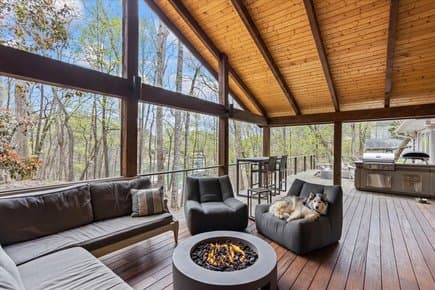
Lake Lanier STR demand skews toward large-group bookings: family reunions, multi-generational weekends, bachelor and bachelorette parties, corporate retreats, and friend-group lake weekends drive a meaningful share of summer-weekend revenue. The strongest revenue performers typically offer five to seven bedrooms, four or more bathrooms, multiple king and queen bed configurations, and bunk rooms that handle teenagers or children separately from adult sleeping quarters. A three-bedroom home in the same shoreline neighborhood typically commands a materially lower nightly rate and a shorter average booking window. Layout matters as much as raw bedroom count. The best-performing properties combine a large open-concept main living area that comfortably hosts twelve to twenty guests for meals and gatherings, separate sleeping wings or floors that give adults and children privacy, multiple full bathrooms distributed across the sleeping floors, and a lake-side outdoor program that includes a covered patio, an outdoor kitchen or grill station, fire-pit seating, and direct lake access. Layouts that force the entire group through a single bathroom hallway or that put bedrooms adjacent to noisy gathering spaces under-perform regardless of square footage. Guest-capacity math should be anchored to septic-system capacity and county ordinance limits, not aspirational bedroom counts. Forsyth County and Hall County both tie maximum occupancy to bedroom count under their STR ordinances, with typical caps of two guests per bedroom plus an allowance for additional children. Buyers should pull the septic permit and confirm the engineered daily flow rating supports the planned guest load before assuming a six-bedroom home can sleep sixteen. Over-occupancy citations are the most common STR enforcement action across Forsyth and Hall, and they trigger both county fines and platform-level account flags.
Parking, noise, neighbors, and operational considerations
Parking capacity is the under-counted property attribute that drives whether an STR operates smoothly or generates persistent neighbor complaints. A property that sleeps sixteen guests typically arrives in four to six vehicles, and the property needs off-street parking for all of them. Many Lake Lanier shoreline driveways accommodate three or four cars at most, and street parking on narrow shoreline roads frequently violates county ordinance or generates HOA complaints. Properties with circular driveways, detached garage parking pads, or dedicated guest-parking areas hold a meaningful operational premium over comparable homes with constrained parking. Neighbor density and HOA dynamics shape the day-to-day operating experience. STR properties surrounded by full-time owner-occupied neighbors generate more complaint volume than properties in second-home or absentee-owner shoreline pockets, and complaint volume drives both enforcement risk and platform-level review scores. Buyers should walk the surrounding shoreline blocks before underwriting an STR thesis and confirm whether the neighborhood has an active HOA noise-complaint pattern. Lake Lanier shoreline neighborhoods near Buford Dam, the southern Forsyth shoreline, and the eastern Hall shoreline include both heavy second-home pockets and full-time residential pockets, and the distinction matters operationally. Operational considerations also include cleaning logistics, dock maintenance, lawn care, hot tub maintenance if applicable, and guest communication. Lake Lanier STR properties typically require a two-person cleaning team between bookings to handle the higher guest count, and turnover windows on summer weekends are tight. Local cleaning, maintenance, and dock-service providers cluster around Buford, Cumming, and Gainesville, with thinner availability on the upper-arm shoreline. Buyers planning to operate the property from a distance should build the local service team before the first booking rather than after.
Underwriting Revenue, Costs, and Investment Risk
Underwriting a Lake Lanier STR investment requires layering realistic revenue projections against the full operating cost stack, the regulatory risk of ordinance changes, and the carrying-cost implications of seasonal demand patterns. The headline nightly rate is only the starting point; net operating income after taxes, mortgage, insurance, dock maintenance, and management fees determines whether the investment pencils across a multi-year hold.
Realistic revenue ranges and seasonal demand patterns
Lake Lanier STR revenue concentrates heavily in the Memorial Day through Labor Day window, with strong demand spilling into shoulder-season weekends in May, September, and October. Summer-weekend nightly rates on permitted-dock waterfront properties with five or more bedrooms typically range from the upper hundreds to the low thousands per night during peak summer holidays, with weekday rates dropping meaningfully. Shoulder-season and winter rates compress further, with many properties effectively dark or operating at break-even from late November through early March. Buyers underwriting annual revenue should anchor on actual booking-platform data for comparable nearby properties rather than blended national averages. Occupancy rates on Lake Lanier STRs typically run materially lower than urban metro STRs because of the seasonal demand pattern. A well-positioned permitted-dock property may achieve 70 to 90 percent weekend occupancy during the May through September window while sitting at 20 to 40 percent occupancy during the October through April window. Annual revenue projections that assume year-round 60-plus percent occupancy generally over-estimate Lake Lanier STR performance. Buyers should model revenue as a summer-heavy calendar with explicit shoulder and winter discounts. Demand drivers include the property's lake-access tier, the bedroom count, the proximity to Atlanta-area weekend drive markets, and the property's marketing presentation. Properties on the southern basin within a 25-to-45-minute drive of Atlanta-area suburbs command the strongest weekend demand, while upper-arm properties further from Atlanta typically rely more on multi-night and week-long bookings during peak summer months. The southern shoreline near Buford, the southern Forsyth shoreline near Cumming, and the eastern shoreline near Flowery Branch concentrate the highest weekend-demand bookings.
Operating costs, taxes, mortgage, and management fees
The Lake Lanier STR operating cost stack is meaningfully higher than a traditional long-term rental. Property tax differs by county across Forsyth, Hall, Dawson, and Gwinnett, with separate millage rates and assessment cycles (county tax commissioner offices, current as of May 2026). Insurance on a Lake Lanier STR includes a higher liability rider than an owner-occupied home, dock-specific coverage, and platform-required short-term rental endorsements that many standard homeowner policies exclude. Buyers should confirm STR insurance availability and pricing with a carrier specializing in short-term rentals before closing. Occupancy and lodging taxes layer on top of the gross nightly rate. Georgia imposes a state hotel-motel fee plus state sales tax, and each county and city layers additional lodging taxes on top, with combined rates typically running into the low to mid teens as a percentage of the nightly rate (Georgia Department of Revenue and county tax commissioner offices, current as of May 2026). Airbnb and Vrbo collect and remit many of these taxes automatically in jurisdictions where they have signed agreements, but operators remain responsible for verifying complete compliance and for any taxes the platforms do not collect. Management fees vary widely depending on whether the owner operates the property remotely, uses a local property manager, or runs a full-service vacation rental management company. Full-service managers on Lake Lanier typically charge 20 to 35 percent of gross booking revenue depending on service tier, and owner-operated properties trade the management fee for direct time investment in guest communication, scheduling, and operational coordination. Buyers should model both scenarios. Cleaning fees, dock maintenance, lawn care, pool or hot tub service, pest control, and minor repair reserves complete the operating stack, and a realistic full-year operating budget on a five-to-seven-bedroom permitted-dock property typically runs into the tens of thousands of dollars annually before mortgage.
Regulatory risk, exit strategy, and finding the right Lake Lanier property
Regulatory risk is the single most significant variable on a multi-year Lake Lanier STR hold. Forsyth County, Hall County, the City of Cumming, and the City of Gainesville have all revisited their STR ordinances within recent code-update cycles, and several other Georgia jurisdictions have moved toward stricter STR registration caps, neighborhood-density limits, or outright prohibitions in residential zones. Buyers should assume the regulatory environment will continue to evolve and underwrite a downside scenario where the property reverts to long-term rental or owner-use only. A property that pencils only under the current STR ordinance and not as a long-term rental or second home is a fragile investment. HOA covenant risk runs parallel to county ordinance risk. Many lake-adjacent HOAs have amended their covenants to add STR restrictions following neighbor complaint cycles, and covenant amendments typically require only a majority of homeowners rather than unanimous consent. Buyers should pull the full covenant package, including all amendments and meeting minutes from recent HOA board cycles, to gauge whether an STR restriction amendment is being discussed. Properties in neighborhoods without an HOA face less covenant risk but typically rely more heavily on county-level enforcement, which can also change. Exit strategy matters as much as entry pricing. A Lake Lanier permitted-dock waterfront property typically retains strong resale value to either future STR operators or second-home buyers, provided the regulatory environment remains permissive. Properties that work only as STRs, that have neighbor-complaint enforcement histories, or that depend on dock permits with unclear transfer status face thinner exit markets. Ashley Smith, real estate agent with DreamSmith Realty, can build an STR-focused shortlist that screens Lake Lanier shoreline inventory against current county and HOA regulatory clearance, USACE dock permit status, property-fit attributes, and realistic revenue ranges anchored in documented Georgia MLS, USACE, and county-level data rather than aspirational booking-platform headlines.
Frequently Asked Questions
- Is it legal to run an Airbnb on Lake Lanier?
- It depends on the specific county, city, and HOA at the parcel. Forsyth County, Hall County, Dawson County, and Gwinnett County each maintain separate short-term rental ordinances, and the cities of Cumming, Buford, Gainesville, and Flowery Branch run additional municipal rules (county code-enforcement offices, current as of May 2026). Most ordinances permit STRs with registration, occupancy taxes, and operational compliance, but many HOAs prohibit rentals shorter than 30 days regardless of county permission. Buyers should verify both the county or city ordinance and the HOA covenant package at the candidate parcel before underwriting an Airbnb thesis.
- What kind of nightly revenue can a Lake Lanier Airbnb generate?
- Summer-weekend nightly rates on permitted-dock waterfront properties with five or more bedrooms typically range from the upper hundreds to the low thousands per night during peak summer holidays, with weekday rates dropping meaningfully. Shoulder-season and winter rates compress further, with many properties effectively dark from late November through early March. Buyers underwriting annual revenue should anchor on actual booking-platform data for comparable nearby properties and model revenue as a summer-heavy calendar with explicit shoulder and winter discounts rather than year-round occupancy assumptions.
- Do I need a private dock for a Lake Lanier Airbnb to work?
- Not strictly, but a permitted private dock with deep-water access drives meaningfully higher nightly rates and weekend occupancy than lake-view or lake-access homes without on-parcel boating infrastructure. New private dock permits are extremely limited under current U.S. Army Corps of Engineers policy (USACE Mobile District, current as of May 2026), so STR buyers should target homes with existing permitted docks. Buyers should also verify the dock permit's transfer process directly with the Lake Sidney Lanier Project Management Office before closing, because permits do not automatically convey with the deed and require a USACE process for re-issuance.
- What taxes apply to a Lake Lanier Airbnb?
- Georgia imposes a state hotel-motel fee and state sales tax on short-term rentals, and each county and city layers additional lodging taxes on top, with combined rates typically running into the low to mid teens as a percentage of the nightly rate (Georgia Department of Revenue and county tax commissioner offices, current as of May 2026). Airbnb and Vrbo collect and remit many of these taxes automatically in jurisdictions where they have signed agreements, but operators remain responsible for verifying complete compliance and for any taxes the platforms do not collect.
- How many guests can I host at a Lake Lanier Airbnb?
- Guest capacity is governed by county ordinance occupancy caps, septic-system engineered daily flow rating, HOA covenant restrictions, and parking availability rather than aspirational bedroom counts. Forsyth County and Hall County both tie maximum occupancy to bedroom count under their STR ordinances, with typical caps of two guests per bedroom plus an allowance for additional children (county code-enforcement offices, current as of May 2026). Buyers should pull the septic permit and confirm the engineered capacity supports the planned guest load before underwriting a sixteen-guest property based on six bedrooms.
- What is the biggest risk to a Lake Lanier Airbnb investment?
- Regulatory and HOA covenant risk over a multi-year hold. Forsyth County, Hall County, and several Lake Lanier cities have revisited STR ordinances within recent code-update cycles, and many lake-adjacent HOAs have amended covenants to add STR restrictions following neighbor complaint cycles. Buyers should underwrite a downside scenario where the property reverts to long-term rental or owner-use only. A property that pencils only under the current STR ordinance and not as a long-term rental or second home is a fragile investment, and exit value depends heavily on the regulatory environment remaining permissive.
Related
- Lake Lanier Dock PermitsCheck USACE permit requirements and the application process for a new owner.
- Lake Lanier Waterfront HomesPermitted-dock and lake-access waterfront listings across the Lanier shoreline that fit STR property criteria.
- Lake Lanier Cost of OwnershipAnnual carrying-cost model including property tax, dock, septic, and insurance for Lake Lanier shoreline homes.
- South Lake Lanier HomesSouthern shoreline inventory closest to Atlanta-area weekend drive markets that drive Airbnb demand.
- Lake Lanier Luxury HomesUpper-band shoreline inventory with the bedroom count, layout, and dock infrastructure that supports large-group STR bookings.
- Lake Lanier Real Estate OverviewFull Lake Lanier shoreline market, USACE dock permit framework, and lifestyle guide for investor and owner-occupant buyers.