
Seller Guide
The seller's path resolves on dock documentation, shoreline classification, view, architecture, and whether the home goes public or private-channel first. Current market conditions require a dated MLS comparison that identifies the area, property type, reporting period, and sample before a buyer relies on it.
What Makes a Lake Lanier Luxury Home Different to Sell
A Lake Lanier luxury home above $2 million is not priced or marketed like a comparable-square-foot interior estate. The value drivers are dock class, deep-water access, view, architecture, and outdoor-living program, and the buyer pool is national and discretionary rather than regional and necessity-driven. Sellers who run a generic luxury playbook against a Lake Lanier home typically leave both time and money on the table.
Dock class, shoreline classification, and the USACE overlay
The single most important value driver on a Lake Lanier luxury home is the dock permit and the shoreline classification, both governed by the Lake Sidney Lanier Shoreline Management Plan administered by the U.S. Army Corps of Engineers (USACE Mobile District, current as of May 2026). The plan assigns each shoreline parcel a classification of Limited Development, Protected Shoreline, Public Recreation, or Operations, and the parcel's classification determines whether the home holds a permitted private single-slip dock, a permitted double-slip dock, a community-dock assignment, or no dock at all. New private dock permits are extremely limited under the current plan, which means an existing permitted dock on a resale luxury home carries scarcity value that a buyer cannot reproduce by buying a comparable shoreline parcel and applying for a new dock. USACE permits and licenses are nontransferable. A new owner of an existing facility may apply through the Lake Lanier Operations Management Office, and approval is not automatic. Confirm the property-specific record and current requirements before closing. The shoreline classification overlay also drives the renovation, walkway, vegetation, and shoreline-modification limits a buyer can plan against the home. Luxury buyers asking about a future boathouse expansion, an additional slip, a new shoreline staircase, or a hardscape patio against the shoreline buffer need accurate answers in writing, and a seller who can hand the buyer the classification map and the current shoreline-modification rules at the first showing typically converts the showing to a serious offer at a meaningfully higher rate than a seller who deflects the questions to closing diligence.
Deep water, view corridor, and outdoor living as value drivers
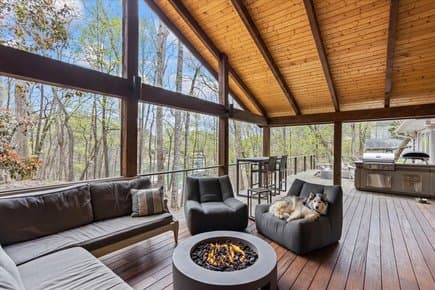
Deep water on a Lake Lanier luxury home means navigable boating depth throughout normal seasonal fluctuations of the lake, with summer full pool at 1,071 feet above mean sea level and winter pool at approximately 1,070 feet (USACE Mobile District, current as of May 2026). A luxury home priced in the upper bands of the Lake Lanier market needs to hold usable water at the dock during the winter cycle, not just during the summer marketing window. A shoreline parcel that drops to unusable depth during drought conditions in dry years sits in a different price band than a deep-water southern-basin parcel that holds usable depth across the seasonal cycle, and the gap widens at the top of the market. View corridor is the second under-priced variable in Lake Lanier luxury inventory. Buyers shopping above $3 million typically anchor on the main-channel long-view parcels, the open-water southern-basin views, and the sunset-facing west-shore parcels in Hall and Forsyth counties more than on raw shoreline frontage footage. A luxury home with 200 feet of shoreline on a tight cove with a 90-degree across-cove view of a neighbor's dock prices differently than a comparable-square-foot home with a wider main-channel view, even when the cove home has more raw frontage. Sellers should pair the listing photography with drone aerial coverage that documents the actual view corridor across the seasonal cycle rather than only a clear-day summer afternoon. Outdoor living program is the third driver, and the one Lake Lanier luxury buyers verbalize most clearly on first walk-throughs. The program a discretionary buyer pays a premium for includes a covered lake-side porch, an outdoor kitchen, a fire feature, terraced lake-side landscaping, a screened porch system or three-season room, a separate lake-side guest or pool house where the parcel supports it, and a walking path or hardscape down to the dock that handles year-round shoreline use. Sellers whose home carries the full outdoor program should make sure the marketing copy, the photography, and the property video document each element, because the program reads on photography and reads even more powerfully on a dusk drone reel.
Architecture, finishes, and the discretionary luxury buyer pool
The Lake Lanier luxury buyer pool above $2 million is structurally different than the buyer pool for an interior North Fulton or Forsyth estate. The Lake Lanier discretionary buyer is more often a relocation buyer from Florida, Tennessee, the Carolinas, or the Northeast; a second-home buyer holding a primary residence in Atlanta or another metro; a family-office or trust buyer; or a downsizing-into-lifestyle buyer who is choosing the lake over a coastal alternative. These buyers shop architecture, finish quality, and program more aggressively than interior-estate buyers because the lifestyle premise is the entire reason they are looking at the lake at all. Architecture on a Lake Lanier luxury home reads on three axes: the lake-side facade and how it relates to the shoreline, the interior floor plan and how it captures the view from primary living spaces, and the lower-level walkout program that connects the home to the lake-side outdoor space. Homes that resolve all three axes cleanly typically command the top of the band. Homes with a strong lake-side facade but a closed-off interior plan that does not capture the view from the kitchen, great room, and primary suite typically sit in the market longer and trade at a discount until the program is recut. Finishes on a Lake Lanier luxury home should support a daily-use lifestyle that includes wet feet, sand, pets, and entertaining at scale. The luxury buyer pool expects natural stone, hardwood, large-format tile in transition zones, professional-grade kitchen appliances, and bathroom programs that serve guests in addition to the primary household. Sellers running an under-finished home into the luxury price band typically resolve to either a targeted finish refresh against the comparable sales the home is being priced against, or a price re-cut into the next band down. Ashley Smith, real estate agent with The Dream Smith Team at Compass, can walk a seller through the architecture-and-finish read against the active Lake Lanier luxury comparables before the listing goes live.
Building the Right Luxury Marketing and Pricing Strategy
A Lake Lanier luxury listing strategy rests on three pillars: a defensible pricing position built off true shoreline comparable sales rather than category averages, an editorial-grade marketing package built for a national discretionary audience, and a deliberate exposure path that combines private-buyer outreach with MLS launch timing. The three pillars together determine whether the home sells inside the first 60 days or sits into a second listing cycle.
Pricing against true Lake Lanier luxury comparable sales
Current market conditions require a dated MLS comparison that identifies the area, property type, reporting period, and sample before a buyer relies on it. Sellers should resist anchoring on aspirational asking prices from active listings that have not yet sold, because Lake Lanier luxury active inventory frequently sits at asking prices above the trailing closed band by 10 to 25 percent and then resolves to closed prices in the trailing band after extended days on market. The defensible pricing position is the trailing closed comparable band adjusted for the candidate home's specific dock class, view, architecture, and finish position relative to those closed sales. Where the candidate home outperforms the closed comparables on dock, view, or architecture, the band shifts up; where it underperforms, the band shifts down. The second pricing decision is the launch price relative to the defensible band. Sellers who launch at the top of the defensible band typically draw the strongest first-30-day showing volume and the most credible offers from the relocation and second-home buyer pool, because the luxury buyer pool reads launch price as a signal of seller seriousness. Sellers who launch above the defensible band typically lose the first-30-day window to other listings, sit on the market into the second cycle, and then resolve to a price reduction that signals weakness rather than confidence. The launch price on a Lake Lanier luxury home matters more than on interior inventory because the buyer pool is smaller and reads the listing more carefully.
Editorial photography, aerial video, and luxury staging
Editorial-grade photography is the minimum marketing standard for a Lake Lanier luxury home above $2 million. The package should include twilight exterior photography from the lake side, daytime exterior photography from both the lake side and the road approach, full interior coverage of the great room, kitchen, primary suite, and outdoor-living areas, and detail photography of architectural and finish features that distinguish the home from comparables. The photographer should be a real estate luxury specialist with a portfolio of comparable Lake Lanier or coastal-luxury work, not a generalist MLS photographer, because the photographic read is the first filter a discretionary buyer applies and the only filter a relocation buyer applies before booking a tour. Aerial drone video is the second non-negotiable element. A Lake Lanier luxury home's value is partially invisible from ground-level photography, and a 60-to-90-second aerial reel that documents the dock, the shoreline frontage, the view corridor across the open water, and the parcel's position on the lake reads to a national audience in a way no still photography can replicate. The reel should be shot at golden-hour or dusk lighting to capture the lake-side ambiance and should include both wide-establishing shots and tighter dock-and-shoreline detail shots. Aerial coverage during the shoulder season, when leaf cover is reduced, can also document the view corridor more honestly than peak-summer foliage. Luxury staging on a Lake Lanier home should support the lake-living lifestyle premise rather than replicate an interior design showroom. The staging should make the lake-side living areas, the outdoor program, the primary suite view, and the entertaining flow read clearly to a buyer walking the home for the first time. Where the home has under-utilized lake-side rooms, sellers should consider editing the room program through staging to clarify the use case. Sellers should also schedule the photography, video, and first showings around the seasonal lake-level cycle so the marketing assets document the home at its best presentation, typically late spring through early fall when full pool is most consistently held.
Private buyer networks, MLS exposure, and timing the launch
The exposure path for a Lake Lanier luxury home should combine private-buyer outreach with public MLS launch, and the order of the two matters. A seller working with a luxury agent network can run a 7-to-21-day pre-MLS private exposure cycle that introduces the home to a curated list of relocation buyers, second-home buyers, and discretionary buyers through national luxury networks including Compass Private Exclusives, Coming Soon listings, and the broker-to-broker luxury referral network. Private exposure produces qualified interest without the public days-on-market clock starting, and a meaningful share of Lake Lanier luxury sales close from the private channel before the home ever hits the public MLS. The MLS launch, when it follows private exposure, carries the photography, video, copy, and pricing position that the private cycle has already refined. The first 14 days on the public MLS draw the strongest showing volume from local and regional buyers in the discretionary band, and a clean launch with editorial-grade marketing and a defensible price typically resolves to multiple showings and at least one credible offer within the first 30 days. Sellers who skip the private cycle and launch straight to the MLS still produce a competitive listing, but they cede the curated-buyer opportunity to other listings. Launch timing on the calendar also matters for Lake Lanier luxury inventory. The Lake Lanier luxury market runs strongest from late February through early July, with a meaningful secondary window from mid-September through early November after the summer holiday cycle resolves. Late-July and August launches typically run into the boating-vacation cycle and lose showings; mid-November through January launches typically run into the holiday and tax-year cycle and produce thin showing volume. Sellers with calendar flexibility should target the late-February-through-May window for the strongest combination of private and public exposure. Ashley Smith, real estate agent with The Dream Smith Team at Compass, can build the private-exposure list, the MLS launch package, and the timing plan against the seller's actual calendar and the active Lake Lanier luxury inventory.
Seller Diligence, Discretion, and Pre-Listing Preparation
A Lake Lanier luxury seller's pre-listing work runs across four streams: dock and shoreline documentation, property-condition diligence and pre-listing improvements, discretion and privacy controls for the marketing process, and the actual showing-and-offer logistics on a high-value home. Each stream materially affects time-on-market and net-to-seller, and each is most efficiently resolved before the listing goes live rather than during contract.
Documenting dock permit, shoreline classification, and surveys
Pre-listing dock and shoreline documentation should produce a buyer-facing diligence packet that resolves the highest-friction buyer questions before they reach the contract. The packet should include the current U.S. Army Corps of Engineers dock permit with permit number, classification, and conditions; the parcel's shoreline classification map under the Lake Sidney Lanier Shoreline Management Plan administered by the U.S. Army Corps of Engineers; a current as-built dock survey showing the slip count, covered versus uncovered configuration, and dimensions; and a current parcel survey showing the lot boundary, the shoreline contour, and any easements or encroachments (USACE Mobile District and Lake Sidney Lanier Project Management Office, current as of May 2026). USACE permits and licenses are nontransferable. A new owner of an existing facility may apply through the Lake Lanier Operations Management Office, and approval is not automatic. Confirm the property-specific record and current requirements before closing. A septic system pre-inspection, well water test where applicable, and the parcel's tax history from the relevant county tax commissioner's office (county tax commissioner offices, current as of May 2026) complete the pre-listing documentation set. Most Lake Lanier shoreline parcels are not on municipal sewer, and the septic class and condition is a regular friction point on luxury inspection diligence; a pre-listing septic report removes the friction and shifts the negotiation onto the actual home rather than the system. The documentation set is part of the seller's marketing investment, not part of the closing cost.
Property condition, pre-listing improvements, and ROI
Pre-listing improvements on a Lake Lanier luxury home should be filtered through the comparable-sales lens: which specific improvements close the gap between the candidate home and the closed comparables at the top of the band the seller is targeting. Targeted improvements that typically carry positive ROI on Lake Lanier luxury inventory include kitchen finish refreshes where the comparables show a clear standard, primary bathroom refreshes for the same reason, lake-side outdoor-living additions or upgrades, dock refurbishment or lift maintenance, shoreline landscaping and erosion control, and exterior paint and trim where weathering shows. Improvements that frequently do not carry positive ROI include full additions, major architectural reconfiguration, and high-end finish-overs in rooms that are already comparable to the band. The pre-listing improvement budget should be scoped against the actual pricing band the home is being launched into. A $50,000 to $150,000 pre-listing budget on a $3 million to $5 million home that closes a real finish or program gap typically returns multiples on the investment through a stronger launch price and a shorter days-on-market window. A $300,000 to $500,000 pre-listing budget that does not close a real gap or that over-improves the home relative to the band typically does not return the investment because the buyer pool will not pay for finishes above the comparable band regardless of how good the work is. A pre-listing inspection by a licensed home inspector, parallel to the seller's diligence packet, surfaces the buyer-inspection issues the home will face during contract and lets the seller decide which items to resolve before listing and which to disclose. On a Lake Lanier luxury home, common pre-listing inspection items include dock and lift condition, shoreline retaining structures, lower-level moisture and waterproofing, HVAC capacity in lake-side glass-heavy rooms, and roof condition on homes with complex roof systems. Resolving the items before listing typically produces a smoother inspection-response window and a smaller buyer-credit ask at the contract stage.
Discretion, private exposure, and managing the showing process
Discretion is a value driver in the Lake Lanier luxury seller pool that interior-luxury sellers often under-weight. Many Lake Lanier luxury sellers have public-profile reasons to control who knows the home is for sale, when the home is being shown, and how the home is being marketed. A seller-controlled private-exposure cycle through Compass Private Exclusives, Coming Soon listings, and the broker-to-broker luxury referral network gives the seller the ability to test pricing, photography, and buyer interest without the public days-on-market clock starting and without the listing surfacing on consumer aggregator sites. A meaningful share of Lake Lanier luxury sales close from the private channel before the home ever hits the public MLS. Showing controls on a Lake Lanier luxury home should be tighter than on interior inventory. The luxury seller's protocol typically includes appointment-only showings booked through the listing agent rather than open self-service lockbox showings, buyer pre-qualification or proof-of-funds verification before booking, accompanied showings with the listing agent present, and a documented showing log that tracks every buyer and buyer's agent who has been through the home. The protocol protects the home's physical security, the seller's privacy, and the integrity of the buyer-interest data the seller and listing team are using to make pricing decisions. Offer management on a Lake Lanier luxury home should be run through a deliberate process rather than an open-ended ad hoc negotiation. The listing team should set an offer-review window when private exposure or MLS launch produces multiple credible buyers, communicate the window to all interested parties through their respective agents, and review offers against price, terms, financing strength, closing timeline, dock-transfer plan, and contingency structure rather than price alone. The process produces better net-to-seller outcomes than first-in-first-served negotiation and protects the seller from the dynamic where a single early offer locks the home out of stronger later interest. Ashley Smith, real estate agent with The Dream Smith Team at Compass, can build the discretion plan, the showing protocol, and the offer-management process around the seller's actual privacy, calendar, and net-to-seller objectives.
Frequently Asked Questions
- How long does it take to sell a Lake Lanier luxury home?
- A correctly priced, professionally marketed Lake Lanier luxury home with a documented dock permit and a clean diligence packet often resolves to a contract inside 60 to 120 days from listing, with another 45 to 75 days to close. Homes priced above the defensible comparable band or launched without editorial-grade marketing routinely sit into a second listing cycle of six months or longer. Current market conditions require a dated MLS comparison that identifies the area, property type, reporting period, and sample before a buyer relies on it.
- Does my dock permit transfer to the buyer at closing?
- USACE permits and licenses are nontransferable. A new owner of an existing facility may apply through the Lake Lanier Operations Management Office, and approval is not automatic. Confirm the property-specific record and current requirements before closing.
- What pricing strategy works best for Lake Lanier luxury homes?
- Launching at the top of the defensible band typically produces the strongest first-30-day showing volume and the most credible offers. Launching above the defensible band typically forces a later price reduction that signals weakness and prolongs the listing. Current market conditions require a dated MLS comparison that identifies the area, property type, reporting period, and sample before a buyer relies on it.
- Do I need professional drone or aerial video to sell my Lake Lanier home?
- For homes above $2 million, yes. The value of a Lake Lanier luxury home includes the dock, the shoreline frontage, the view corridor across the open water, and the parcel's position on the lake, and those elements are partially invisible from ground-level photography. A 60-to-90-second aerial reel shot at golden-hour or dusk lighting reads to relocation and second-home buyers in a way that still photography cannot replicate. For homes below the $2 million band, drone coverage is still recommended but the marketing package can be scoped accordingly.
- Should I list publicly on the MLS or do private exposure first?
- A combined path typically produces the strongest outcome. A 7-to-21-day pre-MLS private exposure cycle through Compass Private Exclusives, Coming Soon listings, and the broker-to-broker luxury network introduces the home to a curated buyer pool without the public days-on-market clock starting. The MLS launch that follows carries the photography, video, and pricing position the private cycle has refined. Many Lake Lanier luxury sales close from the private channel before reaching the public MLS, and sellers seeking discretion in particular benefit from the staged approach.
- What pre-listing improvements actually pay off on a Lake Lanier luxury home?
- Improvements that close a real gap between the home and the comparable sales at the top of the targeted band typically return positive ROI: kitchen and primary bathroom refreshes where the comparables show a clear standard, lake-side outdoor-living additions, dock and lift refurbishment, shoreline landscaping, and exterior paint and trim where weathering shows. Full additions, major architectural reconfiguration, and finish-overs that push the home above the comparable band typically do not return the investment because the discretionary buyer pool will not pay for finishes above the band regardless of quality.
Related
- Sell Your Lake Lanier HomeDreamSmith Realty's full seller process for Lake Lanier waterfront, luxury, and shoreline-area homes.
- Lake Lanier Luxury HomesActive luxury inventory and recent closed comparables across the Lake Lanier shoreline.
- Lake Lanier Waterfront HomesPermitted-dock and lake-access waterfront listings across the Lanier shoreline.
- Lake Lanier Dock PermitsUSACE dock permit framework, shoreline classifications, and what sellers and buyers should document.
- Featured PropertiesCurrent featured Lake Lanier and surrounding-market listings represented by DreamSmith Realty.
- Lake Lanier Market ReportsMonthly and quarterly Lake Lanier shoreline market data including luxury comparables and absorption.