
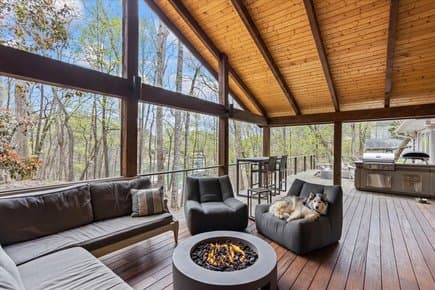
Luxury Lake Lanier
Lake Lanier double-slip dock homes are waterfront properties with an existing private dock permitted by the U.S. Army Corps of Engineers to hold two boat slips under the Lake Sidney Lanier Shoreline Management Plan administered by the U.S. Army Corps of Engineers (Lake Sidney Lanier Project Management Office, current as of May 2026). Current market conditions require a dated MLS comparison that identifies the area, property type, reporting period, and sample before a buyer relies on it.
What a Double-Slip Dock Actually Is on Lake Lanier
A double-slip dock on Lake Lanier is a private USACE-permitted floating dock structure built to accommodate two boats side by side, typically a primary wakeboard or pontoon boat in one slip and a secondary runabout, ski boat, or personal watercraft platform in the other. The permit class, the cove depth, and the shoreline classification together govern whether a parcel can hold a double-slip dock at all.
Permit class, slip count, and structure size on Lake Lanier
USACE permits on Lake Lanier are issued by the Lake Sidney Lanier Project Management Office under the Lake Sidney Lanier Shoreline Management Plan administered by the U.S. Army Corps of Engineers, and the permit specifies the structure footprint, the slip count, the covered area, and the shoreline classification of the parcel (Lake Sidney Lanier Project Management Office, current as of May 2026). A double-slip permit is a specific authorization for two boat slips on the same dock structure, and the permit document itself names the structure dimensions, the maximum dock length from the shoreline, and the allowable accessory features such as a covered roof, a swim platform, or a boat lift. Structure size on a Lake Lanier double-slip dock typically runs larger than a single-slip dock in both footprint and roof span, which means a higher build cost, a higher annual maintenance cost, and a higher insurance carrying line. The double-slip dock also requires a wider stretch of usable shoreline frontage and a cove geometry that accommodates two boats maneuvering at the same time without crowding adjacent parcel docks. Cove width and adjacent-permit spacing at the parcel level both matter. The USACE shoreline classification at the parcel level determines whether the parcel can hold a private dock of any class. The four shoreline classifications are Limited Development, Protected Shoreline, Public Recreation, and Operations, and only the Limited Development classification supports private dock permits (Lake Sidney Lanier Project Management Office, current as of May 2026). Buyers shopping a Lake Lanier double-slip dock home should always verify the shoreline classification at the candidate parcel before assuming the dock can be modified, expanded, or rebuilt within the existing footprint.
Why double-slip docks are constrained inventory
New private dock permits on Lake Lanier are extremely limited under the current shoreline management plan, which means the inventory of double-slip dock homes is essentially a fixed resale pool rather than a category that grows through new construction (Lake Sidney Lanier Project Management Office, current as of May 2026). Buyers shopping the category are competing for an existing permit footprint that was issued under a prior regulatory cycle, and the permit cannot be casually upgraded from a single-slip to a double-slip configuration without a formal USACE review. The constrained inventory dynamic shows up in the listing data. Buyers should expect a tighter days-on-market window for well-priced double-slip dock homes in the spring and early-summer search window. Current market conditions require a dated MLS comparison that identifies the area, property type, reporting period, and sample before a buyer relies on it. The second structural constraint is that the dock permit does not automatically convey with the deed. The dock permit is issued by USACE to the named permit holder, and re-issuance or transfer to a new owner requires a USACE process that the buyer should verify in writing before closing. Buyers should confirm the existing permit document, the slip count, the structure dimensions, and the USACE transfer process directly with the Lake Sidney Lanier Project Management Office during the inspection period rather than assuming the dock conveys with the sale (Lake Sidney Lanier Project Management Office, current as of May 2026).
Two-boat households, family use, and rental dynamics
The buyer profile for a Lake Lanier double-slip dock home is typically a two-boat household. The first slip holds the primary use boat, most often a wakeboard tower boat for a watersports household, a pontoon for a multi-generation family, or a cruiser for a couples-and-guests cadence. The second slip holds the secondary platform, most commonly a runabout, a fishing boat, or a personal watercraft lift platform. The two-boat program changes how the household actually uses the dock across a season. Family-use programs scale meaningfully on a double-slip dock. A multi-generation household running a Saturday cookout with 12 to 20 guests can launch a tube ride on one boat and a fishing run on the other without rotating the same hull, which compresses the planning friction that a single-slip household experiences. The double-slip dock also pairs well with houses programmed for guest accommodations, since the secondary slip absorbs the visiting boat or the rental-day platform without displacing the primary use. Short-term rental dynamics on Lake Lanier vary by jurisdiction and by HOA, and buyers planning a rental use case on a double-slip dock home should verify the local short-term rental ordinance with the relevant Forsyth County, Hall County, Gwinnett County, or municipal authority before committing. Some shoreline communities prohibit short-term rentals through HOA documentation, while others allow rentals subject to a permit cycle. The double-slip dock is a marketable rental amenity when the local jurisdiction permits the use case, but buyers should never anchor an underwriting on rental income that the local ordinance has not been verified to allow.
Where Double-Slip Dock Homes Concentrate on Lake Lanier
Lake Lanier double-slip dock homes concentrate on the deeper southern basin and the southeastern coves closest to Buford Dam, where the navigable boating depth holds across normal seasonal fluctuations and the cove geometry supports a wider dock footprint. Buford, Flowery Branch, Gainesville, and the southern Forsyth shoreline near Cumming each produce a different shortlist with different price bands and access dynamics.
South Lake Lanier and Buford double-slip inventory
The South Lake basin near Buford holds the deepest navigable water on Lake Lanier at summer full pool elevation 1,071 feet above mean sea level, with normal winter pool at approximately 1,070 feet (Lake Sidney Lanier Project Management Office, current as of May 2026). Current market conditions require a dated MLS comparison that identifies the area, property type, reporting period, and sample before a buyer relies on it. Buyers comparing the South Lake double-slip band against the upper-arm shoreline should weigh the depth-of-water premium, the I-985 corridor access, and the year-round boating use case against the higher entry price. Current market conditions require a dated MLS comparison that identifies the area, property type, reporting period, and sample before a buyer relies on it. Daily-life logistics on the South Lake side anchor on the I-985 corridor, the Mall of Georgia retail node, the Northeast Georgia Medical Center system in Gainesville and Braselton, and downtown Buford. Drive time from a South Lake double-slip dock address to the Perimeter (I-285) typically runs 45 to 75 minutes via I-985 depending on the day (Georgia Department of Transportation, current as of January 2026), which fits a hybrid Atlanta-office cadence. Buford's split jurisdiction between Hall County and Gwinnett County means the school assignment and the property tax rate vary by parcel address, and buyers should verify both at the candidate parcel before assuming a category-level rate.
Flowery Branch, Gainesville, and the eastern shoreline
Flowery Branch sits between Buford and Gainesville on the eastern shoreline in Hall County along I-985, with ZIP code 30542 as the primary double-slip dock submarket. The southeastern coves in Flowery Branch hold navigable boating depth across normal seasonal fluctuations and concentrate a meaningful share of the eastern shoreline's permitted double-slip dock inventory (Lake Sidney Lanier Project Management Office, current as of May 2026). Current market conditions require a dated MLS comparison that identifies the area, property type, reporting period, and sample before a buyer relies on it. Gainesville and the upper Hall County shoreline in ZIP code 30506 carry a lower double-slip dock band than the South Lake basin, reflecting the longer commute back to the Perimeter and the upper-arm cove depth profile that varies more across the seasonal cycle. Drive time from a Gainesville double-slip dock address to the Perimeter typically runs 60 to 90 minutes via I-985 depending on the day (Georgia Department of Transportation, current as of January 2026), which fits a weekend or hybrid cadence more cleanly than a five-day Atlanta-office cadence. Hall County Schools assignment, the Hall County permit cycle, and Hall County Environmental Health septic review govern the move. The eastern shoreline's amenity anchors include Aqualand Marina on the Flowery Branch shore in Hall County, the Northeast Georgia Medical Center system, downtown Gainesville, and the Atlanta Falcons training facility in Flowery Branch. Buyers planning a Flowery Branch or Gainesville double-slip dock purchase should drive the actual I-985 corridor during the planned weekday window before committing, because corridor congestion at peak hours runs meaningfully heavier than midday traffic typically suggests.
Forsyth County southern shoreline near Cumming
The Forsyth County southern shoreline near Cumming holds the western-arm and southwestern double-slip dock inventory, with ZIP codes 30040 and 30041 as the primary submarkets along the GA-400 corridor. Forsyth County double-slip dock homes are the natural shortlist for a buyer relocating from Alpharetta or North Fulton, because GA-400 continues directly from the Alpharetta corridor into Cumming with no corridor change and the drive from an Alpharetta address typically runs 25 to 40 minutes (Georgia Department of Transportation, current as of January 2026). Forsyth County Schools assignment, the Forsyth County permit cycle, and Forsyth County Environmental Health septic review govern the move. Buyers should pull the actual prior-year tax bill on the candidate parcel rather than estimating from a county-level millage average, because the lake-front parcel assessment can run materially higher than an interior Forsyth subdivision. Current market conditions require a dated MLS comparison that identifies the area, property type, reporting period, and sample before a buyer relies on it. The Forsyth shoreline's amenity anchors include downtown Cumming, the Vickery commercial node in Forsyth County (note that the Vickery community itself sits inland in Forsyth and does not hold direct Lake Lanier dock rights), Lake Lanier Islands near Buford, Aqualand Marina in Hall County, and the GA-400 retail corridor. Forsyth County double-slip dock homes typically pair the deep-water southern-basin advantage with the shortest practical Alpharetta and North Fulton commute, which makes them the densest comparison shortlist for buyers leaving North Fulton for a permitted double-slip waterfront program.
How to Compare Double-Slip Dock Homes Before You Offer
A serious Lake Lanier double-slip dock home shortlist runs four discrete due-diligence streams before the offer: the USACE permit document and slip configuration, the cove's water depth across the seasonal cycle, the parcel's shoreline classification, and the total carrying cost across home, dock, septic, and insurance. The four streams together typically resolve the shortlist faster than another round of property tours.
Verify the dock permit, slip count, and transfer process
Dock permit verification is the single most important step on a Lake Lanier double-slip dock home shortlist, and the one most often handled too casually by buyers new to the lake market. The buyer's agent should pull the existing USACE permit document during the inspection period and confirm the slip count, the structure dimensions, the covered area, the boat lift authorization, the shoreline classification, and the permit holder of record (Lake Sidney Lanier Project Management Office, current as of May 2026). A listing description that calls a dock a double-slip dock is not a substitute for the permit document. The permit does not automatically convey with the deed. The dock permit is issued by USACE to the named permit holder, and re-issuance or transfer to the new owner requires a USACE process that the buyer should verify in writing before closing. Buyers should confirm the USACE transfer procedure, the documentation required, the transfer fee where applicable, and the timeline directly with the Lake Sidney Lanier Project Management Office during the inspection period rather than assuming the dock transfers automatically at closing (Lake Sidney Lanier Project Management Office, current as of May 2026). The permit verification step also flags structural risk that the listing photos rarely surface. A double-slip dock that was modified without USACE authorization, expanded beyond the permitted footprint, or rebuilt without an updated permit can carry a remediation obligation that transfers to the new owner. Buyers should pair the permit document review with a dock inspection from a qualified marine inspector and confirm that the physical structure on the water matches the permit document on file with USACE before closing.
Walk the cove during low water and check usable depth
Cove water depth across the seasonal cycle is the second variable that separates a usable double-slip dock from a marketing photograph. Lake Lanier's summer full pool sits at elevation 1,071 feet above mean sea level and the normal winter pool sits at approximately 1,070 feet, with lower elevations occurring during drought conditions or in dry years rather than as routine seasonal behavior (Lake Sidney Lanier Project Management Office, current as of May 2026). A double-slip dock that sits in a shallow upper-arm cove can lose usable boating depth in a drought year, while a deep-water southern-basin dock typically holds navigable boating depth across normal seasonal fluctuations. Buyers should physically walk the dock and the cove during a draw-down month or during a dry-year cycle rather than relying exclusively on summer marketing photography taken at full pool. The cove's depth profile, the dock's distance from shore, the boat lift's submerged geometry, and the navigable channel out of the cove all matter to whether the double-slip dock supports the intended boat program through the winter and through the occasional drought year. The cove walk also flags adjacent-permit congestion that affects how the double-slip dock actually functions. A cove with three or four densely packed adjacent dock permits behaves differently from a cove with two well-spaced permits, and a wakeboard launch from a tightly-packed cove can crowd adjacent slips in a way that drives ongoing neighbor friction. Buyers should ride the cove on a Saturday morning during the active summer season before signing a contract, not just on a quiet weekday inspection.
Run the carrying-cost math across home, dock, and lake
Total carrying cost on a Lake Lanier double-slip dock home runs structurally different from a comparable interior home in Forsyth, Hall, or Gwinnett County. Property tax differs by county, with separate millage rates, homestead exemption rules, and assessment cycles for each county tax commissioner's office (county tax commissioner offices, current as of May 2026), and the lake-front parcel assessment can run materially higher than an interior subdivision parcel of comparable square footage. Buyers should pull the actual prior-year tax bill on the candidate parcel rather than estimating from a county-level average. Dock insurance is often a separate rider or a separate policy from the homeowner's structure policy, and carriers vary on whether the dock structure, the boat lift, and the boats themselves are covered on the same terms. A double-slip dock typically carries a higher insurance line than a single-slip dock because the structure footprint is larger and the slip count is higher. Septic and well, where applicable, are the third major variable: most Lake Lanier shoreline parcels are not on municipal sewer, and the engineered septic class is determined by the soil percolation test and the relevant county environmental health department's review. Lake-specific operating costs on a double-slip dock home extend beyond the home itself to the dock, the shoreline buffer, the boat lift, and the boats. Annual dock inspection, lift maintenance, shoreline erosion control under the USACE buffer rules, seasonal winterization, and two-boat maintenance cycles all cost real money that an interior budget does not contain. Ashley Smith, real estate agent with DreamSmith Realty, can build a Lake Lanier double-slip dock home shortlist that filters Forsyth County, Hall County, Gwinnett County, and Dawson County shoreline inventory against the buyer's actual permit-class, slip-configuration, cove-depth, and carrying-cost requirements, anchored in documented USACE, Georgia MLS, and county-level data rather than category averages.
Frequently Asked Questions
- Can a single-slip dock on Lake Lanier be upgraded to a double-slip dock?
- Not without a formal USACE review, and in practice not in most cases under the current shoreline management plan. New private dock permits and expansions are extremely limited on Lake Lanier under the Lake Sidney Lanier Shoreline Management Plan administered by the U.S. Army Corps of Engineers (Lake Sidney Lanier Project Management Office, current as of May 2026). Buyers who require a double-slip configuration should shop homes with an existing double-slip permit rather than planning to expand a single-slip permit after closing, and they should verify the slip count on the existing permit document during the inspection period.
- How much more does a double-slip dock home cost than a single-slip dock home?
- The premium widens in the deeper southern basin coves closest to Buford Dam where the navigable boating depth holds across normal seasonal fluctuations. Current market conditions require a dated MLS comparison that identifies the area, property type, reporting period, and sample before a buyer relies on it.
- Does the USACE dock permit transfer to me automatically when I buy the home?
- USACE permits and licenses are nontransferable. A new owner of an existing facility may apply through the Lake Lanier Operations Management Office, and approval is not automatic. Confirm the property-specific record and current requirements before closing.
- Where on Lake Lanier do double-slip dock homes have the deepest water?
- The South Lake basin closest to Buford Dam holds the deepest navigable water on Lake Lanier at summer full pool 1,071 feet above mean sea level and normal winter pool of approximately 1,070 feet (Lake Sidney Lanier Project Management Office, current as of May 2026). The southeastern coves in Flowery Branch and the deeper southwestern coves in Forsyth County also hold navigable boating depth through normal seasonal fluctuations. Upper-arm coves on the northern shoreline can lose usable boating depth in drought years, so buyers prioritizing year-round two-boat use typically anchor on the southern basin.
- Can I rent out a Lake Lanier double-slip dock home as a short-term rental?
- It depends on jurisdiction and HOA. Short-term rental rules vary across Forsyth County, Hall County, Gwinnett County, Dawson County, and the incorporated cities and HOAs on the shoreline. Some communities prohibit short-term rentals through HOA documentation, while others allow rentals subject to a permit cycle. Buyers planning a rental use case should verify the local ordinance and any HOA restrictions in writing before committing, and they should never anchor underwriting on rental income that the local rules have not been verified to allow.
- What boats fit on a typical Lake Lanier double-slip dock?
- A typical Lake Lanier double-slip dock supports two boats side by side under one roof structure, most often a primary wakeboard or pontoon boat in one slip and a secondary runabout, ski boat, or personal watercraft lift platform in the other. The specific dimensions of each slip are governed by the USACE permit document, which names the structure footprint, the maximum boat length per slip, and the boat lift authorization (Lake Sidney Lanier Project Management Office, current as of May 2026). Buyers should match the existing permit's slip dimensions to the intended two-boat program before assuming a specific hull fits.
Related
- Lake Lanier Waterfront HomesAll permitted-dock and lake-access waterfront inventory across the Lake Lanier shoreline.
- Lake Lanier Dock PermitsUSACE permit classes, shoreline classifications, and transfer process for Lake Lanier private docks.
- South Lake Lanier HomesSouthern basin shoreline closest to Buford Dam with the deepest navigable boating water.
- Lake Lanier Luxury HomesUpper-tier Lake Lanier waterfront homes and estate properties with premium dock and shoreline programs.
- Lake Lanier Cost of OwnershipAnnual carrying-cost model for Lake Lanier homes including dock, septic, insurance, and county tax.
- Waterfront ListingsActive Lake Lanier waterfront listings filtered by dock class and shoreline area.