
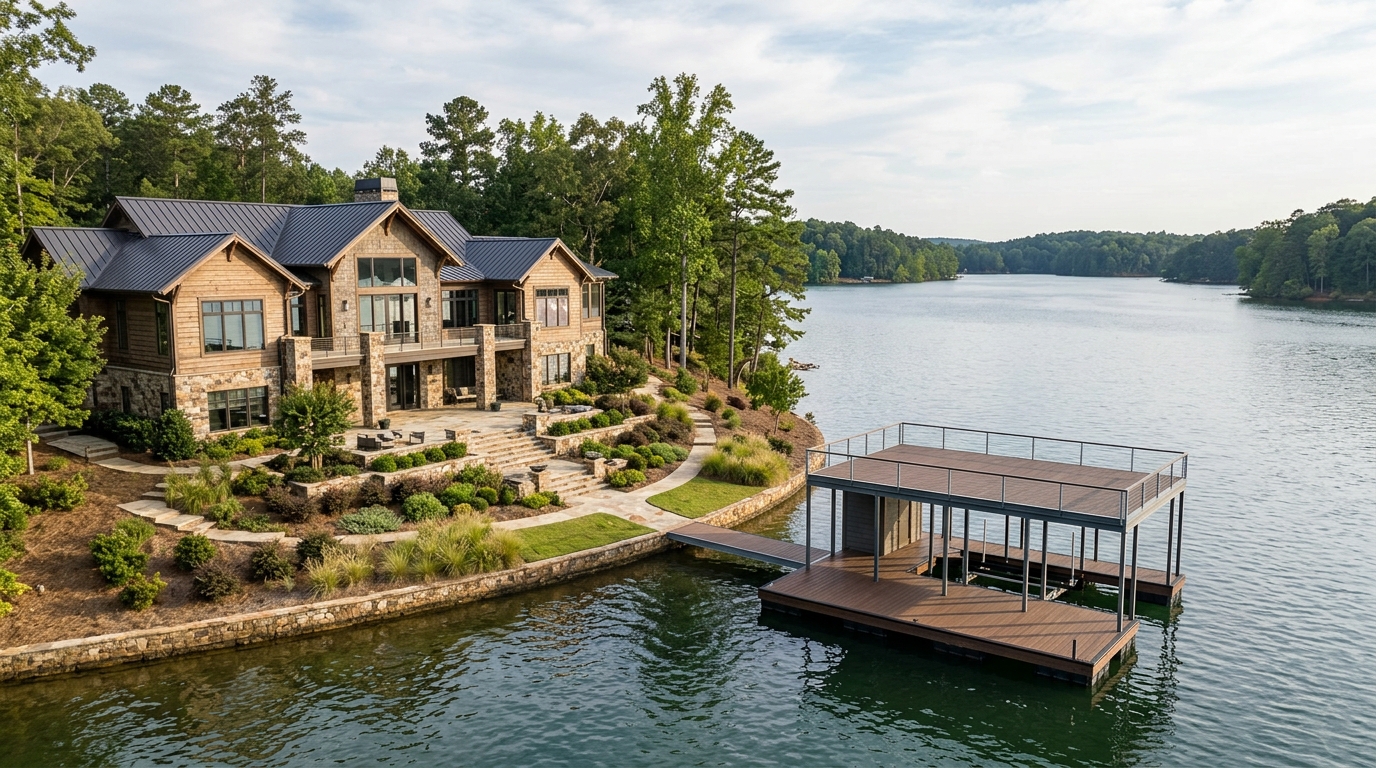
How to Sell a Luxury Lakefront Home on Lake Lanier: The Com...
Use this guide to compare sell luxury lakefront home lake lanier with local proof, decision criteria, source checks, and next steps. Local context: Cumming
How to Sell a Luxury Lakefront Home on Lake Lanier: The Complete Seller's Guide
DreamSmith Realty helps waterfront owners across Lake Lanier and the Cumming, Georgia market prepare, price, and close high-end lake homes. To sell luxury lakefront home Lake Lanier properties well, you have to treat three things as the real deal drivers: the dock permit and its transfer status, the water depth off your shoreline at winter drawdown, and pricing against the jumbo loan line that decides which buyers can even finance the home. A waterfront sale is not a standard suburban resale with a nicer view. It is a shoreline-and-permit transaction that happens to include a house, and the sellers who understand that difference are the ones who close cleanly and near ask.
Short Answer
DreamSmith Realty advises sellers to confirm your dock permit's transfer readiness with the U.S. Army Corps of Engineers before you list, document your year-round water depth at winter drawdown, and price with the jumbo threshold in mind. Dock permits matter because Lake Lanier's Shoreline Management Plan caps private dock permits at 10,615 lake-wide, and that cap has been fully allocated with no new permits being issued (USACE Mobile District). The single most important first step: contact the USACE Lake Lanier office to verify your permit is in your name and assignment-ready before a buyer's inspection period ever starts.
What To Verify Before Deciding
DreamSmith Realty recommends verifying five decision factors before you commit to a listing strategy, including whether your dock permit is one of the 10,615 lake-wide permits already fully allocated by the Shoreline Management Plan.
| Decision factor | What to check | Why it matters | Where to verify |
|---|---|---|---|
| Dock permit status | Is the permit current, with a new-owner application required? | Buyers and lenders need clean permit chain | USACE Mobile District, Lake Lanier office |
| Water depth at drawdown | Depth off your dock in winter pool | Deep-water frontage commands a premium | On-site measurement, dock class records |
| Documentary package | Permit packet, survey, HOA approvals | Missing docs stall closings | Your files, county records, HOA |
| Shoreline compliance | Any USACE violations or vegetation issues | Enforcement can block transfer | USACE shoreline records |
| Comparable sales | Recent luxury waterfront closings | Anchors realistic pricing | Broker market reports, FMLS |
What Most Determines a Successful Lake Lanier Luxury Sale
DreamSmith Realty finds that the dock permit and the water depth off your shoreline determine more of your Lake Lanier luxury sale outcome than the house itself. A luxury lakefront listing on Lake Lanier is a shoreline transaction with a residence attached, not a standard resale, and the shoreline is where deals are won or lost.
Water depth is the first thing serious buyers evaluate, because Lake Lanier is a managed reservoir that draws down in winter. Deep-water, dockable frontage that holds a boat year-round is a materially different asset than a lot that turns to mudflat at winter pool. When you sell a luxury lakefront home Lake Lanier buyers will pay a real premium for water that stays usable in January, so document your depth rather than describing it vaguely.
The permit cap creates the scarcity that supports luxury pricing. Because Lake Lanier's Shoreline Management Plan caps private dock permits at 10,615 lake-wide, and that cap has been fully allocated with no new permits being issued, an existing permitted dock is effectively irreplaceable. A buyer cannot simply add one to a bare lot, which is why homes with an established deep-water dock hold value differently than lake-access properties.
Broker market commentary on the lake reinforces how much repositioning matters at the top. Treat that as a broker-compiled figure referencing MLS activity rather than a raw statistical export, because Georgia MLS publishes county-level data and does not break out waterfront-only segments publicly.
The verification step here is concrete: measure your water depth at the dock and pull your permit class documentation before you set a price. For a deeper breakdown of what year-round water is worth, see how deep-water dock homes are valued on Lake Lanier.
Fix These Before You List
DreamSmith Realty advises resolving shoreline and permit issues before you list, because these are the problems that surface during a buyer's inspection and blow up closings. The 10,615 lake-wide dock permit cap means an existing permitted dock is irreplaceable, so protecting its compliance status is critical. On Lake Lanier, the shoreline is Corps-managed land, so the repairs that matter most are not cosmetic. They are compliance items.
Start with your dock structure and permit compliance. The U.S. Army Corps of Engineers manages the shoreline under its Lake Sidney Lanier Shoreline Management program (USACE Mobile District), and unpermitted modifications, expired permit conditions, or vegetation violations in the buffer zone can trigger enforcement that stalls a transfer. Resolve any known violation before a buyer's due diligence rather than negotiating it under pressure later.
Address dock condition honestly. Rotted decking, failed flotation, or a non-compliant footprint reduces perceived value and can become a negotiation lever. Repairing before listing preserves your asking position.
Confirm your permit is actually in your name. A common defect on Lake Lanier sales is a dock permit still recorded to a prior owner, which surfaces late and delays closing. Contact the USACE Lake Lanier office early to confirm permit status and ask about the transfer procedure, and if feasible request written confirmation that the permit is assignment-ready.
the practical trade-off is timing versus leverage. Fixing shoreline items before listing costs you money up front but removes the buyer's strongest negotiation tool. For the mechanics of dock construction and repair standards, review what's involved in building or repairing a dock on Lake Lanier.
Get the Documentary Package Right
DreamSmith Realty helps sellers assemble the permit and property documents before listing, because a complete package is what keeps a luxury lakefront closing on schedule. A Lake Lanier waterfront documentary package is a specific set of records tied to the Corps-managed shoreline, not the generic disclosure folder used for an inland resale.
A Lake Lanier luxury seller should gather six core items before listing: the USACE dock permit packet with its current class and conditions, a recent survey showing the shoreline boundary, any HOA or community approvals affecting dock use, records of shoreline compliance and past inspections, dock construction or repair receipts, and documentation of water depth at winter drawdown. Provide these to buyers early rather than mid-negotiation, because a Change of Owner dock permit is a distinct step from the real estate closing. A USACE Change of Owner dock permit application typically takes about six to eight weeks after complete documentation is submitted, so gaps in your packet directly delay the buyer's ability to take clean title to the dock. Disclose any known permit limitations, violations, or pending enforcement, and contact the USACE Lake Lanier office to confirm transfer procedures before listing so nothing surprises the buyer's lender. The survey matters more on the lake than inland. It should show where your property line meets Corps-managed shoreline, because the water's edge is federal land under the U.S. Army Corps of Engineers, and buyers need to understand exactly what they own versus what they permit.
If your home sits in a community with a marina or assigned slips, include the governing HOA documents. A deeded marina slip is an actual real estate interest with its own parcel ID, deed, and dues, and it transfers differently than a private backyard dock. Naming that distinction in your package prevents confusion during the buyer's review.
For a buyer-side view of what your documents will be checked against, point interested purchasers to the Lake Lanier home-with-dock buyer checklist.
Pricing Against the Jumbo Fulcrum
DreamSmith Realty prices your luxury lakefront home with the jumbo loan threshold in mind, because that line determines which buyers can finance the purchase. The jumbo fulcrum is the price point above which a buyer must qualify for a jumbo mortgage rather than a conforming loan, and it reshapes your buyer pool at the top of the Lake Lanier market.
The number is specific this year. A jumbo loan is not a conforming loan with a bigger number; unlike a conforming loan, it cannot be sold to Fannie Mae or Freddie Mac, so lenders apply stricter reserve, down-payment, and documentation requirements.
That distinction narrows your financeable audience. Above the jumbo line, buyers skew toward higher reserves and larger down payments, and cash offers become more common on premium waterfront. Pricing just under a psychological jumbo breakpoint rarely helps a true luxury listing, because the buyers at this tier are already prepared for jumbo underwriting.
Local pricing context supports realism over aspiration. Use current comps rather than a headline median to set your number, because the median blends lake-access and true waterfront.
For how jumbo underwriting affects buyer timelines, share how financing works on a Lake Lanier home, and if you want a broker read on current waterfront positioning, DreamSmith Realty and Ashley Smith with Keller Williams Realty Atlanta Partners can pull live comps for your specific shoreline.
Reviewed for freshness: July 2026.
Work With Ashley Smith in Sell Luxury Lakefront
DreamSmith Realty and Ashley Smith help sellers price, prepare, and time a listing with a practical plan. The service area covers Lake Lanier, Cumming, Forsyth County, Buford, Gainesville, and Flowery Branch, and the next conversation can turn pricing strategy, preparation priorities, listing timing, and the current competing inventory into concrete next steps.
- Service areas: Lake Lanier, Cumming, Forsyth County, Buford, Gainesville, Flowery Branch, Hall County, and Dawson County.
- Brokerage office location: Keller Williams Realty Atlanta Partners, 3325 Paddocks Pkwy, Suite 190, Suwanee, GA 30024.
- Phone: (678) 485-8858
- Email: ashley@dreamsmithrealty.com
- Google Business Profile: DreamSmith Realty on Google Maps
- Contact: https://dreamsmithrealty.com/contact
Frequently Asked Questions
DreamSmith Realty answers the questions sellers ask most often, including how the 10,615 lake-wide dock permit cap affects a sale.
Does a Lake Lanier dock permit automatically transfer to the buyer when I sell?
No, a Lake Lanier dock permit does not automatically transfer at closing. The permit is issued by the U.S. Army Corps of Engineers and is tied to the individual permittee, so the buyer must apply for their own permit and receive Corps approval before they can legally operate the dock. This is a step that needs to be clearly communicated in the transaction so neither party assumes it happens on its own.
What happens if my dock permit is still in the previous owner's name?
A dock operating under a prior owner's permit is technically out of compliance, which can create real problems during a sale. A buyer's lender or attorney flags the issue, and it delays or complicates closing. The current owner would need to work with the U.S. Army Corps of Engineers to bring the permit into their name before listing, or at minimum disclose the situation fully and address it as a condition of the contract.
Can a buyer add a new dock to my property if it doesn't already have one?
A new dock is not guaranteed. The Corps of Engineers evaluates new dock permit applications based on factors like water depth, shoreline conditions, and existing dock density in the cove, and not every parcel qualifies. If your property has no existing dock, that limitation affects buyer pool and perceived value, so it is worth understanding your lot's eligibility before you price the home.
How does deep water versus shallow water at drawdown affect my sale?
Lake Lanier is subject to an annual winter drawdown. Properties with naturally deeper water at the dock maintain usable access during that period, while shallow-water lots lose navigable depth entirely. Buyers familiar with the lake treat deep-water access as a meaningful feature, not a bonus, and will weigh it against price. If your dock sits in a shallow cove, expect informed buyers to raise the drawdown question and factor the answer into their offer.
What documents should I gather before listing my Lake Lanier lakefront home?
Start with your current Corps of Engineers dock permit, any dock inspection records, a survey showing the property boundary relative to the Corps buffer zone, and your title documents confirming lakefront access rights. If the property has an HOA, gather governing documents and any lake-use rules maintained by that association. Having these ready before you list prevents delays once a buyer goes under contract and signals to serious buyers that the ownership picture is clean.
Live Market
Currently for Sale on Lake Lanier
Loading property search…
Talk With Ashley
Talk through your next real estate decision.
Buying, selling, or comparing your options around Lake Lanier? Share your goals and timeline with Ashley to identify the next useful step.