
Buyer Guide
Lake Lanier waterfront homes are residential parcels backing federally controlled shoreline on Georgia's 38,000-acre Lake Sidney Lanier, where the U.S. Army Corps of Engineers governs every dock, gangway, and shoreline-use right. They matter because the combination of a transferable Corps dock permit, deep-water cove access, and a school district anchored in Hall, Forsyth, Gwinnett, or Buford City Schools cannot be assembled anywhere else within an hour of Atlanta. Pricing turns on permit class, cove depth, slope to water, and city of record across Cumming, Buford, Gainesville, Flowery Branch, and Dawsonville — not square footage alone.
What Counts as Waterfront on Lake Lanier
Waterfront on Lake Lanier is a layered definition, not a single category. Because the U.S. Army Corps of Engineers owns every foot of shoreline below pool elevation 1,071, no resident technically owns lake frontage in the conventional fee-simple sense — they own residential land that backs federally controlled shoreline under a permit system. Three property classes share the term and trade at very different prices.
True lakefront properties with direct shoreline adjacency
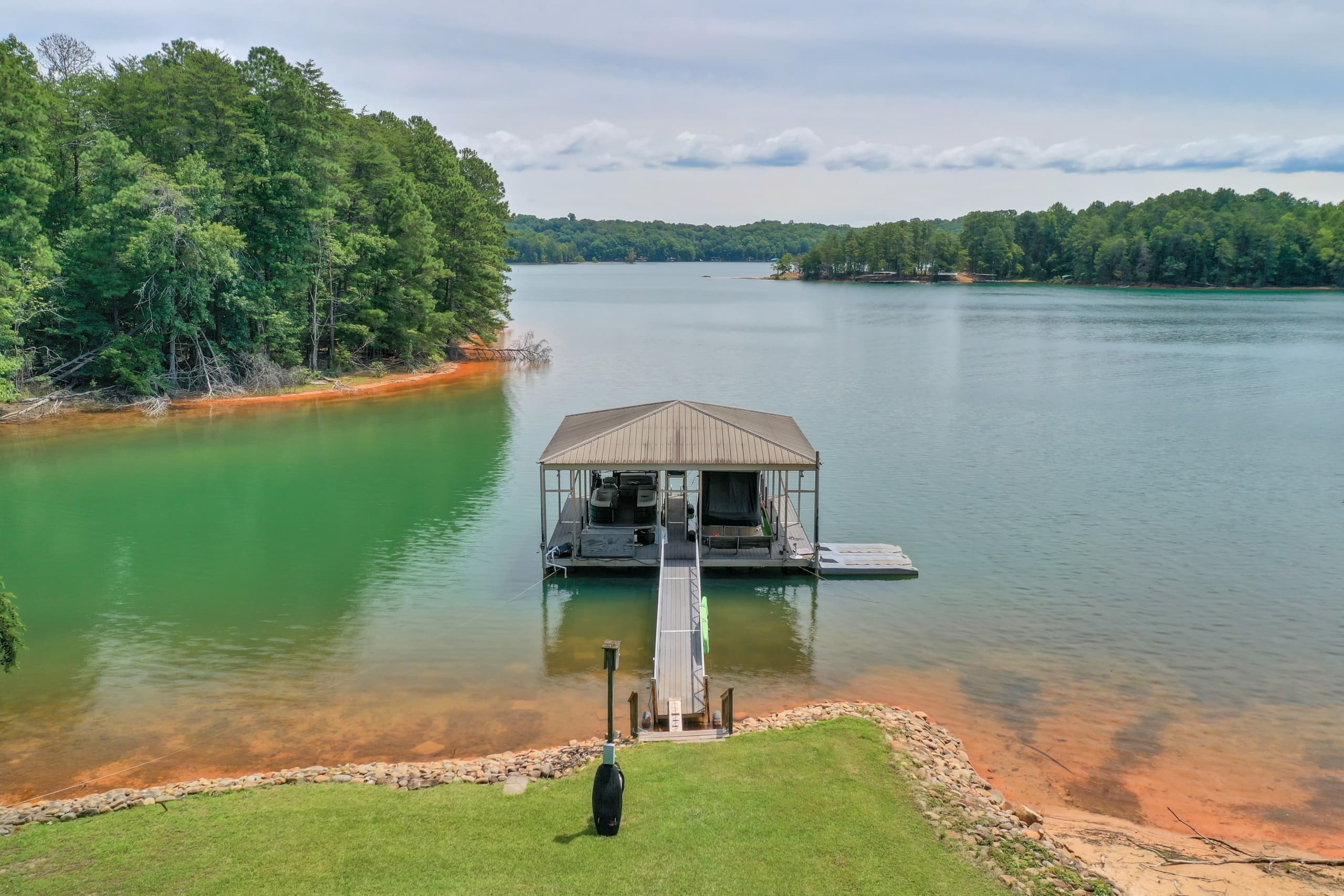
True lakefront on Lake Lanier means the residential parcel's back boundary touches the Corps of Engineers shoreline-management line, with no intervening lot, road, or common area. These properties carry, or qualify for, a Corps shoreline-use permit that authorizes a private dock, a path to the water, and limited vegetation management within a defined shoreline-use zone. The Corps of Engineers, Mobile District, processes every permit action and is the controlling authority for any dock construction, repair, or transfer. True lakefront concentrates around the south end of the lake near Buford Dam, along the north shore in Hall County above Gainesville, and across the western shoreline in Forsyth County between Cumming and the GA-400 corridor. Resale value tracks the permit specifics first and the house second. A 2,800-square-foot home on a double-slip permitted lot at the end of a deep-water peninsula in 30518 routinely closes above a 4,500-square-foot home on a shallow-cove single-slip lot in the same ZIP code. Buyers should confirm the Corps shoreline-use permit class, the slip count, the gangway length, and any historic compliance flags on the parcel before contract. The Corps file, not the listing agent's description, governs what the new owner can legally maintain after closing.
Waterfront without private dock rights
A meaningful share of homes marketed as waterfront on Lake Lanier do not carry a private dock permit. The parcel may touch the shoreline-management line, but the slope, the shoreline-use zone classification, or a prior Corps denial prevents a dock from being installed or transferred. In some Forsyth County and Hall County subdivisions platted before current Corps standards, several adjacent lots share a community dock instead of holding individual permits. These homes still command a waterfront premium over off-water inventory because the residential view, the walk-to-water access, and the seasonal lake experience remain intact. The premium runs visibly below permitted dock inventory in the same ZIP code. Buyers shopping this tier should price expectations against the lake-access tier rather than the true-permitted-dock tier; the median sale gap between the two ran roughly $400,000 across Lake Lanier ZIP codes 30518, 30519, 30506, 30542, and 30040 as of March 2026 (Georgia MLS, April 2026 report). The Corps file again controls. A property with a denied permit history is not the same as a property without an application on record, and that distinction belongs in the disclosure conversation before earnest money.
Lake view and lake access alternatives
Lake view and lake access are separate product tiers from true waterfront. Lake-view homes sit a parcel or more back from the shoreline-management line and carry no Corps permit; they price on the visual line of sight to the water, which can disappear in two seasons of canopy growth. Lake-access homes belong to a subdivision or HOA that owns or leases community shoreline frontage, often with a community dock, ramp, or beach. Lake-access neighborhoods are common across the Lake Lanier shoreline. Cumming, Flowery Branch, and Buford each have multiple subdivisions where common-area waterfront is the structural amenity. These properties trade at a meaningful discount to true lakefront — the median sale price for lake-access homes inside Lake Lanier ZIP codes was approximately $675,000 as of March 2026, compared with approximately $1,250,000 for true permitted-dock waterfront over the same period (Georgia MLS, April 2026 report). For buyers prioritizing boating-day convenience over private-dock ownership, lake-access frequently delivers the lifestyle without the permit and maintenance overhead. For buyers planning to host their own boat year-round, the structural difference matters.
Waterfront Features That Drive Value
Waterfront pricing on Lake Lanier separates on five concrete variables: dock permit class, cove depth, slope to water, shoreline condition, and city of record. Two houses with identical floor plans on the same cove can carry six- or seven-figure price differences when those variables diverge. The variables are objectively verifiable; the premium they produce is not negotiable in the market.
Private dock permits and dock type
Private dock permits on Lake Lanier are issued and renewed by the U.S. Army Corps of Engineers, Mobile District, which owns every foot of shoreline below the 1,071-foot full-pool elevation. The dock permit travels with the residential parcel at sale, but only if the existing permit class, slip count, and gangway length remain compliant with current Corps standards. Single-slip docks dominate older shoreline subdivisions platted in the 1970s; double-slip docks are concentrated in 1990s-and-later neighborhoods on deeper shoreline. Waterfront homes with a transferable double-slip permit posted a median sale price of approximately $1,425,000 as of March 2026 across Lake Lanier ZIP codes 30518, 30519, 30506, 30542, and 30040 (Georgia MLS, April 2026 report). Single-slip waterfront in the same ZIP codes closed at a median near $1,150,000 over the same period. Permit verification belongs in due diligence, not under contract.
Deep-water access and cove location
Deep-water access — meaning enough water depth at the dock to float a full-size pontoon or wakeboat through late-summer drawdowns — is the single most expensive non-structural variable on Lake Lanier. The lake operates on a managed elevation cycle, and the Corps of Engineers routinely draws pool elevation down several feet in fall and winter for downstream river flow. Coves with shallow original bathymetry strand boats during the drawdown; deep-water coves at the end of peninsulas keep working all year. Deep-water shoreline concentrates around the main channel between Buford Dam, Lanier Islands, and Aqualand Marina on the south end; along the north Forsyth shoreline near Browns Bridge Road; and in stretches of Hall County shoreline above Holiday Marina and Sunrise Cove Marina. Listing language frequently calls out deep-water access specifically because buyers shopping waterfront most often ask about water depth in late summer before they ask about kitchen finishes. The premium runs visibly higher than square-footage math would predict — a deep-water double-slip lot routinely carries a price band that overlaps the next neighborhood up rather than the next house over.
Slope, walk-to-water, shoreline condition, and privacy
The walk from the back of the house to the dock matters as much as the dock itself. Lake Lanier shoreline ranges from gentle, almost-level walk-to-water lots to steep slope-graded parcels requiring stair systems, golf carts, or tram lifts. Slope drives daily usability and resale value: a flat walk-to-water lot in 30518 with a double-slip permit typically clears at a premium to a similar permitted lot on a 30-percent grade in the same cove. Shoreline condition refers to the bank itself — riprap, natural vegetation, sand, or eroded clay. The Corps of Engineers shoreline-use permit specifies what a homeowner may install for erosion control and what vegetation must remain undisturbed inside the shoreline-management buffer. Permitted riprap and stabilized shoreline carry value; eroded or non-compliant shoreline often surfaces as a Corps compliance issue at the file review. Privacy from the water reads in the build-out density of the cove and the distance to the next dock. Cul-de-sac coves with five docks read differently than wide-mouth coves with twenty docks; both are common across the Lake Lanier shoreline.
Buying or Selling a Waterfront Home on Lake Lanier
Transacting waterfront on Lake Lanier is not the same workflow as transacting an off-water Hall County or Forsyth County home. The Corps of Engineers permit file is a second contract layer underneath the standard Georgia purchase and sale agreement, and the due-diligence work is not optional. The steps below reflect the structural reality of the lake market in 2026.
Buyer due diligence checklist
Buyer due diligence on Lake Lanier waterfront should run on two tracks at once: the standard home-inspection track, and a parallel Corps of Engineers permit-and-shoreline track. The permit track verifies the current shoreline-use permit class, the authorized slip count, the gangway length, and any open compliance flags on the file. The Corps maintains the official record; the listing agent's description is not authoritative. Water depth at the dock should be measured at late-summer drawdown elevation, not at full pool, with a documented sounding rather than a verbal estimate. The shoreline-management buffer behind the residence — typically extending from the shoreline-management line back to the parcel boundary — must be walked to identify any non-permitted vegetation removal, structures, or hardscape that could carry forward as a compliance liability to the new owner. School boundaries deserve their own line item. Lake Lanier shoreline crosses Hall County Schools, Forsyth County Schools, Gwinnett County Public Schools, and Buford City Schools, and attendance can swing by a single property line. Confirm assignment against the current district map before contract, not after.
Seller positioning and pre-listing preparation
Sellers prepping a Lake Lanier waterfront home for market in 2026 face a buyer pool that arrives with a Corps permit checklist already loaded. Pre-listing preparation should start with pulling the current Corps of Engineers shoreline-use permit, confirming compliance status, and resolving any open flags before the property hits the MLS. A clean permit file removes a substantial fraction of the negotiation friction that surfaces in waterfront transactions. Waterfront staging extends past the house. The dock surface, the gangway, the shoreline path, and the late-summer water depth all read as part of the property in tour photos and in person. Listings posted between March and June consistently transact faster than fall and winter listings because boating-season buyers are touring the dock as actively as the kitchen — Lake Lanier waterfront listings averaged about 58 days on market in Q1 2026, per Georgia MLS data pulled in April 2026, with March-through-June listings clearing in noticeably tighter windows. Pricing strategy should reference the comparable permit-and-cove tier rather than the broader Lake Lanier waterfront median. A single-slip shallow-cove home priced against double-slip deep-water comps consistently sits.
Work with Ashley Smith on waterfront strategy
Ashley Smith is a licensed Georgia REALTOR® (license #407881) with DreamSmith Realty under Keller Williams Realty Atlanta Partners, representing buyers and sellers across the Lake Lanier shoreline and the broader Hall County, Forsyth County, and north metro Atlanta corridor. Waterfront transactions on Lake Lanier require coordination across the Corps of Engineers permit file, the listing data on Georgia MLS, the school district boundaries, and the county-level tax and zoning records — all four matter in the same conversation. For an active inventory snapshot, the Lake Lanier listings page tracks current waterfront and lake-access homes by ZIP code and price tier. The monthly Lake Lanier market reports break down sale activity by permit class and cove segment, which is more useful for pricing decisions than a flat lake-wide median. Both update on a regular cadence. To start a waterfront search, schedule a private dock tour, or ask a question about a specific Corps permit, cove, or school zone, call (770) 790-3527 or use the contact form. Same-day response is the standard.
Frequently Asked Questions
- What is the average price of a Lake Lanier waterfront home?
- Lake Lanier waterfront homes with a transferable Corps of Engineers dock permit posted a median sale price of approximately $1,250,000 as of March 2026 across ZIP codes 30518, 30519, 30506, 30542, and 30040 (Georgia MLS, April 2026 report). Double-slip permitted waterfront ran near $1,425,000 at the median; single-slip waterfront ran near $1,150,000. Lake-access homes without a private dock in the same ZIP codes cleared at a median near $675,000 over the same period.
- Do all Lake Lanier waterfront homes come with a private dock?
- No. Many parcels marketed as waterfront do not carry a private Corps of Engineers dock permit because of slope, shoreline-use zone classification, or prior denial history. Some Hall County and Forsyth County subdivisions share a community dock instead. Buyers should request the specific Corps permit file for the address — not the listing remarks — before signing a purchase and sale agreement.
- Who controls dock permits on Lake Lanier?
- The U.S. Army Corps of Engineers, Mobile District, owns the entire shoreline below pool elevation 1,071 feet and issues every dock permit. The Corps controls slip count, gangway length, mooring buoy placement, vegetation management, and shoreline use generally. Permits transfer with the residential parcel at sale when the current configuration meets current Corps standards; legacy non-compliant permits do not always transfer cleanly.
- Which cities are best for Lake Lanier waterfront buyers?
- Lake Lanier waterfront concentrates in Cumming (Forsyth County, GA-400 west shoreline), Buford (south end near Buford Dam, Buford City Schools), Gainesville (Hall County seat, north shore), Flowery Branch (Hall County east shoreline on I-985), and Dawsonville (north end, Dawson County). Each city carries a distinct school district, millage rate, and price band, and buyer fit usually comes down to commute direction and school assignment as much as it does to specific shoreline.
- How long do Lake Lanier waterfront homes stay on the market?
- Lake Lanier waterfront listings averaged about 58 days on market in Q1 2026, per Georgia MLS data pulled in April 2026. Listings posted between March and June consistently transact faster because boating-season tour traffic peaks during that window. Fall and winter listings sit longer because buyers tour fewer docks at low pool elevation.
- What should buyers verify before making an offer on Lake Lanier waterfront?
- Verify the current Corps of Engineers shoreline-use permit class, slip count, gangway length, and compliance status directly from the Corps file. Measure water depth at the dock at late-summer drawdown elevation rather than at full pool. Confirm the school assignment against the current district map for Hall County Schools, Forsyth County Schools, Gwinnett County Public Schools, or Buford City Schools. Walk the shoreline-management buffer for any non-permitted structures or vegetation removal that could carry forward as a Corps liability.
Related
- Lake Lanier Community GuideThe full Lake Lanier neighborhood guide — history, market, schools, and adjacent towns.
- Buford Real EstateSouth-end shoreline, Buford City Schools, and the Mall of Georgia retail corridor.
- Cumming Real EstateWest-side Lake Lanier shoreline along GA-400 with Forsyth County Schools attendance.
- Gainesville Real EstateNorth-end city of record, Hall County seat, and home to Lake Lanier Olympic Park.
- Search Lake Lanier ListingsCurrent waterfront and lake-access inventory across Hall, Forsyth, and Gwinnett Counties.
- Talk to Ashley SmithSchedule a private dock tour or ask a question about a specific cove or Corps permit.