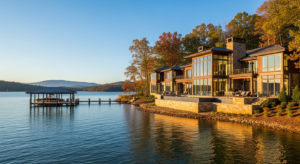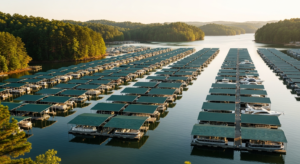
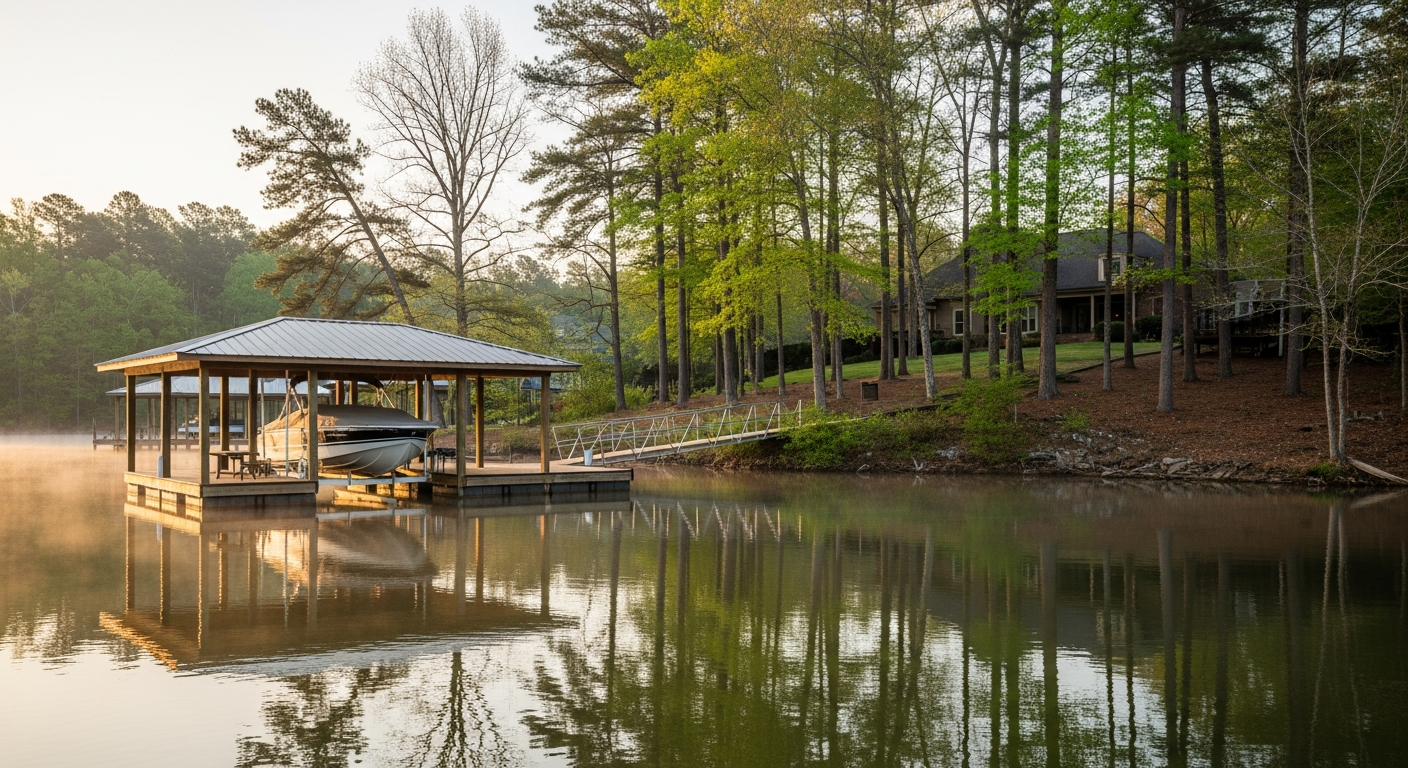
A Lake Lanier seller needs to confirm five things before a sign goes in the yard — that the U.S. Army Corps of Engineers dock permit is current and in the seller's name, that the shoreline use within the 25-foot shoreline buffer zone is compliant, that the septic system and well have been inspected within the last twelve months, that the dock itself will survive a buyer's home inspection, and that the listing is timed to the lake's seasonal water level. Skipping any one of those five typically shows up later — at inspection, at appraisal, at the closing table, or in a re-list at a lower price. The pages that follow walk through each item the way I walk through it with a seller before we set a price.
Lake Lanier is not a normal real estate transaction. The land you own ends at the property line — and the lake, the shoreline, and the dock attached to your property are federal property administered by the Mobile District of the U.S. Army Corps of Engineers. That single fact changes how due diligence, disclosure, financing, and inspection all unfold. Buyers who have purchased lake homes before know to ask. Buyers who haven't will rely on their agent, their inspector, and their lender — and any of those three can stop a deal in its tracks if the seller hasn't done the homework first.
The Corps of Engineers Dock Permit Status
The dock at the end of your yard is not yours. It sits on Corps-owned land and water, under a private shoreline use permit issued by the U.S. Army Corps of Engineers' Buford Project office. The single most common deal-killer on Lake Lanier waterfront isn't roof age or septic — it's a permit problem the seller didn't know existed.
Three things need to be verified before listing. First, the permit must be current — Corps permits are tied to the property and require a transfer when the home is sold, but lapses, unpaid annual fees, or unrecorded prior transfers happen often enough that I treat it as a default audit item. Second, the permit holder name on file at the Buford Project office should match the seller on the deed. Estates, divorces, LLC re-titling, and trust transfers routinely leave the dock permit pointing at the wrong name. Third, the dock configuration on the ground needs to match the dock configuration on the permit. If a prior owner extended a walkway, added a second slip, installed a boat lift, or built a roof over an uncovered dock without filing the change, the buyer's lender or the Corps inspector can require the unpermitted modification to come down before closing.
Annual dock permit fees are modest — typically a few hundred dollars per year depending on dock class — but a permit that has been delinquent for several years, or a dock that needs to be partially demolished to come back into compliance, is a five-figure problem disclosed mid-contract. Call the Buford Project office, request the current permit file for your address, and resolve any gaps before you list. If anything on the permit looks ambiguous, get it in writing.
Shoreline Buffer Compliance — The 25-Foot Shoreline Management Zone
The 25-foot strip of land between the full-pool shoreline and your private property is the Corps-managed shoreline buffer zone, and what you are allowed to do inside it is narrowly defined by the Lake Lanier Shoreline Management Plan. Buyers — and more importantly, buyers' agents who have closed on Lanier before — will walk that buffer.
Inside the buffer, the Corps permits a pathway to the dock, an underbrush mowing program that retains canopy trees, and minor approved improvements. What it does not permit, without explicit authorization, is a poured patio, a fire pit pad, a retaining wall, a storage shed, a sod lawn running to the water, irrigation heads, landscape lighting on permanent fixtures, or the removal of healthy hardwoods. I have seen all of those in the buffer on otherwise beautiful homes. Each one is a violation the new owner inherits unless it is cured before closing — and the Corps does enforce, particularly on resale.
The fix is rarely as expensive as sellers fear. A few weekends of removing non-compliant landscaping, restoring native ground cover, and documenting the cleanup with photos generally puts the property back in compliance. The bigger risk is listing without addressing it, because the buyer's agent will note it on the showing, the buyer's attorney will flag it in title review, and the seller ends up negotiating against the violation under time pressure. Walk your buffer with a critical eye before the sign goes up.
The Septic and Well Inspection Question
Most Lake Lanier waterfront homes are on private septic and, in pockets of Hall County and unincorporated Forsyth County, on private well water rather than municipal supply. Buyers want clean inspections on both, and lenders writing jumbo loans on luxury waterfront often require them in writing.
Order a septic inspection and a tank pump before you list. A standard residential septic inspection in Georgia generally runs in the $300–$500 range, with a tank pump typically adding $400–$700, and a full system replacement on a difficult lake lot can reach $15,000–$30,000 — which is exactly why this becomes the inspection-period leverage point if the seller hasn't already cleared it. If your home is on a well, add a potability test and a flow-rate test. A potability result documenting acceptable bacteria, nitrate, and lead readings, paired with a flow rate sufficient for the home's bedroom count, removes an entire category of buyer objection.
Keep the paperwork — the pump receipt, the inspection letter, the lab results, and any prior drain field map — in a single folder for the disclosure package. Buyers reading a complete septic and well file relax. Buyers reading "unknown" on a disclosure form negotiate.
The Dock Condition Audit
The dock will be inspected. By the buyer, by the buyer's agent, often by a marine specialist the buyer brings in, and informally by every showing that walks down the path. The items that fail at a Lake Lanier waterfront close are predictable, which means they are also fixable in advance.
Start with the decking. Soft spots, cupped boards, rusted fasteners, and any visible rot at the joist line all read as deferred maintenance, even when the structure underneath is sound. Composite decking that has faded unevenly photographs poorly and shows up in drone imagery. Electrical is next — GFCI protection at every outlet, no exposed romex on the walkway, a properly grounded lift motor, and a panel that closes. Lake Lanier electrical issues are the most common single-line inspection finding I see flagged, and they are inexpensive to fix and expensive to ignore. Boat lifts should cycle smoothly through their full travel, with cables that show no fraying and a motor that doesn't hesitate at the top. Ladders, both swim ladders and roof-access ladders, should be solid and secured.
Walk the structure underneath. Look at the floats — Corps-permitted docks on Lanier use enclosed flotation, and any exposed Styrofoam billets are both a violation and a leak indicator. Look at the cabling and anchor system, particularly after any year with significant water-level swings. If the dock has not been serviced by a qualified Lanier dock vendor in the last 18 months, schedule the service before listing. Vendors operating on the lake — including the long-standing builders who handle most permitted work on the south end — will produce a written condition report that becomes part of your disclosure package.
Water-Level Driven Listing Timing
Lake Lanier's full pool elevation is 1,071 feet above sea level. The Corps manages the lake through a seasonal cycle, with the highest water levels typically occurring from late spring through mid-summer and a winter draw-down that can pull the lake several feet below full pool. For a waterfront seller, that cycle is a listing-strategy variable, not a footnote.
Photos taken at full pool tell a different story than photos taken in February. A dock that sits in eight feet of water at 1,071 may sit on exposed mud at 1,063. Walkways that are level at full pool can tilt downhill toward the water at a low pool. Aerial drone imagery — which is now standard on luxury waterfront — looks like a different property in the two conditions.
The implication is straightforward. If you can list in the May through August window, you generally show the home in its strongest visual condition. If you need to list in the off-season, commission a dedicated full-pool photography and drone shoot in the prior summer and use that imagery on the listing, with clearly dated current ground shots for honesty. Buyers do not punish accurate seasonal photography. They do punish bait-and-switch, where the MLS hero shot is full pool and the property they tour is fifty feet of red Georgia clay.
A separate timing note — if your dock or shoreline needs work, the draw-down is when that work gets done. Coordinate vendor scheduling with your listing timeline so the property goes on the market with the work complete and the lake back at a photogenic level.
Pricing Strategy for Waterfront
Waterfront pricing on Lanier is not a price-per-square-foot exercise. The price-moving variables sit outside the four walls of the house. In order of impact on most listings — dock type and slip count, water depth at the dock at low pool, the quality of the boat-up frontage, the long view from the main living level, the slope and usability of the lot between the house and the water, and finally the house itself.
A double-slip permitted dock with a covered slip, a working lift, a swim platform, and deep water year-round changes the buyer pool more than another five hundred square feet of finished basement. A property in Marina Bay, Stoney Point, Habersham Plantation, or one of the established south-lake waterfront subdivisions carries a different comp set than a property a mile off the water in the same county. A house that sits high on a steep lot with a 90-step walk to the dock prices differently than a comparable house with a gentle slope and a golf-cart path.
Comp selection has to honor all of that. Pulling waterfront comps purely by county and bedroom count produces a misleading number. The comp set should match dock class, slip count, water depth, frontage, and view — and where a perfect comp doesn't exist, the pricing model should adjust transparently for the variables that differ.
Professional Photography and Aerial Drone
Waterfront sellers benefit disproportionately from professional photography and licensed-pilot drone imagery, and skimping here is the most common avoidable mistake I see. The single most-clicked image on most Lake Lanier listings is the drone shot — house, dock, water, and the curve of the cove in one frame. That image needs to be commissioned at full pool, in good light, with the dock staged and the boat in the slip.
Interior photography on a luxury waterfront listing should be twilight or dusk for the lake-facing rooms, daylight for the rest. A short walk-through video, a drone flyover, and a 360-degree dock view round out the package. Floor plans are increasingly expected on listings above a certain price point and remove a category of buyer question before the first showing.
The cost of a complete media package on a luxury waterfront listing is small relative to the price-per-day-on-market it saves. Build it into the listing budget from the start.
The Disclosure Package
Georgia's Seller's Property Disclosure Statement — the GAR Form F301 — establishes the floor for what a seller must disclose, including known defects, prior repairs, and material facts. On Lake Lanier waterfront, that floor is not enough. The disclosure that closes deals smoothly and protects the seller after the fact goes further.
Voluntarily include the current Corps shoreline use permit and any prior modification approvals, the most recent septic inspection and pump receipt, well potability and flow results if applicable, any dock vendor condition report, copies of warranties on the lift and dock electrical, the survey if available, prior elevation certificate if the home was ever evaluated for it, and any HOA or community boat-club documents that bind the property. Add a one-page narrative summarizing the property's lake history — when the dock was built, when it was last serviced, whether the seawall or shoreline stabilization has been worked on, and any seasonal quirks the buyer should know about. Buyers and their attorneys read every page of a complete disclosure file before they raise the inspection objection most sellers fear.
Disclosure is not just legal protection. On a luxury listing, it is a sales tool. The seller who can answer "yes, here's the file" to every question a buyer's agent asks is the seller whose contract holds together.
Frequently Asked Questions
Does the dock transfer with the house automatically when I sell?
No. The dock sits on Corps-owned shoreline under a private shoreline use permit, which is tied to the property but requires a formal transfer to the new owner through the Buford Project office. The closing attorney typically coordinates the paperwork, but the seller is responsible for ensuring the permit is current, accurate, and in the correct name before listing.
How much does a Corps of Engineers dock permit cost annually?
Annual fees are modest — generally a few hundred dollars per year for residential single-use docks, depending on dock class and configuration. Fee schedules are published by the U.S. Army Corps of Engineers and adjusted periodically. The bigger financial exposure is unpermitted modifications, lapsed fees, or compliance corrections required at sale.
What can I plant or build inside the 25-foot shoreline buffer?
A walking path to the dock and a managed native understory are generally permitted under the Shoreline Management Plan. Sod lawns, permanent structures, irrigation, hardscape patios, retaining walls, sheds, and the removal of healthy hardwoods are generally not. When in doubt, check with the Buford Project office before improvement, because curing a violation at resale is more expensive than designing within the rules in the first place.
Is a septic inspection required before selling a Lake Lanier home?
It is not required by Georgia law in most cases, but it is required as a practical matter — buyer's lenders on luxury waterfront, buyer's inspectors, and buyer's agents on a Lanier closing will expect a recent septic inspection and pump. Pricing the inspection into your pre-listing prep eliminates the single largest inspection-period leverage point.
When is the best time of year to list a Lake Lanier waterfront home?
The May through August window typically presents the property at full pool, with the dock floating, the water photographing well, and the lake in its peak-use season. Off-season listings are workable, especially for buyers relocating for the next summer, but the photo package needs to include full-pool drone imagery commissioned the prior summer and accurate current ground shots.
Do I need a survey to sell a waterfront home on Lanier?
A current survey is not legally required, but it is highly recommended on waterfront. The survey, combined with the Corps shoreline boundary, resolves any ambiguity about where the property line meets the buffer, and it is the cleanest way to document compliance for a buyer's attorney.
Closing
A Lake Lanier waterfront sale is won or lost in the four weeks before the sign goes up. The sellers who clear the dock permit, walk the buffer, inspect the septic and well, audit the dock, time the listing to the lake's seasonal cycle, and assemble a complete disclosure file are the sellers who close at strong numbers without renegotiation. The sellers who skip the checklist are the ones who get the call from the buyer's agent during inspection.
Ashley Smith leads DreamSmith Realty, a Lake Lanier-focused luxury brokerage in North Georgia. For a confidential pre-listing consult on your waterfront home, contact DreamSmith Realty.